Wok vs Skillet: Which Pan Actually Wins Which Job
Wok vs skillet, settled by geometry. A skillet gives you contact area. A wok gives you a heat gradient and somewhere to put food. Who wins what, and why.
Updated
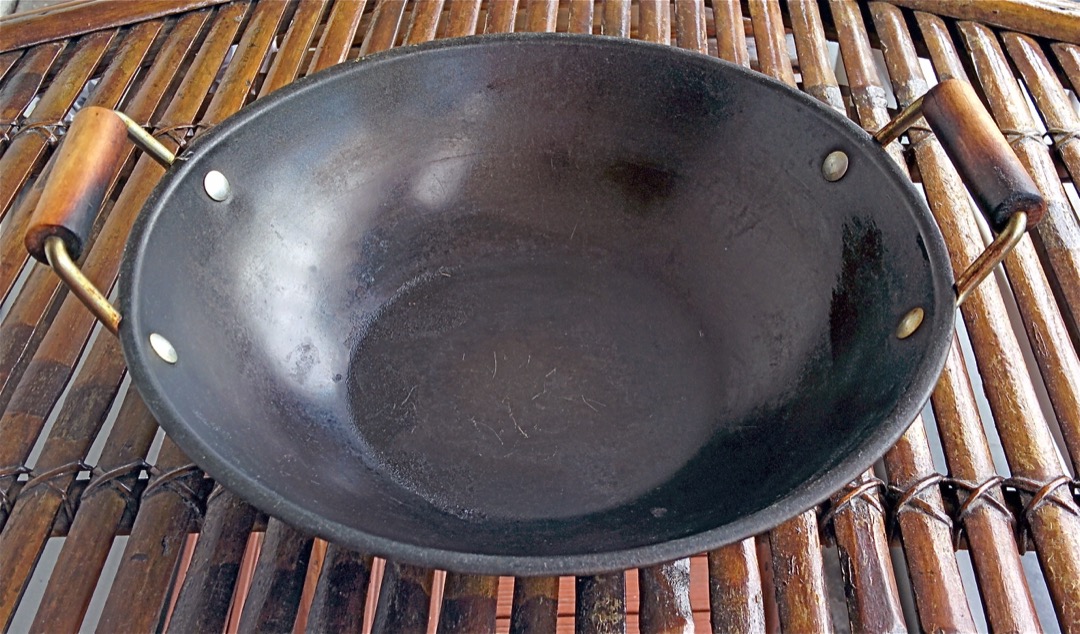
The framing everywhere is that a wok and a skillet are two shapes doing the same thing, and that choosing between them is a matter of cuisine, or taste, or how authentic you are trying to be. That is not what separates them. They differ on one variable, which is whether the pan gives you contact area or gives you somewhere to put food, and every argument about which is better resolves the moment you know which of those the dish needs.
I ran a restaurant group’s test kitchen for four years, which meant assigning prep to stations, and nobody on that line ever debated this. A dish that needed a flat surface and stillness went to a flat surface. A dish that needed constant motion went to a curve. The home version of the question is harder only because most people own one pan and are trying to work out what they are missing.
The Short Answer
Use a skillet when the food should sit still and touch metal. Use a wok when the food should keep moving and needs somewhere to go.
Reach for the skillet:
- Steak, chops, chicken thighs, and anything seared as a single piece
- Fried eggs, omelettes, pancakes, and crepes
- Shallow frying breaded cutlets and fritters
- Pan sauces built on fond, and anything reduced
- Anything that starts on the stove and finishes in the oven
Reach for the wok:
- Stir-fry of any kind
- Fried rice and fried noodles
- Deep frying, especially in a kitchen without a dedicated fryer
- Steaming, with a bamboo or metal steamer set in the bowl
- Large-volume blanching, boiling, and anything for more than four people
- Toasting spices, nuts, and popcorn
The Geometry Is the Whole Argument
Everything below follows from this table, so it is worth sitting with for a moment.
| Skillet | Wok | |
|---|---|---|
| Flat cooking floor | About 9.25 inches across on a 12-inch pan | About 5.5 inches across on a 13-inch flat-bottom wok |
| Metal thickness | 3 to 5mm in cast iron, 2 to 3mm in carbon steel | 1.5 to 2mm, which is 14 gauge |
| Walls | Low, 2 inches, flared or straight | High, 4 inches or more, continuous curve into the base |
| Heat zones | One, with a cooler rim on a small burner | Two, a searing base and a wall running much cooler |
| Food returns to the centre | No, it stays where you put it | Yes, under gravity, which is what makes tossing work |
| Steam behaviour | Drifts off the low edge | Corralled into a column over the food |
| Usable volume | Shallow, limited by 2-inch walls | Deep, and it narrows toward the bottom |
| Oven | Yes, for cast iron and carbon steel | Almost never, because of handle material and size |
| Typical weight, empty | About 8 pounds for a 12-inch cast iron | About 4 pounds for a 14-inch carbon steel |
Those first two rows are worth stating as plainly as possible, because they are the numbers the rest of the internet asserts without ever measuring. The flat-contact figures are Made In’s, one of the few cookware makers that publishes them: a 12-inch frying pan gives you about 9.25 inches of genuinely flat floor, and a 13-inch wok gives you about 5.5. That is not a small difference in a pan that is nominally an inch larger. It is nearly three times the usable searing area on the smaller pan.
The thickness row is the one nobody explains at all. Everyone repeats that a wok heats and cools fast while a skillet holds its heat, and then leaves it there as though it were a property of the shape. It is not. It is the metal. A carbon steel wok is 1.5 to 2mm of steel, so there is very little mass to heat and it responds to the burner within seconds. A cast iron skillet is 3 to 5mm of a denser metal, so a 12-inch one weighs around 8 pounds against a 14-inch carbon steel wok’s 4, and holds roughly twice the energy for the same temperature. That is the entire mechanism behind every behavioural claim in this comparison, and it explains why a cast iron wok, at 11 or 12 pounds, behaves nothing like a carbon steel one despite being the same shape.
Two entries in that table do more work than the rest. The wok’s second heat zone is a place to park food that is already cooked, which no flat pan has. And the skillet’s flat floor is contact area, which no curved pan has. The rest of this piece is those two facts applied to specific dinners.
What a Skillet Wins Outright
Anything seared as a single piece. Browning needs the food pressed against hot metal across its whole footprint. A ribeye is maybe five inches by four. On a skillet floor, all of it touches. In a wok, the flat base is about five inches across and then the metal curves away, so the centre of the steak makes contact and the edges lift off into air. You get a browned disc in the middle and grey borders, and no amount of pressing fixes it, because you are fighting the shape.
Eggs and pancakes. Same mechanism, different food. Batter poured into a curve pools deep at the centre and runs thin at the edges, so a pancake comes out with a raw middle and burnt rim. A fried egg slides down and folds over itself. There is no technique for this. You need a floor.
Fond and pan sauces. Fond is the browned residue that sticks to the pan and dissolves into a sauce when you deglaze. It forms where food touches metal, so a skillet builds it across a wide floor and a wok builds it in a small circle at the bottom. Pour wine into a skillet and you lift a whole pan’s worth of flavour. Do it in a wok and most of the liquid runs down into the base and sits there, in contact with a fraction of the browning, while the walls stay comparatively clean.
Reduction. Evaporation is a function of exposed surface area. A cup of sauce in a 12-inch skillet spreads into a wide shallow film and reduces quickly. The same cup in a wok collects into a narrow pool a couple of inches across, with much less surface exposed, and takes far longer. If a recipe says reduce by half, the pan shape changes the timing more than the burner setting does.
The oven handoff. Sear on the stove, slide the pan into a hot oven, finish gently. A cast iron or carbon steel skillet does this all day. A wok is out on two counts: the handle is usually wood or phenolic, and a 14-inch bowl with a foot of handle attached does not fit most home ovens on a rack with anything above it.
What a Wok Wins Outright
Stir-fry, obviously, and for a reason worth stating. The usual explanation is heat. The better explanation is real estate. A stir-fry is five or six components that cook at different rates, and the wok gives you a hot base and a much cooler wall, so you sear the protein in the centre and push it up the side while the vegetables go in below. Nothing sits waiting in a bowl on the counter going cold and nothing overcooks while its neighbour catches up. A skillet has one temperature, so the second ingredient lands on top of the first and everything below it stops browning and starts steaming. The full sequence, with batch sizes and timings, is in our guide to using a wok.
Deep frying, on oil economy alone. Two inches of oil in a 14-inch wok comes to roughly a quart and a half. The same two inches in a 12-inch skillet takes closer to three quarts, because a skillet floor is the same width all the way up while a bowl narrows as it goes down. I worked those out from the geometry rather than pulling a published figure, so treat them as close rather than exact, but the ratio holds and you feel it every time you fill a pan. The wok also gives you far more headroom above the oil line, which is what stops a boil-over when something wet goes in, and its high walls catch spatter the skillet throws across the stovetop.
Steaming. Set a bamboo or stainless steamer into the bowl over two inches of simmering water and you have a steamer that holds a whole fish or three tiers of dumplings. A skillet cannot do this at all. Its walls are too low to hold a basket above water and its lid sits too close for anything tall.
Volume. A wok’s usable capacity is several times a skillet’s, and it achieves that while occupying the same burner, because the bowl widens above the heat rather than beside it. A 14-inch wok fits where a 12-inch skillet fits. For anyone cooking for a family, that is the difference between one batch and three. It is also why a wok is the pan I reach for to blanch greens, which then go straight into a colander to drain properly, because anything carrying surface water into a hot pan later will steam instead of sear.
Dry toasting. Spices, nuts, sesame seeds, popcorn. The curve keeps everything circulating with a small movement of the wrist, and the high walls mean nothing escapes. A skillet needs constant stirring with a spoon and still throws seeds onto the burner.
The Contested Jobs
These are the ones that actually generate arguments. Each resolves on contact area versus motion.
| Job | Winner | Why |
|---|---|---|
| Stir-fry | Wok | Two heat zones and somewhere to park what is already cooked |
| Searing a steak or chop | Skillet | The food is wider than a wok’s flat base |
| Fried or scrambled eggs, pancakes | Skillet | Batter and egg run downhill in a curve |
| Shallow frying breaded cutlets | Skillet | A cutlet has to lie flat in half an inch of oil |
| Deep frying | Wok | Half the oil for the same depth, plus headroom and spatter control |
| Fried rice and fried noodles | Wok | Needs continuous tossing against very hot metal |
| Pan sauces and reductions | Skillet | Fond forms across the floor, and wide liquid evaporates fast |
| Low and slow braising | Skillet | A wide sear, then an even simmer under a close lid |
| Steaming | Wok | The only one of the two that can hold a basket above water |
| Sauteing vegetables | Volume decides | Under half a pound, skillet. More than that, wok |
| Boiling and blanching | Wok | More water than a skillet, faster to temperature than a stockpot |
| Toasting spices, nuts, popcorn | Wok | The curve circulates everything with one wrist movement |
Shallow frying cutlets: skillet. Breaded chicken or pork needs to lie flat in half an inch of oil without moving. A wok’s curve would have the cutlet standing at an angle with one edge out of the oil.
Fried rice: wok, decisively. Cold rice needs to be tossed continuously against very hot metal so the grains separate and dry rather than clumping and steaming. This is the single most wok-dependent dish in a home kitchen, and it needs day-old rice cooked earlier and chilled, which is exactly why a rice cooker earns its counter space: it finishes on its own schedule the day before. The smoky character people chase in this dish has a specific mechanism, and we take it apart in our piece on wok hei.
Sauteing vegetables: either, and volume decides. A pound of mushrooms in a skillet is one crowded layer that steams. The same pound in a wok has room and browns. Under half a pound, the skillet is fine and easier to control.
Braising: skillet, and most of the internet has this backwards. Half the comparisons out there list braising under the wok’s column, which comes from generic copy about a wok doing everything rather than from anyone braising in one. Wok braising is a real technique and it is a fast, hard simmer of fifteen or twenty minutes, not a Western low and slow. A proper braise wants a broad sear, then two or three hours at a bare simmer under a lid sitting close to the food, and then usually an oven. A skillet does all three. A wok’s thin base over a small flame runs too hot at the bottom and too cool at the wall to hold a low even simmer, its domed lid leaves a lot of air above the liquid, and the pan cannot go in the oven. The exception is volume: a whole cut-up chicken in a fast Chinese-style braise is a wok job, because nothing else on the stove holds it in one layer.
Searing scallops or shrimp: skillet if browning matters, wok if speed matters. Scallops want an unbroken flat contact patch and stillness, so skillet. Shrimp cook in 90 seconds and benefit from constant motion, so wok, and a pair of long kitchen tongs keeps your hand clear of a rim running past 600 degrees.
Boiling pasta or blanching: wok, surprisingly. It holds more water than a skillet, heats it faster than a stockpot because the metal is thinner, and the wide rim makes lifting things out easy.
Heat: Concentration Versus Coverage
This is the part most comparisons get backwards, so it is worth being precise.
A home gas burner throws a flame ring four to six inches across. A wok takes that ring and concentrates it into a base of about the same diameter, with the flame licking up the lower walls, so essentially all of the burner’s output lands on metal that is doing work. That is why a modest burner can get a wok’s base genuinely searing hot. It is also why the upper wall stays cool, since that heat has to conduct up through thin steel against a lot of air on the outside.
A 12-inch skillet sitting on the same burner has a floor of roughly 80 to 90 square inches and a heat source covering maybe 20 of them. The centre runs hot, the outer ring runs measurably cooler, and how much that matters depends entirely on the material. Cast iron evens it out over several minutes because it conducts slowly but holds a great deal of energy. Thin stainless does not even it out at all, which is why a stainless skillet browns a ring in the middle of a pan and leaves the edges pale. Clad pans with an aluminium core sit in between and are worth the money for exactly this reason.
So the honest statement is that a wok concentrates a weak burner and a skillet spreads it. If your range is feeble, the wok is getting more out of it than the skillet is. The trade is that a wok gives you a small hot zone rather than a large warm one, and a steak does not fit in a small hot zone.
Why a Skillet Cannot Produce Wok Hei
Every comparison names wok hei and none of them explain why the flat pan is structurally locked out of it, so here is the mechanism. Wok hei is three things happening at once: Maillard browning running at high speed, oil breaking down and partially burning in a mist above the food, and a steam cycle that moves heat without the food touching metal. A skillet can do the first one. It cannot do the other two, and not because it is not hot enough.
The oil mist needs tossing. Food thrown up out of the pan carries a fine spray of oil with it, and that spray meets the heat above the burner and combusts in a way oil sitting in a pan never does. You cannot toss in a skillet, because a skillet has no curve to return food to the centre. Anything you flip in one either lands where it started or goes on the floor.
The steam cycle needs walls. Moisture coming off the food rises, hits the cooler upper bowl, recondenses onto whatever is up there, and dumps a large amount of energy in the process. A wok’s high sides corral that vapour into a column over the food. A skillet’s two-inch wall lets it drift straight off the edge.
So the answer to whether you can get wok hei in a skillet is no, and the reason is geometry rather than heat. What you can get is genuinely excellent browning, which covers most of what people actually want from a stir-fry. The full breakdown of what the term does and does not mean is in our piece on wok hei.
Your Stove Decides More Than Your Cooking Does
Here is the thing that gets left out of every version of this comparison, and it inverts the answer for a lot of kitchens.
A skillet works on every heat source there is. Gas, coil, glass ceramic, induction, a campfire. No caveats beyond the pan being magnetic if you are on induction, which cast iron and carbon steel both are.
A wok’s advantages are mostly gas advantages. On a gas burner with a ring, a round bottom sits in the flame and the whole curve heats. On a flat electric or induction top, you need a flat-bottom wok, and then only a disc at the base heats while the sloping walls get whatever conducts up through thin steel. The two-zone gradient collapses into a hot spot with cold sides. Induction makes it worse in a way that is specific and not obvious: lift or tip the pan to toss and the magnetic coupling breaks, so heating stops entirely. A gas flame still reaches a pan held at an angle. An induction cook is choosing between agitation and heat, which is the whole technique gone.
Setting it out as a grid makes the decision quicker than any amount of prose about it.
| Your stove | Stir-fry | Searing | Deep frying | Eggs and pancakes |
|---|---|---|---|---|
| Outdoor propane or wok burner | Round-bottom wok, no contest | Either | Wok | Skillet |
| Home gas, 12,000 BTU or better | Flat-bottom wok | Skillet | Wok | Skillet |
| Home gas, under 9,000 BTU | Wok, smaller batches | Cast iron skillet, preheated long | Wok | Skillet |
| Electric coil | Flat-bottom wok, acceptable | Cast iron skillet | Wok, watch stability | Skillet |
| Glass ceramic | Skillet, or a wok used as a sauté pan with no tossing | Cast iron skillet | Skillet, or a dedicated pot | Skillet |
| Induction | Skillet, unless you add a wok cooktop | Skillet | Skillet, or a dedicated pot | Skillet |
If you cook on glass or induction, the ranking genuinely changes. A skillet keeps all of its advantages there and a wok keeps roughly one, which is capacity. That is the situation our electric wok roundup exists for, where the element wraps the bowl rather than sitting under a disc of it, and it separates sealed nonstick units from induction wok cooktops because they are two different machines with two different ceilings. Whether cast iron behaves on a smooth surface is its own question, covered in does cast iron work on induction and can you use cast iron on a glass top stove.
Material and Mass Are Not the Same Question as Shape
People conflate these constantly. Shape decides what the pan can do. Material decides how it behaves while doing it.
Carbon steel is the default wok material and a fine skillet material. Thin, so it responds to the burner within seconds, and it takes a seasoning that gets slick. A 14-gauge wok at around 2mm is the standard recommendation, and our wok roundup goes through gauge, diameter, and handle style.
Cast iron gives that stored energy up slowly, which is the flip side of taking a long time to accept it. In a skillet, that is exactly what you want for searing: the pan does not crater when a cold steak lands. In a wok, it is a mixed blessing. It buys back some of the heat recovery a weak burner cannot supply, which is a real argument for a cast iron wok on a bad range, and it costs you responsiveness and the ability to toss a pan that now weighs 10 pounds loaded.
Stainless sears well and does not season, so food sticks, which makes tossing pointless. Fine as a skillet with an aluminium core. Poor as a wok.
Nonstick caps out below the temperatures either pan is for. Useful for eggs in a skillet, and close to useless in a wok, since the coating limits you to roughly 400 to 425 degrees and the whole point of the shape is the zone above that.
Whichever you pick, the oil has to survive the temperature you are running, and that is a real constraint rather than a detail. Our oil smoke point chart lists where each one gives up. If you are prepping enough vegetables for a family stir-fry, a slicing disc turns ten minutes of knife work into about fifteen seconds, which is most of the practical argument for the machines in our food processor roundup.
Care Is Not Equivalent, and That Should Affect the Purchase
This belongs in the buying decision rather than as a footnote after it, because seasoned steel is a commitment and plenty of people discover that only once the pan is on the hook. Both pans are seasoned steel and the maintenance is close but not identical, mostly because of where water sits.
A skillet has a flat floor and a low rim, so it dries fast on a warm burner and the seasoning wears evenly from the middle out. The routine is in how to season a cast iron skillet and how to clean a cast iron skillet.
A wok has a bowl, and the bowl collects. Water pools in the base, and that base is also where the seasoning takes the most heat and the most abrasion from the spatula. The consequence is that woks develop a bare patch in the centre long before the walls need anything, and the fix is a spot re-season rather than stripping the pan. The other difference is that a new wok arrives with a factory coating that has to be scrubbed off before you start, which a modern cast iron skillet does not. How to season a wok covers the first-time strip, and how to clean a wok covers the weekly reality.
If You Can Only Own One
Buy the skillet. It fails at fewer things, it works on every stove, it goes in the oven, and the jobs it cannot do have workarounds that are merely slow rather than impossible. A 12-inch cast iron or carbon steel skillet is the most useful single pan in a Western kitchen and it is not close.
The wok is the better second pan, and by a wide margin over a second skillet. The moment you own both, the split is clean: still food on the flat one, moving food in the curved one, and volume in the curved one regardless.
There is one exception, and it is a real one. If you cook Chinese, Thai, or Vietnamese food more nights than not, and you have a gas range, buy the wok first. In that kitchen the skillet becomes the specialist.
The Short Version
A skillet gives you contact area. A wok gives you a heat gradient and somewhere to put food. If the dish wants stillness against metal, use the flat pan. If it wants constant motion and staged ingredients, use the bowl. Every contested case in the middle, the shrimp and the mushrooms and the braise, comes down to which of those two the dish needs more, and your stove decides how much of the wok’s advantage you actually get to keep.
Frequently Asked Questions
Can a wok replace a frying pan?
Why can't you get wok hei in a skillet?
Do I need both a wok and a skillet?
Can you stir fry in a skillet?
Which uses less oil for deep frying, a wok or a skillet?
Related Articles
About the Reviewer

Nora Whitfield, CIA Culinary Arts, ServSafe Certified
A.O.S. Culinary Arts, The Culinary Institute of America
Nora Whitfield trained at the Culinary Institute of America and spent twelve years in professional kitchens, the last four running the test kitchen for a regional restaurant group where her job was to decide which equipment could survive a dinner service and which could not. She has seasoned more carbon-steel woks than she can count, boiled water in every kettle worth owning, and broken enough cheap gear to know exactly where manufacturers cut corners. She reviews kitchen equipment the way she specified it professionally: cook on it, clean it, and see what it looks like after a month.