How to Clean a Wok
Wok cleaning is five different problems, not one routine. A chef sorts patina, burnt-on food, sticky residue, rust, and stripping, with the fix for each.
Updated
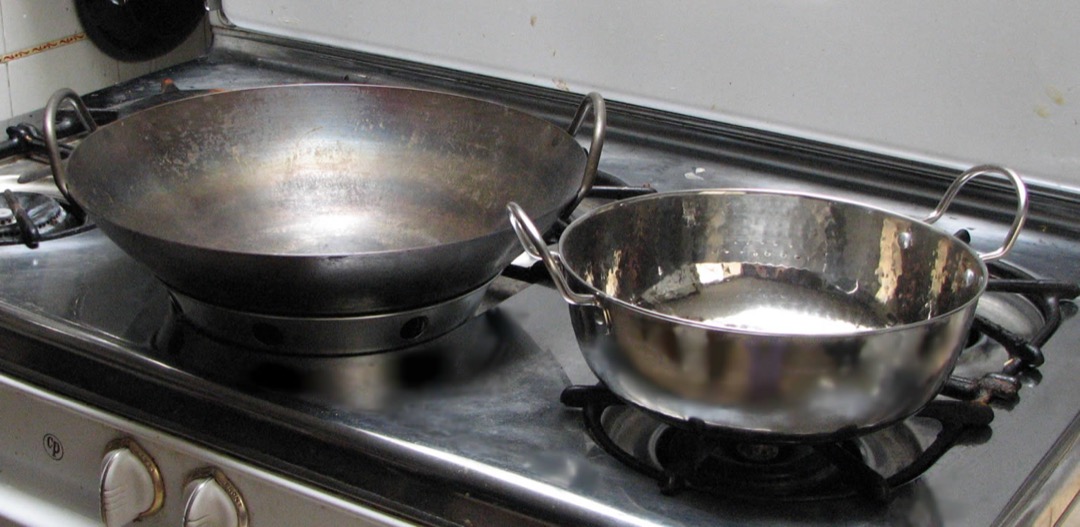
Most wok cleaning advice reads like one routine. Rinse, scrub, dry, oil, repeat. That answers maybe half the questions people arrive with, because a wok that needs attention is usually showing one of several unrelated problems, and the right response to each is different. Burnt-on rice does not respond to the treatment that fixes a tacky surface, and a tacky surface gets worse if you treat it like burnt-on rice.
I ran a restaurant group’s test kitchen for four years, and before that I cooked on commercial wok ranges where a bowl gets cleaned six or eight times a service. That volume teaches you to sort problems fast, and it taught me that the habit that matters most, cleaning the wok while it is still hot, is the one home cooks are talked out of.
So this guide is organised by what you are looking at. Find your case, go to that section, skip the rest. If you have just bought a wok and have not seasoned it, that is a different job, covered in our guide to seasoning a wok.
What Are You Looking At?
Look at the interior in daylight if you can, and touch it with a dry finger.
| What you see | What it actually is | Go to |
|---|---|---|
| Uneven brown to blue-grey to black, dry and matte, darker in the middle | Normal patina forming. Nothing is wrong | Case 1 |
| Hard dark crust welded to one area, usually the base | Carbonized food and sugars from the last cook | Case 2 |
| Surface feels gummy or slightly sticky, may look glossy | Uncured oil, applied too thick | Case 3 |
| Orange or reddish patches, gritty under a finger | Rust, from water left on bare steel | Case 4 |
| Black material lifting in sheets, or a thick uneven lacquer | Seasoning delaminating or built up too far | Case 5 |
The first row is misdiagnosed most often. A young wok is supposed to look blotchy for a month or two, with a darker disc where the flame lands and pale steel up the walls. That goes away by cooking, not by scrubbing.
Case 1: The Routine Clean After Every Cook
Clean the wok while it is still hot, straight off the burner with the food dished out. This is how every professional wok station works. Hot metal releases residue that cold metal grips, because the fats and proteins holding food down are still soft rather than set. Water hitting a hot surface flashes to steam under the residue and lifts it, which is deglazing doing your scrubbing for you. And a hot wok dries itself in seconds, which closes the rust window.
The thermal shock objection does not apply here the way it does to cast iron. A wok is around 2mm thick and holds very little energy for its surface area, so the gradient when water hits it is small and equalises almost at once. A heavy skillet stores far more heat in a thick section, which is why a cold quench can crack one.
The method takes about thirty seconds:
- Dish the food out. Put the empty wok back on medium if it has cooled much.
- Add a cup or so of hot water. It will hiss and steam hard. Keep your face out of it.
- Work the surface with a bamboo wok brush or a stiff nylon brush.
- Tip out, rinse, and put it straight back on the heat to dry.
A bamboo wok brush is the right tool: stiff enough to shift residue, soft enough to leave the patina alone, long enough to keep your hand out of the steam. Skip the detergent unless the dish demands it, and bring it in after fish, after anything heavily spiced, or when the wok has gone properly greasy.
The Right Scrubbing Motion for a Curved Wok
A flat skillet takes a flat circular scrub, because the cooking surface is one plane and a circle covers it. A wok is not a plane, and the part doing most of the work is the sloping sidewall, not the base. Work the brush up and down the slope, from base to rim, rotating the wok a few degrees between strokes so you walk the whole circumference.
The sidewalls carry the thinnest residue and get missed the most. Food spends only a moment against them as it is tossed, so it leaves a light film rather than a visible deposit, and a circular scrub in the bottom of the bowl never reaches it. That film carbonizes into the lacquer that becomes a Case 5 problem. Sidewalls are also where seasoning is weakest, so they are the first place rust shows.
Dry It on the Burner, Not With a Towel
Put the rinsed wok back on medium heat for a minute, until every trace of water has steamed off and the metal is too hot to touch comfortably.
A towel leaves a film of water you cannot see, particularly in the seam where the base curves into the wall and around rivet heads, and carbon steel begins oxidizing in that film within minutes. Cast iron gets away with sloppier drying because a thick pan finishes the job on its own residual heat, which is why our cast iron cleaning guide treats burner drying as best practice while here it is a hard rule.
Then, while it is still warm, wipe a few drops of neutral oil around the interior and immediately wipe it back until the surface reads matte. Glossy means more oil than can cure, which is how a clean wok becomes Case 3.
Case 2: Burnt-On Food
Hard carbonized crust, usually in the base, usually after sugar, soy sauce, or a starchy noodle dish. The instinct is to attack it dry with something abrasive. Do not. Dry abrasion takes real force, and that force lands on the seasoning around the deposit rather than on the deposit itself, so you win a small battle and lose a large area of patina.
Boil and scrape instead. Two or three inches of water in the wok, on the burner, simmering for five to ten minutes. Then push at the edges of the crust with a wooden or bamboo scraper. Tip out, rinse, dry on the burner, re-oil.
Simmering rehydrates the deposit and sends steam under its edges to break the bond to the metal. This is deglazing, and most crusts release in one pass with almost no pressure. Use wood rather than metal: wood is hard enough to break a carbon deposit and soft enough to deform before the seasoning does. If a deposit resists after ten minutes, add a spoonful of baking soda and give it another five, keeping that for stubborn cases because it lifts loose surface oil too.
Do not leave the wok soaking overnight. Soaking holds the whole bowl wet for eight hours, which is Case 4 waiting to happen.
Case 3: Sticky or Tacky Residue
Run a dry finger over the surface. If it drags, or feels gummy, or the wok looks glossy rather than matte, this is not burnt food and boiling water will not fix it. The problem is uncured oil.
The mechanism explains why more oil always makes it worse. Only the molecular layer of oil actually touching the metal can cross-link to metal. Everything stacked above it bonds only to itself, and with limited oxygen reaching it most of it does not bond at all, so it stays as soft, half-oxidized oil and will still be soft next month. The usual cause is a generous seasoning pass, or oiling for storage without wiping the oil back off.
The fix is mechanical. For light tack, coarse kosher salt and a splash of neutral oil on a folded paper towel, worked up and down the slope: the salt supplies grit, the oil carries it, and the tacky layer comes off as a brown smear. For heavy tack, fine steel wool with a little dish soap, accepting that it takes some cured seasoning with it. You cannot leave uncured oil in place and build over it. Finish by washing, drying on the burner, and re-oiling so thin the metal looks dry.
If the tack covered most of the bowl, treat it as a re-season and follow the oil passes in our wok seasoning guide. The same failure produces tacky cast iron, and the cast iron cleaning guide fixes it the same way.
Case 4: Rust
Orange or reddish patches, gritty under a fingertip, often in the base seam or around the rivets. A rusty wok is not ruined.
Carbon steel rusts faster than cast iron for three reasons. It is thin, so it holds almost no residual heat and cannot dry itself the way a heavy skillet does. It is iron with under 2% carbon and essentially no chromium, so unlike stainless it has no passive oxide layer defending the surface. And a wok meets water more often, because the routine clean is a water-based one.
- Scour the affected area back to clean grey metal. Coarse salt and oil for light bloom, fine steel wool for anything heavier. Work the rusted area plus a small margin, and expect to lose the seasoning there.
- For heavy or pitted rust, soak it short. Equal parts white vinegar and water, enough to cover the area, checked every ten to fifteen minutes and pulled out as soon as the orange lifts. Twenty to thirty minutes is usually plenty, an hour is the ceiling. That limit is real: once the oxide is gone the acid moves on to the bare steel, and a wok left in vinegar overnight comes out visibly pitted.
- Neutralise with a baking soda slurry, then rinse in hot water.
- Dry on the burner immediately. Bare stripped steel flash-rusts within minutes if you go looking for a towel.
- Re-season the bare area per our seasoning guide: thin oil coat, wipe back to matte, heat until it smokes and the smoke thins, two or three times.
Steel wool rusts with use and sheds fine metal fibers, so rinse thoroughly and do not store a used pad against the pan. Chainmail does the same job and does not shed. Then fix the cause: rust means water sat on the surface, so the culprit is nearly always towel drying, a wet sink, or storing the wok glossy rather than matte.
Case 5: When to Strip It Back and Start Over
Nobody names this as a deliberate procedure, so people either strip a wok that only needed a scrub or persist for months with one that needed stripping. Three conditions justify it:
- Black flakes keep shedding into food, across several cooks rather than once. A delaminating film cannot be patched, because the loose material keeps lifting the sound material next to it.
- Deep rust across most of the surface. Spot repair is right for a patch, but when the whole bowl is orange, patch-by-patch takes longer than starting over.
- Thick, hard, uneven lacquer. Half-carbonized residue built into a bumpy brown-black shell. It cooks unevenly, traps food, and will eventually flake.
To strip it: fine steel wool or a metal scouring pad, hot water, and dish soap, over the whole interior until you reach uniform bare grey steel. Use real pressure. This is the one time abrasion is the correct answer, and for a heavy build ten minutes of simmering water first saves your forearms. Rinse, dry on the burner immediately, and go straight into a full seasoning. Do not leave a stripped wok overnight: bare carbon steel with no film on it is the most vulnerable that pan will ever be, and it will bloom orange by morning. Our wok seasoning guide covers the bluing pass and the oil coats on top.
Cleaning Rules That Change by Material
Most wok advice online assumes carbon steel and says so nowhere. The rules genuinely differ.
| Wok type | Soap | Abrasives | Dishwasher | Watch out for |
|---|---|---|---|---|
| Carbon steel | Rescue only | Steel wool for rescue, brush for routine | Never | Rust within hours of a wet finish |
| Cast iron wok | Rescue only | Same as carbon steel | Never | Heavy, so it holds heat and dries itself better |
| Nonstick | Always fine | Never, soft sponge only | Check the maker, usually no | Overheating ruins the coating faster than washing does |
| Stainless steel | Always fine | Yes, including steel wool | Yes | Stuck protein and rainbow heat tint, not rust |
| Flat-bottom for electric or induction | As per its material | As per its material | As per its material | The underside, which has to sit flat on the element |
Stainless is the easy case and nobody covers it. No seasoning to protect and no rust problem to manage, so soap, abrasives, and the dishwasher are all fine. Its two real issues are stuck-on protein, which comes off with the boil-and-scrape from Case 2, and rainbow heat tint, which is chromium oxide thickening under high heat, purely cosmetic, and removed by a wipe of white vinegar.
Nonstick woks fail from heat, not from washing, which is part of why we recommend carbon steel throughout our wok roundup.
An electric wok has one rule that overrides everything: the base unit, element, and power connection cannot go near the sink. If yours has a removable bowl, take it to the sink alone. If it is fixed to the housing, you are wiping it out in place with a damp cloth, which makes cleaning it while still warm worth more here than anywhere else.
And unless it is stainless, no wok goes in the dishwasher. The detergent is built to strip fat, the cycle holds the pan wet and hot for over an hour, and it finishes by leaving bare thin steel damp in a warm humid box.
The Bottom and the Outside
Nearly every guide stops at the rim. The underside of a wok accumulates black carbon from the flame, and on a round-bottom wok over gas that is cosmetic. Scrub it if you want it tidier, leave it if you do not.
A flat-bottom wok on an electric coil or induction hob is the exception. That disc is the only contact between the heat source and the pan, and carbon builds up unevenly, dries into hard bumps, and lifts the base by a fraction of a millimetre where it is thickest, which costs conduction on a coil and coupling on induction. Scrape it flat every month or two, checking by setting the wok on a counter to see whether it rocks.
Check the handle while you are there. Wooden and phenolic handles are held by rivets or a screw collar, and repeated cycles of heat and water swell the wood, dry it, and shrink it back, slowly loosening the fixing. A wobbling handle on a two-kilo bowl of hot oil is a real hazard, not a cosmetic complaint. Tighten a screw collar as soon as it moves, and keep the handle out of standing water and out of the flame path.
Soap, Steel Wool, and Soaking: Rescue Versus Routine
The advice online contradicts itself on these three, and the contradiction is not real. The same site will tell you to avoid steel wool in its washing article and recommend it in its rust article. That is advice for two different situations, presented as one. State it as one principle: soap, steel wool, and soaking are all appropriate for rescue and all discouraged for routine care.
Soap will not strip cured seasoning. It is a surfactant, so it lifts loose fat by giving it something water can carry away, and it has no chemistry that touches a cross-linked polymer bonded to metal. The reason to skip it after a normal stir-fry is narrower than the folklore suggests: it also removes the thin coat of loose surface oil you wiped on last time, which on chromium-free steel is the layer standing between the pan and rust. Our cast iron cleaning guide works through the same argument at length.
Steel wool removes seasoning, which is exactly why it is right for rust and tack and wrong for a Tuesday. Soaking has no upside at all: whatever softening it gives you, ten minutes of simmering gives faster, and simmering leaves the wok hot and ready to dry instead of cold and saturated.
Why This Happens: The Short Chemistry
All of this comes back to one reaction. Heat an unsaturated oil past its smoke point against metal, and the double bonds along its fatty acid chains generate free radicals, which attack neighbouring chains until the molecules cross-link into a hard network bonded to the steel. That is oxidative polymerization, closer to a varnish curing than to anything else in a kitchen. It is the same reaction that seasons a cast iron skillet, and our wok seasoning guide covers which oils do it well.
Two consequences follow, and between them they explain nearly every problem here. Only the layer in contact with metal can bond to metal, so a thin coat cures completely and a thick coat leaves soft uncured oil on top. That is Case 3. And a cured film has finite ability to absorb strain: steel and polymer expand at different rates through every heating and cooling cycle, and a wok’s cycles are violent, with sidewalls past 600°F, cold liquid into the base, then the whole bowl into water. A thin film flexes with that. A thick or unevenly stressed stack cracks and lifts. That is Case 5.
So the routine reduces to two habits. Dry it hot, so no water sits on chromium-free steel. Oil it thin, so nothing accumulates that cannot cure. What you get for it is release: food comes off a good patina instead of gripping it, and release is what makes tossing possible, which is what throws oil into the air above the burner. That is a precondition for wok hei, though a precondition is all it is. Heat and technique produce wok hei, and cleaning does not create it. A long pair of kitchen tongs keeps your hand clear of a rim running well past anything you want to touch.
Store the wok hanging rather than nested inside another pan, so air moves over both faces. If you must stack, put a paper towel between the surfaces. And never put a wok away glossy: uncured oil in a warm cupboard goes rancid and tacky within weeks, and you will open the door to a Case 3 problem you did not have when you closed it.
Frequently Asked Questions
Can you use soap to clean a wok?
Why is my wok sticky or tacky after seasoning?
Is a rusty wok ruined, and how do I get the rust off?
Why are there black flakes coming off my wok into the food?
Can a carbon steel wok go in the dishwasher?
Related Articles
About the Reviewer

Nora Whitfield, CIA Culinary Arts, ServSafe Certified
A.O.S. Culinary Arts, The Culinary Institute of America
Nora Whitfield trained at the Culinary Institute of America and spent twelve years in professional kitchens, the last four running the test kitchen for a regional restaurant group where her job was to decide which equipment could survive a dinner service and which could not. She has seasoned more carbon-steel woks than she can count, boiled water in every kettle worth owning, and broken enough cheap gear to know exactly where manufacturers cut corners. She reviews kitchen equipment the way she specified it professionally: cook on it, clean it, and see what it looks like after a month.