How to Clean a Cast Iron Skillet
Soap is fine, soaking is not, and vinegar has a time limit. A chef explains the chemistry behind cleaning cast iron, rust removal, and enameled pans.
Updated
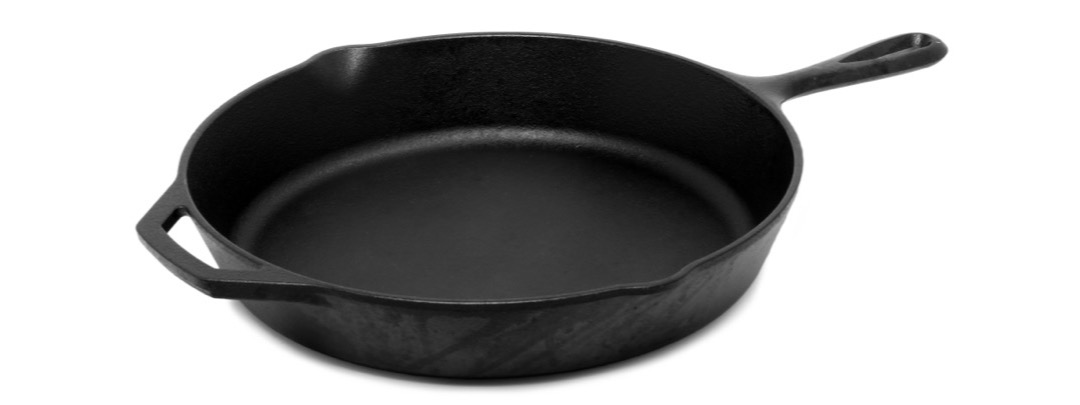
Cast iron carries more bad advice than any other pan in a domestic kitchen, and most of it is protective in intent. Do not use soap. Never scrub it. Keep it away from water. Follow all of that faithfully and you get rancid oil in the low spots, carbonized food welded to the surface, and rust blooming underneath, because the real causes of damage are close to the opposite of what people are told to fear.
I ran a restaurant group’s test kitchen for four years, which meant I decided whether a pan stayed in rotation or went in the bin. Our line cooks washed cast iron with soap and a brush several times a night for years, and those pans were black and slick. The pans that reached me in bad shape had always been treated gently: soaked, rinsed without scrubbing, towel-dried, put away.
The Short Answer
Wash the skillet while it is still warm, using hot water, a stiff brush or nylon scrubber, and dish soap if you want it. Work stuck food loose with a paste of coarse kosher salt and a splash of water rather than soaking. Rinse, then dry the pan on a burner over medium heat until every trace of water has steamed off and the metal is too hot to touch. Wipe on about a quarter teaspoon of neutral oil and immediately wipe it back until the surface reads matte rather than glossy. Cool and store dry.
Why There Are So Many Rules
Every cleaning rule you have heard about cast iron traces back to one misunderstanding: people think seasoning is grease. It is a cured cross-linked polymer, formed when unsaturated fat was heated past its smoke point and its molecules bonded to each other and to the iron. That film is a few molecules thick per layer and chemically bonded to the metal, closer in structure to a varnish than to anything in a frying pan. The chemistry, including which oils cure and which never do, is in our guide to seasoning a cast iron skillet.
Dish soap is a surfactant, a molecule with a water-loving end and a fat-loving end that surrounds loose fat droplets so they rinse away. It has no mechanism for breaking covalent bonds in a cured polymer, which is why detergent lifts bacon fat off the pan and leaves the black film untouched. Hold that distinction and the rest follows: anything that removes loose fat and food is fine, and what to avoid is whatever attacks the polymer or leaves bare iron sitting in water.
How to Clean Cast Iron After Every Cook
Wash While It Is Still Warm
Timing does more work here than technique. A warm pan releases stuck food that a cold pan holds onto, because the fats and sugars in the residue are still soft and the metal has not contracted around them.
Run hot water in, scrub with a stiff-bristled brush or a nylon pad, and use soap if the pan cooked something greasy or strongly flavored. Lodge, Field Company, and Smithey, all of which have an obvious financial interest in their pans lasting forever, tell their own customers to use soap. The routine covers any bare-iron pan carrying a polymerized film, which is why the carbon steel and cast iron models in our best woks roundup get washed this way after a stir-fry.
Stuck-On Food
Coarse kosher salt is the tested winner, and it beats every specialist gadget I have used. Pour a tablespoon or two into the warm pan, add a splash of water to make a gritty paste, and scrub with a folded paper towel. Salt crystals are hard enough to shear off carbonized residue and soft enough to crumble before they cut into cured seasoning. For heavier residue, simmer a shallow layer of water in the warm pan for a minute and scrape with a wooden or nylon scraper, then pour it out before the water can sit.
Chainmail scrubbers are where honest sources disagree. Lodge sells them and endorses them, on the reasoning that stainless rings cannot remove a bonded polymer. Serious Eats’ testing found the opposite in practice, with repeated use visibly wearing seasoning down over time, particularly on younger pans where the film is only a few cycles deep. Treat chainmail as an occasional tool for a stubborn spot rather than a nightly default, and reach for salt first.
Dry It on the Burner
This is the step that actually prevents rust, and the one people skip. Set the rinsed pan on a burner over medium heat, not high, and leave it until the last of the water has steamed off and the metal is hot and completely dry. Two or three minutes is enough.
Medium matters. Modern cast iron is cast noticeably thinner than the milled vintage pans people compare it to, and a thin casting heated hard and unevenly over one small burner ring can warp across repeated cycles, showing up later as a base that rocks on a flat surface. I have watched it happen to good pans belonging to cooks who dried them on a screaming burner every night.
Oil and Buff to Matte
With the pan hot and dry, add about a quarter teaspoon of neutral oil, spread it with a paper towel, then wipe it back until the surface looks matte and dull rather than shiny. There is still oil on it, a microscopically thin film sitting in the surface texture, and that is all the pan needs.
The buffing is not optional. Oil left glossy never gets hot enough to polymerize, so it stays as oil, and oil in a warm cupboard oxidizes into something rancid and tacky within weeks. A pan that comes out of storage sticky and smelling faintly of old fat was put away wet with oil, every time.
Cleaning a Brand-New Pan
Factory pre-seasoning is one thin coat of soybean oil sprayed on and baked, enough to stop rust in a warehouse and not much more. It is food-safe and it is real seasoning, so there is nothing to strip. Wash a new pan with hot soapy water to remove packing residue, rinse, dry on a burner, and wipe on a thin coat of oil. Then cook something fatty in it: bacon, a hard-seared steak, shallow-fried potatoes. Fat at high heat builds a usable finish faster than anything you can do to an empty pan.
How to Clean a Rusty Cast Iron Skillet
Most rusty-pan advice pushes people toward heavier intervention than they need. The right response scales with the damage, so work down this list and stop as soon as the rust is gone.
Light Surface Rust
An orange bloom or a scattering of speckles, the sort of thing that appears after a pan sat wet overnight or spent a humid summer in a cupboard. Scour it with coarse kosher salt and a little oil on a paper towel, or fine steel wool if the salt is not cutting it, until you are down to grey metal and surrounding black seasoning. Wash with soap and hot water, rinse, and dry on a burner immediately, because bare iron flash-rusts within minutes.
Then reseason, because any patch scoured back to metal has no film left on it. Our cast iron seasoning guide has the temperatures and coat-thickness rules. This handles the large majority of rusty pans, and there is rarely a reason to escalate past it.
Heavy Rust
Rust across the whole cooking surface, flaking scale, or pitting you can feel with a fingertip. This is where a 50/50 soak of plain white vinegar and water earns its place, and where published advice becomes genuinely contradictory: you will find 30 to 60 minutes, “a few minutes,” and 6 to 12 hours stated with equal confidence. (Cast iron is one of the surfaces where vinegar does harm outside this one job, and our guide to household uses of vinegar lists the others.)
Those sources disagree because they are describing different pans. Acetic acid dissolves iron oxide, and once the oxide is gone it starts dissolving the bare iron underneath. On a pan that still carries seasoning and is being cleaned rather than restored, fresh bare metal is exposed continuously as the rust lifts, so the window between rust removed and surface etched closes fast. On a pan a restorer has already stripped to bare metal with lye, where further etching is irrelevant, a multi-hour soak is reasonable to write down. Different pan, different job.
For routine rust: check every fifteen minutes, scrub the loosened oxide off with steel wool between checks, cap the soak at one hour. Never overnight. Rinse, dry on a burner right away, reseason.
When You Actually Need to Strip
Genuinely rarely, and America’s Test Kitchen makes the same point. Full stripping is for flaking sheets of failed seasoning, thick sticky varnish, or rust across the entire surface. A pan that is merely blotchy, dull, or partly bare does not need it. The methods that work are a lye-based oven cleaner sealed in a bag for 24 to 48 hours, or electrolysis with a battery charger and a sacrificial anode. Both are in the seasoning guide, because stripping is half a job and the rebuild is the half that matters.
The Potato and Baking Soda Trick
The theory is not nonsense: potatoes contain oxalic acid, and oxalic acid chelates iron oxide, which is the mechanism behind several commercial rust removers. It does not survive contact with a pan. The Kitchn ran it against other methods in a controlled test and rated it near-useless, which matches the arithmetic, since oxalic acid in a raw potato is a tiny fraction of a percent and baking soda is a mild abrasive at best. What little rust comes off is coming off because you are rubbing it.
Worth saying plainly, because people bin pans over this: rust on cast iron is a surface condition on a solid block of metal, not a structural failure and not a health hazard. A skillet that comes out of a garage covered in orange scale is a two-hour project, not scrap.
Enameled Cast Iron Is a Different Pan
Le Creuset, Staub, and Lodge’s enameled line are cast iron with a layer of glass fused to the surface. There is no seasoning to protect, because there is no exposed iron for a polymer to bond to, which makes the bare-iron rulebook irrelevant.
Wash enameled cast iron with soap and a non-abrasive sponge as freely as you would wash a glass baking dish. Most pieces are technically dishwasher-safe, though the exterior enamel dulls and can develop fine crazing over years of cycles, so hand washing keeps a colored Dutch oven looking new for longer.
Never use steel wool or chainmail on enamel. The rules invert here: chainmail is at worst debatable on bare cast iron and permanently damaging on enamel, because it cuts fine scratches into the glass that trap stains and eventually chip. For brown staining on a light interior, leave a paste of baking soda and water on the mark for fifteen minutes, or simmer a shallow layer of water for a few minutes.
The real hazard with enamel is thermal shock rather than rust. A hot enameled pan plunged into cold water can crack or chip the glass, because the enamel and the iron beneath it expand at different rates. Let it cool on the stovetop before it goes near the sink, and do not dry an enameled pan on a burner. It has nothing to rust and a towel is all it needs.
What Actually Damages a Cast Iron Skillet
Soaking. Prolonged water contact softens and lifts the polymer film and starts corrosion anywhere the film does not cover. A pan left in a sink under a stack of plates comes out dull with orange starting in the low points. This is the most common cause of the damage blamed on soap.
The dishwasher. Detergent there is strongly alkaline, built on sodium carbonate and sodium metasilicate, and the machine runs it hot for an hour or more in constant contact with the pan. Alkalinity plus heat plus time is a weak, slow lye bath, and a lye bath is the deliberate method for stripping seasoning. Then the pan sits wet through the drying cycle and rusts on top of it.
Air-drying or towel-drying only. A towel leaves moisture in the surface texture you cannot see or feel, and air-drying leaves more. Both produce rust spots overnight.
Long acidic simmers. Acid hydrolyzes the film and lifts it off the iron. A splash of wine deglazed and poured out in ninety seconds is fine on a mature pan. A 45-minute tomato braise leaves the surface grey and thin and the food faintly metallic.
Storing damp or stacked wet. Trapped moisture between two nested pans has nowhere to go. If you stack, put a paper towel between them.
Long empty dry heat. Two or three minutes of preheating is normal. Twenty minutes empty on high carbonizes the top of the seasoning into a brittle crust over a softer layer that then flakes.
Soap does not appear on that list. The never-use-soap rule is real history rather than invention: household soap was once made by boiling fat with lye, and batches routinely carried excess sodium hydroxide, which genuinely does dissolve seasoning. Nothing in a bottle has worked that way for generations.
Why Your Pan Still Looks Brown or Blotchy
A pan that is grey and brown in patches rather than uniformly black is the most common question people have after a clean, and the answer depends on which of three conditions you are looking at.
Young seasoning still building. A newer or recently stripped pan reads bronze and brown with darker rings and lighter centers. The film is there, it is simply thin, and thin polymer layers are semi-transparent so the color looks uneven. It feels smooth and slightly slick, water beads on it, and nothing sticks unusually. Fry in it for a month and it darkens and evens out on its own.
A bare-metal patch. A dull grey area with a defined edge, usually in the center where heat is highest or wherever an acidic sauce sat. It feels rougher and drier than the surface around it, food sticks there specifically, and a drop of water spreads instead of beading. Cook something fatty at high heat, or run a maintenance oil cycle, and it fills back in.
Carbon build-up. Hard, matte black, slightly raised deposits with irregular crusty edges, often around the outer rim of the cooking surface or up the walls. This is burnt-on food that carbonized, and it never becomes seasoning. You can catch it with a fingernail as a bump standing above the surface. Take it off with coarse salt and a scraper.
Your fingertip separates them fastest. Smooth and slick means seasoning, whatever the color. Rough and dry with a clean edge means bare metal. Raised and crusty means carbon.
The Method Transfers
None of this is specific to a skillet. Any pan carrying a polymerized oil film cleans the same way, which is why the warm-water-and-brush routine handles the carbon steel and cast iron models in our wok roundup, and why the seasoning rules transfer across both materials without amendment. The one adjustment is drying. A heavy cast iron wok holds enough residual heat to dry itself once the burner goes off, while thin carbon steel cools fast and wants a full minute of active heat before the oil goes on.
Cast iron is close to indestructible. Rust comes off, sticky seasoning scrubs back, blotchy finishes even out with use, and a pan that looks past saving is almost always a Saturday afternoon away from cooking eggs again. Wash it properly, dry it hot, and store it with a matte film of oil on it. If you are still choosing a first pan, our best non-toxic cookware guide sets bare cast iron against carbon steel, clad stainless, enamel and ceramic.
Frequently Asked Questions
Is Dawn dish soap safe for cast iron?
Are you supposed to clean a cast iron skillet after every use?
Does vinegar remove rust from cast iron?
Is it safe to cook in a rusty cast iron pan?
When should you throw away a cast iron skillet?
Related Articles
About the Reviewer

Nora Whitfield, CIA Culinary Arts, ServSafe Certified
A.O.S. Culinary Arts, The Culinary Institute of America
Nora Whitfield trained at the Culinary Institute of America and spent twelve years in professional kitchens, the last four running the test kitchen for a regional restaurant group where her job was to decide which equipment could survive a dinner service and which could not. She has seasoned more carbon-steel woks than she can count, boiled water in every kettle worth owning, and broken enough cheap gear to know exactly where manufacturers cut corners. She reviews kitchen equipment the way she specified it professionally: cook on it, clean it, and see what it looks like after a month.