Does Cast Iron Work on Induction?
Yes, and it is not the best coupler on the hob. A chef explains the physics, the hot ring, the buzzing, the warping risk, and why half power is the real rule.
Updated
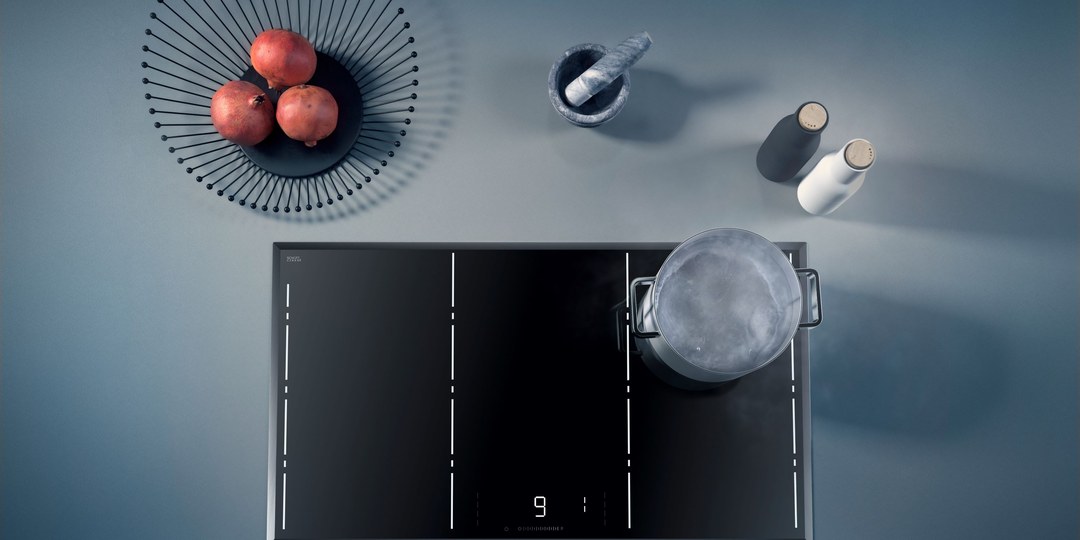
Yes. Cast iron is the single most reliably induction-compatible material in a domestic kitchen, and the people on the cookware forums who answer this question with “if it doesn’t work on induction it isn’t cast iron, that’s just physics” are correct, if not especially helpful.
The interesting questions are the ones underneath. Cast iron works, but it is not the most efficient thing you can put on an induction hob, which is the opposite of what most articles imply. It heats in a ring before it heats evenly. It hums. It can warp if you treat the hob’s boost button the way you would treat a gas burner. None of that is a reason to avoid the pairing, and all of it changes how you should run it.
I ran a restaurant group’s test kitchen for four years and we moved a working line from gas to induction during that time, with the cast iron coming along. The pans were fine. The habits were not, and it took a while to work out which ones had to change.
This guide is about the induction side of the question. Induction hobs are built on a glass-ceramic surface, so the separate question of scratching and cracking that surface applies here as much as it does to a radiant electric cooktop, and we cover it properly in can you use cast iron on a glass top stove. The short version, which is all I will say here: lift the pan, do not drag it.
Why It Works
An induction hob has a coil under the glass carrying a rapidly alternating current, which produces a rapidly alternating magnetic field. Put a conductor in that field and Faraday’s law does the rest: the changing field induces circulating currents, called eddy currents, inside the metal, and the metal’s own electrical resistance turns those currents into heat. That mechanism works in any conductor at all, which is why aluminium and copper can technically be heated by induction, just very badly on a normal domestic hob.
Ferromagnetic materials get a second mechanism on top. As the field alternates, the magnetic domains inside the iron flip back and forth to follow it, and they lag behind, which dissipates energy as heat on every single cycle. That is hysteresis loss, and only magnetic materials have access to it.
Which of the two does most of the work in cast iron is genuinely unsettled. You will find confident claims in both directions, and the more rigorous discussions argue that for a material with a wide magnetic hysteresis loop the eddy current losses actually exceed the hysteresis losses, which is the reverse of the intuitive answer. My reading is that eddy current heating is the primary mechanism and hysteresis is a real additive bonus that magnetic pans get and non-magnetic ones do not. Anyone quoting you a clean percentage split is quoting a number nobody has established.
The Part Everyone Gets Backwards
Here is the finding I did not expect. Cast iron is not the best coupler on your hob. Magnetic stainless is.
How strongly a pan couples to the field comes down to two material properties: magnetic permeability and electrical resistivity. The surface resistance that determines heating scales with the square root of their product, which means permeability carries enormous weight. Research published through the Modern Energy Cooking Services programme puts the numbers like this:
| Base material | Resistivity (µΩ·cm) | Relative permeability | Surface resistance (Ω) |
|---|---|---|---|
| 430 stainless, magnetic | 60 | 800 | 6.7 |
| Cast iron | 100 | 60 | 2.4 |
| 304 stainless, non-magnetic | 72 | 1 | 0.26 |
| Aluminium | 2.7 | 1 | 0.05 |
Cast iron has the higher resistivity of the two magnetic entries, which helps it, but its permeability is more than ten times lower, which hurts it far more. The result is that a 430 stainless base, the alloy makers bond to the bottom of induction-ready clad pans, develops close to 2.8 times the surface resistance of bare cast iron and therefore converts more of the field into heat.
That is worth stating precisely, because it is easy to over-read. It does not mean cast iron is a poor pan on induction. It means the field-to-heat conversion is less efficient, so cast iron draws its heat a little more slowly than a well-made clad pan at the same setting. Cast iron’s advantage was never coupling. It is mass. A three kilogram skillet holds so much heat that a cold steak barely dents its temperature, and no thin pan of any alloy can do that. You are trading a little efficiency at the coil for a great deal of stability at the food, which for searing is a trade worth making every time.
The non-magnetic rows in that table explain the other half of the picture. 304 stainless, the 18/10 alloy used for the visible surfaces of good cookware, is essentially transparent to an induction hob on its own, which is why clad pans have a magnetic disc bonded into the base. Anything genuinely non-ferrous does nothing at all, which is the reason a glass tea kettle is the one kettle that will never work on induction no matter how flat its base is.
The Hot Ring
Induction does not heat a pan’s whole base evenly. The coil is a spiral, and the field is strongest above the windings, so the heat arrives in a ring. A peer-reviewed study on induction temperature control describes exactly this, noting that induction hobs generate ring-like temperature distributions with the hot spots in the middle of the ring, and that the pattern is most pronounced at high power and during heat-up, evening out at steady low power.
Every pan gets this. What makes it a cast iron issue specifically is that cast iron conducts heat sideways rather poorly, far worse than aluminium or copper, so it takes longer than a clad pan to smear that ring out into a uniform surface. On a thin clad pan the ring has mostly evened out by the time you notice it. On a cast iron skillet you can genuinely have a hot band and a cooler centre and rim for a few minutes.
This is why the standard advice to preheat cast iron slowly is real physics rather than caution for its own sake. Give it a low to medium setting and a few minutes, and the iron’s own conduction distributes the ring. Hit it with boost and you get the ring at full strength, which is uneven cooking now and warping stress over time.
It also explains a complaint I hear constantly from people new to induction, which is that their cast iron seems to have developed a hot spot it never had on gas. It has not changed. The heat source has.
Detection, and What the Magnet Test Misses
An induction hob will not switch a zone on unless it detects a suitable pan, and the threshold is a base diameter, generally somewhere between about 9 and 12 cm depending on the brand and on which zone you are using. Smaller auxiliary zones usually detect smaller pans than the big ones. Below the threshold the hob reads the zone as empty, and there is nothing you can do about it, because it is a magnetic coupling judgement rather than a weight or contact judgement.
A pan larger than the zone does not fail. It heats unevenly, because only the part of the base sitting over the coil couples strongly. A pan smaller than the zone, but still above the detection floor, works at reduced efficiency over a smaller hot area.
The magnet test is the right first check: if a fridge magnet snaps firmly onto the base, the pan is ferromagnetic and will couple. It is worth knowing what that test does not tell you.
- It does not tell you the base is big enough to trip detection.
- It does not tell you the base is flat. A warped or concave base still passes the magnet test, then sits on the glass with an air gap, and coupling strength falls off exactly where the gap is. That is the mechanism behind uneven heating on an old pan, and it is geometric rather than magnetic.
- It does not tell you how efficiently the pan will heat, because magnetism is a yes or no and efficiency is a spectrum, as the table above shows.
- It does not tell you whether the pan will hum.
- On a clad pan it may only tell you about the spot you tested, since some constructions carry a magnetic disc across part of the base rather than all of it.
Stovetop kettles are where this catches people out most often, because a kettle body made of 18/10 will happily fail on induction while looking identical to one with a magnetic base, so it is worth running a magnet over the base before buying. Our stainless steel tea kettle roundup notes base construction for exactly this reason, and if you are on gas the calculus is different again, which we cover in tea kettles for a gas stove.
The Noise
Cast iron on a high setting hums, buzzes or occasionally whines. The cause is magnetostriction: a ferromagnetic material changes shape very slightly in a magnetic field, and since this field alternates thousands of times a second, the base of the pan is being flexed at an audible frequency. Turn the power up and the field gets stronger and the noise gets louder. GE, JennAir and Sub-Zero all document humming in their own support material as normal induction behaviour.
There is a second noise worth telling apart from the first. A hum that tracks the power level is magnetostriction and is harmless. A rattle or a chatter is mechanical, meaning the base is not flat and is vibrating against the glass, and that one is a signal, because a base that rattles is a base that is not making even contact and is not heating evenly either.
To reduce the hum: run lower, centre the pan properly, and expect a heavy one-piece pan to be quieter than a light layered one. You will not eliminate it.
Warping Is the Real Risk, Not Cracking
The internet will tell you induction cracks cast iron through thermal shock. I went looking for a documented case of that and did not find one. The most detailed firsthand account available comes from someone running around twenty skillets on a high-powered commercial induction unit, and what they report is warping, explicitly not cracking. The cracking claims all appear as bare assertions with no mechanism attached.
Warping is real and follows directly from everything above. The ring pattern plus a fast ramp means part of the base expands well ahead of the rest, and enough cycles of that differential stress leave a base that no longer sits flat, which then heats unevenly and rattles. Cast iron users commonly work to a rule of staying under about half power on induction for this reason. That is experienced practice rather than a published manufacturer limit, and I would follow it anyway, because there is no cooking benefit on the other side.
The practical version is simple. Do not use boost to preheat cast iron. Bring it up at a low to medium setting, give it a few minutes, then cut the power well back once it is hot, because it will keep climbing after you do. Boost is for filling a stockpot with water, not for warming three kilograms of iron from cold.
Nothing here changes how you look after the pan otherwise. Induction does not affect a seasoning layer any differently than a gas flame does, and the routine in how to season a cast iron skillet and how to clean a cast iron skillet applies unchanged.
Woks Are the Real Exception
This is where cast iron and induction genuinely conflict, and it is a geometry problem rather than a metallurgy one.
A round-bottom wok has almost no flat area touching the glass, and induction only heats what sits over the coil. On a standard flat hob a round-bottom wok barely heats at all, and the small patch at the very bottom that does heat is nothing like the wide sloping heat zone the technique depends on. Purpose-built induction wok hobs exist with a bowl-shaped coil that matches the wok’s curve, but they are a specialist and largely commercial item rather than something in most kitchens.
So on induction a wok has to be flat-bottomed, with something on the order of 11 cm or more of genuine flat base to clear detection reliably. A flat-bottomed cast iron wok works on that basis and gives you heat retention that carbon steel cannot match, which matters if you are cooking in batches.
The honest caveat is that most wok cooking wants the opposite quality. The technique is built on tossing and on rapid response to power changes, and cast iron is heavy and slow to react, which is why carbon steel remains the wok material of choice for most cooks even on induction. Our wok roundup covers that trade-off across materials, and if you want the round-bottom shape and a genuinely responsive heat source on an induction kitchen, a dedicated electric wok sidesteps the problem entirely by bringing its own burner. The heat-retention argument matters more than usual on induction, though, because of the hot ring: a heavy wok evens out the coil pattern that a thin one passes straight through to the food. If you want the theory behind why any of this affects the finished dish, wok hei goes into it properly.
The Short Version
Cast iron works on induction, always, bare or enameled. It couples less efficiently than magnetic clad stainless and makes up for it with thermal mass. It heats in a ring before it heats evenly, so preheat gently and give it time. It hums, and that is normal. It can warp if you keep slamming it with boost, so do not. And the only cast iron that genuinely will not work is the shape that cannot touch the glass, which means a round-bottom wok and nothing else.
Frequently Asked Questions
Does cast iron work on an induction cooktop?
Why does my induction cooktop buzz or hum with a cast iron pan?
Is cast iron more efficient than stainless steel on induction?
Can cast iron crack or warp on an induction hob?
Do I need to use lower power settings with cast iron on induction?
Related Articles
About the Reviewer

Nora Whitfield, CIA Culinary Arts, ServSafe Certified
A.O.S. Culinary Arts, The Culinary Institute of America
Nora Whitfield trained at the Culinary Institute of America and spent twelve years in professional kitchens, the last four running the test kitchen for a regional restaurant group where her job was to decide which equipment could survive a dinner service and which could not. She has seasoned more carbon-steel woks than she can count, boiled water in every kettle worth owning, and broken enough cheap gear to know exactly where manufacturers cut corners. She reviews kitchen equipment the way she specified it professionally: cook on it, clean it, and see what it looks like after a month.