Wok Hei: What It Is and How to Get It at Home
Wok hei is three separate mechanisms, and a home cook can reach most of them. A chef separates the chemistry from the folklore, with real temperatures.
Updated
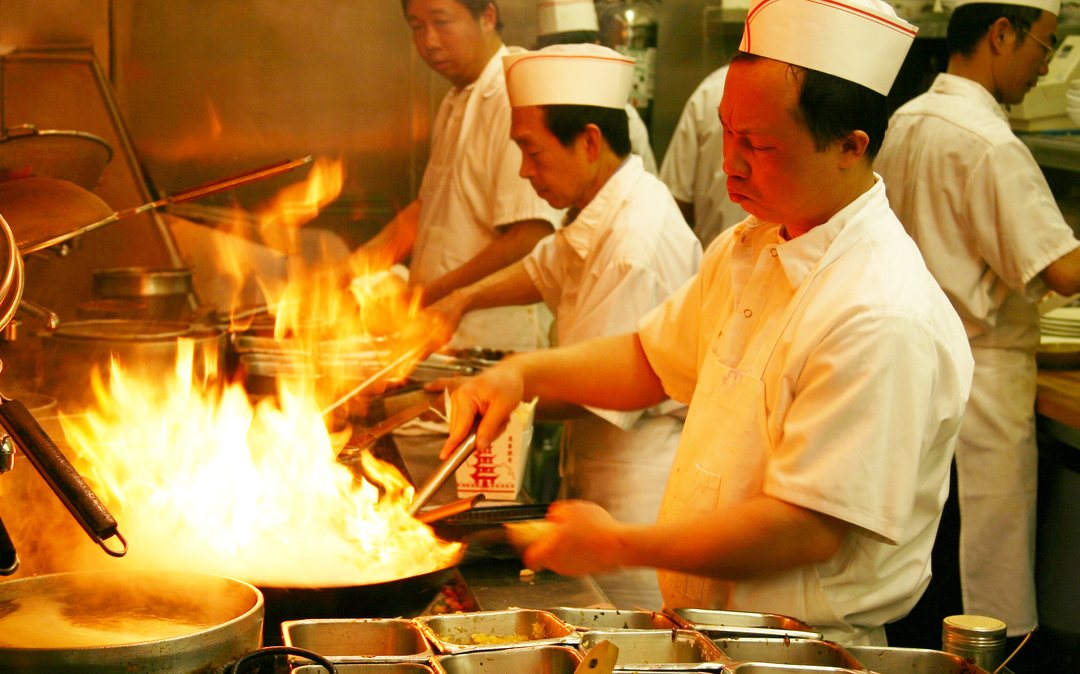
Wok hei announces itself before the plate lands. It is a scorched, faintly smoky smell with a toasted sweetness under it, and on the tongue it reads as a dry seared surface on food that is still juicy inside. A slice of beef comes out charred at the edges and barely cooked through. Rice tastes of the pan rather than of soy sauce. It is the single quality that separates a stir-fry from a restaurant in Kowloon from the same recipe made at home, and it is the reason takeout in a container almost never has it.
Here is the one-line answer, before the long one. Wok hei is three separate physical processes that happen to occur at the same time in a very hot wok, and a home cook can reach most of what matters in two of them. Nothing about it is mystical, and nothing about it lives permanently in an old pan.
I ran a restaurant group’s test kitchen for four years and spent a good part of it standing over commercial wok ranges, the sort that put out more heat in ten seconds than a home range manages in ten minutes. I have also spent years cooking on ordinary domestic burners and testing what actually transfers. What became clear is that almost every explanation online collapses three mechanisms into one paragraph, and then tells the reader that the only fix is a jet burner they cannot install. Both halves of that are wrong. Separate the mechanisms and it becomes obvious which parts you can reach at home, which parts you cannot, and which parts do not matter as much as the internet insists.
What Wok Hei Means
The term is Cantonese, written 鑊氣 and romanised in Jyutping as wok6 hei3. Pronounce it roughly as wok hey.
The first character is the wok. The second, 氣, is the hard one, because it carries breath, air, gas, steam, and energy depending on context. A literal English rendering lands somewhere near wok thermal radiation or wok energy. What it does not literally say is breath of a wok. That translation was coined by Grace Young, first in The Wisdom of the Chinese Kitchen and then developed properly in her 2004 book The Breath of a Wok and her essay “Wok Hay: The Breath of a Wok” in Gastronomica 4(3), 2004. It is the best phrase anyone has produced in English and it has done more than any other single thing to bring the concept to Western kitchens.
It has also caused a specific confusion worth naming. Breath implies something the pan gives off and passes into the food, which nudges people toward believing the wok itself is the source and that an old wok holds more of it. That is not how any of this works, and I will come back to it.
In Mandarin the same idea is read guo qi, written 鍋氣 or 锅气. Worth knowing, because English writing tends to treat wok hei as a universal Chinese culinary standard, and it is not. It is overwhelmingly a Cantonese concern. The eight major regional traditions value very different things, and a Sichuanese cook obsessing over ma la balance or a Huaiyang cook working on knife precision is not chasing this at all. Wok hei belongs to a specific tradition of very fast, very hot cooking, and Cantonese kitchens are where it became a standard you can be judged on.
The Three Things People Call Wok Hei
The four-bullet version repeated across the search results lists high heat, the Maillard reaction, aerosolized oil, and the wok’s seasoning, and treats them as one lump. They are not one lump. Two of them are separate chemical processes, one is a piece of equipment, and they contribute in very different amounts.
One: Maillard and Caramelization, Running at Speed
This is ordinary browning chemistry, the same reaction that darkens a steak, a loaf crust, or an onion. Amino acids and reducing sugars rearrange into hundreds of new aromatic compounds, and sugars caramelize alongside. Nothing exotic.
What is different in a wok is the timescale. The reactions run at temperatures well above ordinary Western pan technique, above roughly 200°C or 392°F, and the surface of a wok base over a strong burner can go far higher than that. America’s Test Kitchen measured wok bottoms exceeding 750°F over a conventional gas burner. At that temperature browning that would take four minutes in a skillet happens in fifteen seconds, which is exactly what you need when the inside of the food has to stay raw or barely cooked.
Michelin, America’s Test Kitchen, and Kenji López-Alt all agree this is the largest single contributor. It is also the part a home cook gets most of. Your burner is weaker than a restaurant’s, but 750°F at the bottom of a wok is achievable on a domestic gas range, and the chemistry does not know what it is sitting on.
Two: Oil Breaking Down and Partially Burning
This is the mechanism that produces the smoky note specifically, and it is the one most home explanations skip.
Kenji López-Alt’s framing is the clearest published statement of it, and worth quoting directly. Wok hei comes, he writes, “from a combination of polymers and oil breaking down within the skillet, and from microscopic droplets of fat vaporizing as you toss food up and over the edge of a wok into the hot column of air created by the intense burner below.”
Two things are happening in that sentence. Oil sitting on very hot metal thermally decomposes, cracking into smaller volatile fragments including aldehydes and other odorants. And a fine mist of fat gets thrown into the air above the pan, where it meets a rising column of extremely hot gas and, in a restaurant, an open flame. Those airborne droplets ignite or partially combust, and their products settle back onto the food.
That mist is the part almost nobody explains correctly. It forms when water boiling out of the ingredients mixes with hot oil under vigorous agitation. Steam expanding through a film of oil shatters it into fine droplets, which is the same physics that makes bacon spit. Toss the food and you launch that aerosol up into the hot zone.
Three: The Seasoning, and Why That One Is Contested
The third claim is that the wok’s polymerized patina contributes flavour directly, and this is where I part company with the confident tone of most articles, in both directions.
The case for it is not trivial. Michelin’s own writing asserts that the polymerized fat on a well-used wok imparts charred aroma to the food. America’s Test Kitchen reports Grace Young and others attributing part of the character to chemical interactions between the food and the components of the wok’s seasoned steel. Kenji’s phrasing implicates “polymers… breaking down within the skillet,” which is the seasoning layer itself contributing decomposition products.
The case against treating it as a main cause is mechanical. The uncontroversial job of a patina is release. Food that releases can be tossed. Tossing is what throws oil and water into the air. So the patina is a precondition for mechanism two whether or not it flavours anything directly, and a good deal of the credit it gets may be that role rather than a chemical one.
My position, and I would rather state it as a position than dress it up as settled fact: the seasoning is at minimum a precondition, plausibly a minor direct contributor, and it is not the main event. Anyone telling you flatly that the patina is where the flavour comes from is going further than the evidence does. So is anyone telling you flatly that it contributes nothing. If you want the mechanics of building one, we cover them properly in how to season a wok, and the underlying polymer chemistry is the same reaction described in our guide to seasoning a cast iron skillet.
Wok Hei Versus Merely Well Browned
Here is a distinction that decides whether the term means anything, and I cannot find it drawn anywhere else.
A steak seared in a cast iron skillet can be beautifully browned. Deep crust, full Maillard development, better than most stir-fries manage. Nobody says that steak has wok hei, and nobody is being precious when they refuse to. So browning alone cannot be the definition.
Put it as a condition. Maillard and caramelization are necessary but not sufficient. They supply the seared savoury base, and without them there is nothing to build on, but the quality people are naming sits on top of that base: a specific smoky top note that arrives from outside the food. It comes from combustion products of the oil mist landing back on the surface, which is mechanism two, and a skillet has no way to produce it because nothing gets thrown into a hot column of gas above the pan.
That answers a question people ask constantly, which is whether wok hei is a real thing or a piece of romanticism. It is real, and it is narrower than the way the phrase gets used. A hot pan that browns food well gets you most of the way and then stops short, because the last stretch requires a second flavour source layered over the first.
Which has a practical consequence. Simply getting hotter has a ceiling, and past a point you are only burning things. The remaining gain comes from tossing.
What the Flames Are Actually Doing
Every video of a Cantonese wok line shows the chef tipping the wok forward, fire climbing the side of the bowl, and the food coming out smelling of smoke. The obvious conclusion is that the fire makes the flavour, and it is wrong in a specific and useful way.
What ignites is the oil mist. Aerosolized fat is flammable, the column above a commercial burner already carries an open flame, and the mist catches. So the visible fireball is evidence that the conditions are right rather than the cause of anything, and a good deal of the oil decomposition that actually flavours the food happens with no visible fire at all. A chef tipping a wok into the burner flame is adding energy to the vapour above the food and putting on a show for a dining room that expects one.
That removes the despair at home. You are not failing because your kitchen does not catch fire. You are chasing conditions, and flames are one symptom of those conditions.
The Toss Is a Cooling Technique
The best-sourced fact in this whole subject comes from a paper almost nobody writing about wok hei has read. Hungtang Ko and David Hu at Georgia Institute of Technology published “The physics of tossing fried rice” in the Journal of the Royal Society Interface in 2020. They filmed five professional chefs at restaurants in Taiwan and Henan Province during 2018 and 2019, the Taiwanese chefs being restaurant owners with more than twenty years each behind a wok, and analysed the motion frame by frame.
What they found is that the toss has a period of about 0.3 seconds and combines two independent motions. The wok slides back and forth, which pushes rice along its floor, and it rocks, which throws the rice into the air. What a chef is actually controlling is the phase lag between those two motions, and at the frequency real chefs work at, the phase difference they perform is close to optimal for mixing.
Then the line that reframes everything. The paper states that wok tossing “enables food to undergo temperatures of 1200°C without burning.”
Read that carefully, because it is easy to garble. The 1200°C figure is the temperature of the flame and the hot gas the food passes through. It is not the temperature of the wok surface, and any article telling you a wok reaches 1200°C has misread it. The point is what the food survives. Airborne food is not touching metal, so it can pass through a temperature that would incinerate it in a second if it sat still on the pan.
So the toss is a cooling technique as much as a mixing one. That is why the motion looks frantic and continuous rather than occasional. Far from being flourish, it is the mechanism that makes extreme heat survivable, and it is precisely what lets a Cantonese cook run heat that would carbonise the same food in a skillet. The authors go further and suggest chefs could toss at a higher frequency still, throwing the rice further and promoting more cooling and mixing.
One incidental finding from the same paper is worth knowing before you decide to toss like a professional: 64.5 percent of Chinese restaurant chefs report shoulder pain. A domestic 14-inch wok loaded with two portions is heavy, the motion is repetitive, and there is no prize for doing it fast. Toss enough to keep food moving through the air, not enough to injure yourself, and use tongs to lift and turn when your arm has had enough.
The Water Detail That Everyone Gets Backwards
Every stir-fry guide tells you to dry your ingredients thoroughly. That advice is correct and incomplete, and stated without qualification it works against you.
Serious Eats, testing whether a propane torch could reproduce wok hei over a home pan, found that adding a splash of water improved the effect. Water in the marinade, and water added to the pan late in cooking. The reason follows from the mechanism: more moisture leaving the food under high heat means more steam shattering the oil film, which means a finer and denser mist, which means more material available to decompose and burn above the pan.
Both pieces of advice are true at different moments, and the distinction is where the water is.
Surface water on the food is bad at the start. It has to boil off before the surface can climb past 212°F, and until it does, no browning happens. Wet ingredients dropped into a hot wok cool it, steam, and stew. That is the real failure the dry-your-ingredients rule protects you from.
Water leaving the pan is good in the middle. Once the food has taken colour and the pan is roaring, moisture escaping under agitation is what generates the aerosol. That is why a splash of stock or Shaoxing wine down the side of a wok at the end of a stir-fry does more than season the dish, and why marinating with a little liquid held in the meat beats marinating something bone dry.
So: dry surfaces going in, moisture leaving on the way out. Pat your protein dry, drain your vegetables properly, and let a good colander do that job rather than a plate and a paper towel, because vegetables that sit in their own pooled water go into the pan wet no matter how well you shook them. Then, once things are searing, do not be afraid of a splash.
The Heat Gap, Honestly
The numbers deserve stating plainly rather than hiding or surrendering to.
A commercial Cantonese wok range commonly runs 100,000 BTU and up, sometimes considerably more, with the flame directed into the bowl rather than sitting under it. A typical home gas burner runs 7,000 to 12,000 BTU, and a range’s designated power burner somewhere around 9,500 to 18,000. That is close to an order of magnitude, and no amount of technique closes it entirely.
What the gap costs you is heat recovery. Kenji’s illustration is the one to hold onto: take a wok sitting at 650°F, lift it off the burner, add food, and the temperature falls very fast, so what happens inside is barely a sear. A restaurant burner’s real advantage is that it puts energy back into the metal faster than cold food takes it out. Peak temperature is easy. Recovery is what you are buying.
A wok has two working zones and the distinction matters here. The base, in direct contact with the flame, is the sear zone, and that is where America’s Test Kitchen measured over 750°F. A couple of inches up the sloping wall is a cooler steam zone, where the curved sides corral the moisture coming off the food. Restaurant technique moves food constantly between the two, searing at the bottom and parking things on the wall while the next component goes in. Cooking everything in the flat bottom four inches of the bowl, which is what most home cooks do, wastes half the tool.
That steam zone does more work than it gets credit for, and Kenji López-Alt has described the mechanism in the New York Times. Steam rising off the wok recondenses onto food that is airborne or sitting on the cooler upper walls. Condensation dumps a large amount of energy into whatever it lands on very quickly, because it releases the full latent heat of vaporisation at the moment it turns back to liquid, and then that water re-evaporates and the cycle repeats. It is a heat transfer path that never involves the food touching hot metal at all, which is part of why a wok cooks faster than its surface temperature alone would predict. It also explains why a bowl shape beats a flat pan for this work: sloping sides corral the vapour into a column above the food instead of letting it drift off the edge.
And BTU is a bad number to compare across heat types, because it measures fuel burned rather than heat delivered. A gas burner puts roughly 30 percent of its energy into the pan. The rest goes around the sides of the wok and into your kitchen, which is why a gas range makes a room hot. Induction delivers roughly 85 to 90 percent into the metal. So a 1,800 watt induction wok burner, which converts to about 6,100 BTU on paper, is not remotely as feeble against a 12,000 BTU gas burner as those two numbers suggest. It is a different kind of arithmetic and the honest comparison is delivered heat, not rated input.
Why You Can Get Most of It at Home
Here is the evidence that changed how I talk about this. America’s Test Kitchen deliberately set out to test whether wok hei requires a restaurant range, and reported that Grace Young produced a fragrant batch of fried rice with good wok hei on a regular home stovetop. No jet burner, no acrobatic tossing, no pyrotechnic flare-ups. Their conclusion was that it is achievable at home. Coming from the two sources with the most standing on the subject, that carries more weight than any amount of encouragement, and it flatly contradicts the fatalism running through the search results.
The technique below is what closes as much of the gap as technique can.
Preheat the wok dry and empty, then add cold oil immediately before the food. Highest heat, two to three minutes on a home burner, until you see the first wisps of vapour coming off bare metal. Then the oil goes in, swirled up the sides, and the food follows within seconds. Michelin states this rule without explaining it, so here is the reason: oil is a consumable in this process. Its thermal decomposition products are half of what you are cooking for, and an oil left sitting in a fully preheated wok spends that chemistry on empty air. By the time the food lands, the useful fraction has already smoked off and what remains is spent, acrid, and pushing toward bitter. Cold oil hitting hot metal a moment before the food arrives times the breakdown to happen while there is something in the pan to catch it. The sequence is preheat, oil, food, in that order and without pauses.
Cook in small batches. The single biggest change you can make on a domestic range, and the one people resist hardest. Half a pound of protein at a time, not a pound and a half. Every ingredient you add is a thermal load your burner cannot replace quickly. Two batches that sear beat one batch that stews, and it costs you ninety seconds.
Cut everything to the same size before you light the burner. A stir-fry runs in roughly ninety seconds to four minutes. There is no point in it where you can go back to the board. Uniform pieces cook at the same rate, and unevenly cut pieces guarantee that something is raw when something else has burned. If you are prepping volume, a slicing disc turns ten minutes of knife work into fifteen seconds, which is most of the argument for the machines in our best food processors roundup.
Get the surfaces dry, then let the moisture out. Covered above. Dry going in, splash at the end.
Keep the food moving, and use the whole bowl. Push seared pieces up the wall, bring raw ones into the base, and toss rather than stir where you can. Tossing is what creates the mist. A long, well-sprung pair of kitchen tongs gets you more control over that than a spatula does and keeps your hand away from a rim running past 600°F.
Do not crowd, and do not add cold liquid to a struggling pan. If the wok has stalled and everything is grey and wet, adding sauce will not rescue it. Tip the batch out, let the wok come back to smoking, and finish in two goes. Batch sizes by wok diameter, stage-by-stage timings, and the adjustments that matter on a weak burner are all in our guide to using a wok.
Have the rice already done. Fried rice is the classic wok hei dish and it needs rice that was cooked earlier and cooled, ideally overnight in the fridge, so the grains are dry and separate. Freshly cooked rice steams in the pan and turns to paste. A rice cooker earns its space here specifically because it finishes on its own schedule while your hands are on the wok, and getting the hydration right in the first place is covered in our rice to water ratio guide.
What Equipment Genuinely Changes the Outcome
Carbon steel, and not too thick. A 14-inch carbon steel wok around 14-gauge, roughly 2mm, is the right tool. Thin enough to respond to the burner immediately, thick enough not to warp or stall the moment cold food lands. Cast iron holds more heat but responds slowly and weighs too much to toss. Stainless does not season, so food sticks and you cannot toss it. Nonstick caps out below the temperatures that matter. Our best woks guide works through gauge, size, and handle style, and carbon steel is the recommendation for exactly these reasons.
Round versus flat bottom is a decision about your stove, not about authenticity. A round bottom over a proper wok ring on a gas burner gives you the classic geometry, with the flame licking up the sides. On a flat electric or induction surface a round bottom barely makes contact and is close to useless. Flat bottom is correct for most Western kitchens and costs you a little sidewall heat.
An outdoor propane burner is the cheapest route to real restaurant heat. A turkey-fryer style ring or a dedicated outdoor wok burner runs far past any indoor domestic range, costs less than a mid-range appliance, and removes the ventilation problem entirely. If you cook stir-fry weekly and have a patio, this is the upgrade with the highest return, and it is barely mentioned in most coverage.
Electric and induction, honestly. A sealed nonstick electric wok cannot produce wok hei. The coating caps the temperature around 400 to 425°F, the thermostat exists to enforce that, and the bowl is fixed to a base so you cannot toss. Both mechanisms are out of reach at once. An induction wok cooktop under a separate carbon steel wok is genuinely different: the better units run to about 575°F, the efficiency figures above mean the delivered heat is competitive, and you can lift the pan. That is the closest electric gets, and our best electric woks roundup separates the two categories rather than treating them as one product.
Why induction struggles is worth stating mechanically rather than just asserting, because the reason tells you what to do about it. Induction heats only metal sitting inside the coil’s field, which needs close, flat proximity. Lift or tip the wok to toss and the coupling breaks, so heating stops completely. A gas flame still licks the underside of a pan held at an angle, so a gas cook loses nothing by tossing while an induction cook is choosing between agitation and heat. Keeping a flat bottom seated solves that and creates a second problem, since the field heats a disc at the base and the sloping walls get only what conducts up through thin steel, so there is no real two-zone gradient. And there is no open flame above the pan to ignite the oil mist. Three mechanisms compromised for three unrelated reasons. Work around it with small batches cooked low in the bowl, the pan kept seated, and the understanding that the smoky top note will be faint.
Can a Blowtorch Fake It?
Partly, and the people who invented the hack are the ones most honest about its limits.
The idea is straightforward. If the smoky note comes from oil mist igniting in a hot column of gas above the pan, then supplying that column with a propane or butane torch should reproduce it on a stove that cannot. Serious Eats tested this at length and named the result torch hei, and their own verdict is the fair one: it resembles wok hei but is by no means the real thing. That is worth repeating, because the technique gets passed around online with the caveat stripped off.
Two practical points if you try it. Adjust the torch until the flame runs blue, and do not use it while it is orange or yellow. A blue flame is complete combustion, running roughly 1,980 to 2,000°C, and it burns its fuel cleanly. An orange or yellow flame is incomplete combustion, cooler at around 1,000°C, and it deposits unburned carbon as soot. That soot goes onto your dinner and tastes exactly like what it is. Let the torch settle to blue before it goes anywhere near the pan.
The second point is the one from the water section. A torch supplies the ignition source and nothing else, so it only does anything if there is a mist to ignite. Aim it just above the food while you are agitating vigorously, ideally right after a splash of liquid has gone in, and keep the food moving underneath it. Held steady over a still pan it is just a very expensive way to scorch one side of an onion.
Where Wok Hei Shows Up in Specific Dishes
Fried rice. The easiest place to produce it and the easiest to judge. Grains should be separate, slightly dry on the outside, and visibly toasted in patches, with a smell that hits before the bowl reaches the table. Day-old rice, a very hot wok, egg cooked separately and folded back in, and no more than two portions at once. Wet, clumped, uniformly beige fried rice is a heat and moisture failure, not a seasoning failure.
Beef chow fun, or gon chow ngau ho. The hardest test in the Cantonese repertoire and the classic examination dish for a wok cook. Wide rice noodles are fragile and starchy, they stick to anything less than a well-seasoned surface, and they are cooked with almost no liquid. Done right, the noodles carry brown scorch marks, stay whole rather than breaking into pieces, and taste distinctly of the pan. Done wrong, they weld to the metal and tear. If your wok can produce this dish, the patina and your heat are both working.
Leafy greens. Gai lan, choy sum, water spinach. Thirty to ninety seconds, high heat, a spoonful of oil and a crushed garlic clove. Correct greens are still bright and snapping, with blistered patches on the leaves and a toasted smell. This is the fastest diagnostic in the list, because greens have high water content and a stalled wok turns them olive-coloured and limp in seconds.
Is Wok Hei Bad for You?
Two of the People Also Ask entries on this topic are variations of whether wok hei is carcinogenic or bad for health, and not one of the top-ranking articles addresses either. That is a gap worth filling carefully, because the accurate answer is neither reassuring nor alarming, and because the number that matters is one almost nobody quotes.
The number to start with is the one you control. A 2016 meta-analysis by Xue and colleagues pooled 13 case-control studies of Chinese non-smoking women, 3 population-based and 10 hospital-based, covering 3,596 women with lung cancer against 6,082 healthy controls. Cooking oil fume exposure carried a pooled risk ratio of 1.74, with a 95 percent confidence interval of 1.57 to 1.94. Cooking without a kitchen ventilator carried a pooled risk ratio of 2.11, confidence interval 1.54 to 2.89. The authors concluded that long-term cooking oil fume exposure significantly raises risk in this population and that using a kitchen exhaust ventilator may reduce it. Extraction, not the wok, is the variable in your hands.
Those figures come with limits attached. These are observational case-control studies pooled into a meta-analysis, in one specific population, and what they are mostly measuring is decades of daily domestic cooking in kitchens with poor extraction or none at all. They do not tell you anything about a stir-fry on a Tuesday. Ko and colleagues in the American Journal of Epidemiology in 2000 and Chen and colleagues in Scientific Reports in 2020 sit in the same thread, and Chen also found extractor use associated with lower risk, which is the finding that keeps recurring.
All of this literature measures one thing: inhaling fumes over years. Eating stir-fried food is a separate question, and the two need to stay apart.
That separation is exactly where the PAH claim goes wrong. You will read on food-science blogs that the smoky character of wok hei is polycyclic aromatic hydrocarbons. The Xue paper does identify PAHs and aldehydes as the two main classes of compound in cooking oil fumes, and flags 2,4-decadienal specifically as aggravating their genotoxicity in cell-line work, so these compounds are real and they are a legitimate air-quality concern. But they are in the fumes going up, which is an inhalation question. The flavour is on the food going into you, which is a different one. PAHs are heavy, low-volatility molecules and largely not what your nose is detecting anyway; the aroma is dominated by lighter thermal decomposition products of the oil plus the aldehyde, pyrazine, and furan families thrown off by Maillard chemistry. Blogs that say wok hei is PAHs have collapsed the two questions into one and got both wrong. They overstate what makes the smell, and they point the reader away from the thing the evidence actually implicates, which is ventilation.
The practical translation from a professional kitchen is about extraction. A commercial wok line sits under an enormous dedicated extraction hood engineered for exactly this load, moving air out of the building at volumes a domestic appliance does not approach. I cooked under one for four years and the difference when I started stir-frying at home was immediate. A home range hood is a fraction of that, and a great many of them are recirculating rather than ducted, which filters some grease and moves air around the room without removing anything from it. So: hood on high before the pan gets hot rather than after, ducted over recirculating if you ever get to choose, a window open for cross-draught, and the burner your hood pulls hardest over, which is usually a back one. Keep batches small, which helps here for the same reason it helps the cooking. And use a refined high smoke point oil. That is also what restaurants use, incidentally: refined peanut, soybean, or rice bran oil for the actual cooking, with sesame oil added off the heat as a finishing seasoning and extra virgin olive oil not in the picture at all. If your kitchen has no meaningful extraction, an outdoor propane burner answers the ventilation question and the heat question with one purchase.
Eating it is the easier half of the answer. Charred food carries the same by-products as anything grilled, barbecued, or hard-seared. Normal portions of home stir-fry are not what the fume literature measures, and a dish with good wok hei is not a dish to be nervous about. Scrape off anything genuinely burnt black, do not keep cooking in spent dark oil, and make it as often as you like. This is general information rather than medical advice, and anyone with a specific respiratory condition should raise kitchen ventilation with their own doctor.
How to Tell If a Dish Has It
It arrives on the nose first. Good wok hei is detectable from a couple of feet away before you taste anything. If you have to hunt for it in the mouth, it is not there.
Look for contrast, not uniformity. Seared brown patches next to unbrowned surface, and a juicy interior under a dry exterior. Evenly coloured food that is the same all the way through has been cooked slowly, whatever the recipe said.
Check for pooled liquid. A stir-fry with sauce sitting in the bottom of the bowl was steaming rather than searing. Sauce should cling to the ingredients in a thin glaze.
Bitterness should be at the edge, not through the dish. A faint bitter char note at the boundary of each seared patch is correct. Bitterness running through everything is burnt oil or scorched aromatics.
And it fades. This is the diagnostic that settles the biggest myth about the whole subject. Wikipedia’s article on wok hei flags the folk claim that it lives in the pan and accumulates over years as uncited, and it is worth saying plainly that it is not true. Wok hei is transient. It is created fresh in every single cook and it is gone within a minute or two of plating. Grace Young has put it as an elusive seared taste that only lasts for a minute or two. What genuinely persists in the metal is seasoning, a cured polymer film that sits there between cooks, which is a different thing entirely and is covered in our guide to seasoning a wok.
That decay is also why takeout rarely has it. A dish that carried real wok hei out of the kitchen spends ten minutes in a closed container steaming itself, and by the time the bag reaches your door the volatile compounds have dispersed and the surface has gone soft. The restaurant almost certainly produced it. The property simply has a shelf life measured in minutes, and no packaging preserves it.
Which is, in the end, the argument for making it yourself. You cannot buy wok hei and have it delivered. You can produce a fair share of it on an ordinary domestic burner with a carbon steel wok, a hot dry preheat, batches half the size you want to cook, and the willingness to stand there and keep the food moving for ninety seconds. The flames are optional. The heat, the timing, and the restraint about batch size are not.
Frequently Asked Questions
What does wok hei mean?
What does wok hei taste and smell like?
Can you get wok hei with induction?
Is wok hei bad for your health?
How many BTUs do you need for wok hei?
Related Articles
About the Reviewer

Nora Whitfield, CIA Culinary Arts, ServSafe Certified
A.O.S. Culinary Arts, The Culinary Institute of America
Nora Whitfield trained at the Culinary Institute of America and spent twelve years in professional kitchens, the last four running the test kitchen for a regional restaurant group where her job was to decide which equipment could survive a dinner service and which could not. She has seasoned more carbon-steel woks than she can count, boiled water in every kettle worth owning, and broken enough cheap gear to know exactly where manufacturers cut corners. She reviews kitchen equipment the way she specified it professionally: cook on it, clean it, and see what it looks like after a month.