How to Season a Wok
Seasoning carbon steel is two jobs stacked: bluing the metal, then polymerizing thin oil coats on top. A chef explains both, with real temperatures.
Updated
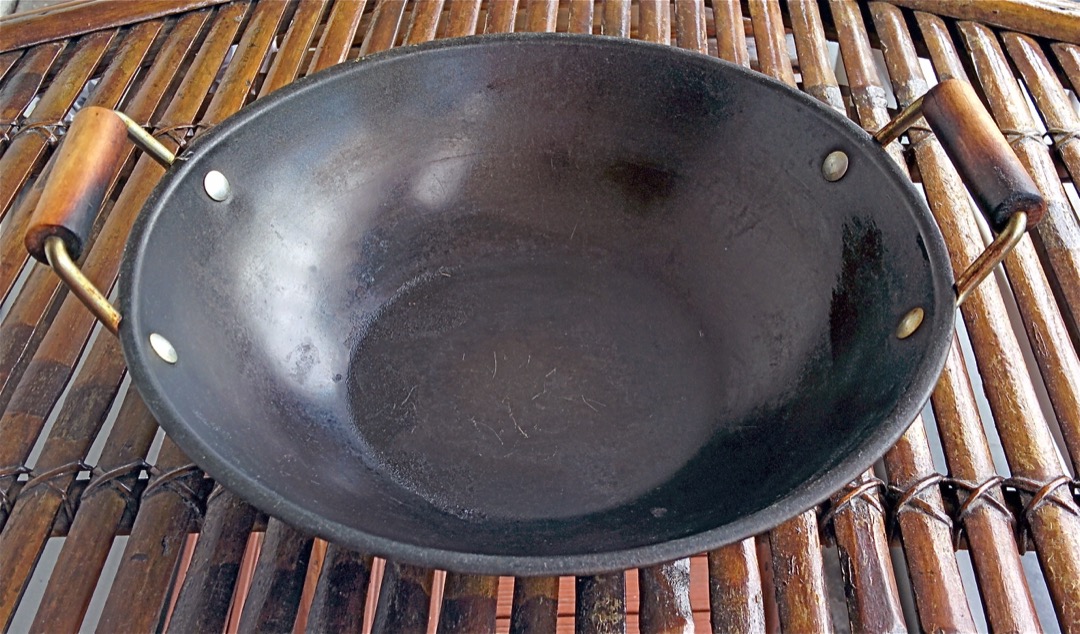
A carbon steel wok arrives looking like a bare metal bowl and is supposed to end up dark, mottled, and slick enough that food slides across it. Between those two states sit a great many instructions that contradict each other, and they contradict each other because most of them describe one process when there are two happening in sequence.
I ran a restaurant group’s test kitchen for four years, which put me in front of commercial woks on jet burners that produced more heat in ten seconds than a home range does in ten minutes. I seasoned new ones, rescued abused ones, and stripped several back to bare steel to start again. What became obvious is that seasoning a wok is two different jobs stacked on top of each other. The first is bluing, a controlled oxidation of the steel itself. The second is polymerization, the same cured oil film that lives on a cast iron skillet. Different chemistry, different temperatures, different purposes. Almost every guide treats them as one continuous step, which is exactly why results are so inconsistent: people skip half of a process they did not know had halves.
Three Different Woks, Three Different Starting Points
Work out which of three things you bought before you light a burner, because the correct first move differs for each and two of them are opposites.
Bare carbon steel with a shipping coating. The majority of woks sold, including most in our best woks roundup. Raw steel would rust in a container in a week, so the factory wipes on a food-grade rust inhibitor, usually mineral oil or a light vegetable oil. It exists to survive humidity and shelf time and it is not seasoning. The wok looks silvery to dull grey, smells faintly of petroleum, and feels slick under a finger. That coating has to come off completely, because cooking on it produces foul smoke and a taste that lingers for several meals.
Genuinely pre-seasoned. A smaller number of manufacturers bake on a shea butter or coconut oil blend, or blacken the bowl in a kiln, which is a factory bluing pass. These arrive dark grey to black, and the tell is a surface that is dry to the touch rather than oily. Taking steel wool to one removes hours of heat treatment somebody already did for you.
Nonstick coated. It needs no seasoning, cannot take one, and these temperatures will wreck the coating and release fumes. If the surface is smooth, uniformly black or grey, and glossy in a way that looks manufactured rather than earned, it is coated.
Listing wording is the fastest filter. “Requires seasoning before use,” “hand-hammered carbon steel,” and even “pre-seasoned” mean bare steel with a shipping coating in the large majority of cases. “Nitrided,” “blued,” or “black steel” usually means real factory heat treatment. Where the copy is ambiguous, trust your fingertip over the description.
Gauge is worth settling first. A 14-gauge bowl around 2mm thick holds heat through a full basket of vegetables and blues evenly, while a thin 18-gauge or 20-gauge wok heats fast, warps more readily, and changes color quickly enough to overshoot. Round versus flat bottom is really a decision about your stove, and our wok guide breaks both variables down by model.
Bluing Is Not Seasoning
Heat bare steel in open air and the iron at the surface reacts with oxygen. Which oxide forms depends on temperature, and because each oxide has a different thickness and refractive index, the surface runs through a predictable sequence of interference colors. Blacksmiths and gunsmiths have used that color march as a temperature gauge for centuries.
On a wok it spreads outward from wherever the flame is hottest. Pale straw and yellow first, around 400 to 440°F. Then bronze and purple through roughly 480 to 520°F. Then blue at about 540°F. Past the interference range you get a flat blue-grey, then a dull grey-black.
That blue-black is magnetite, iron oxide in the Fe3O4 form, produced by the same controlled oxidation gunsmiths mean when they talk about bluing a firearm. It is hard, tightly bonded to the parent metal, and far more corrosion-resistant than the red oxide of ordinary rust.
What it is not is a nonstick surface. Food sticks to magnetite happily. Its value is as an anchor: a blued surface is a far better key for polymerized oil than bright bare steel, and it protects the metal wherever the oil film later wears thin. A restaurant wok that still looks black straight out of a hard scrub is showing you bluing, not oil.
The oil comes second, and it is the reaction described in our guide to seasoning a cast iron skillet. Heat an unsaturated fat past its smoke point, the double bonds in its fatty acid chains generate free radicals, those radicals attack neighboring chains, and the molecules cross-link into a hard three-dimensional network bonded to the metal. Identical chemistry, different pan. A wok simply gets its polymer laid over magnetite rather than raw cast iron, and gets it built on a burner, because a 14-inch bowl does not sit sensibly in a home oven.
Two jobs, in order. Blue the steel, then polymerize oil on top of it.
Choosing an Oil
The number that decides whether an oil can season is its smoke point, because polymerization begins where thermal breakdown begins. Get the metal hotter than the smoke point and the film cures. Stay below it and the oil sits there oxidizing slowly into something rancid and tacky.
| Oil | Approx. smoke point | Notes |
|---|---|---|
| Flaxseed, unrefined | 225°F | Cures hardest and fastest, then cracks and flakes. Wrong for a wok. |
| Olive, extra virgin | 375°F | Solids and free fatty acids burn acrid, and the film cures soft. Avoid. |
| Canola, refined | 400°F | Excellent default. Cheap, neutral, cures reliably. |
| Grapeseed | 420°F | My first choice. Clean-burning, cures hard without going brittle. |
| Peanut, refined | 450°F | Traditional in Cantonese kitchens, allergies permitting. |
| Soybean or generic vegetable, refined | 450°F | Serviceable, and usually already in the cupboard. |
| Avocado, refined | 500 to 520°F | Fine on a screaming gas burner, useless anywhere cooler. |
Grapeseed or refined canola is the right default. Both smoke in a range a gas burner clears without drama, both carry enough unsaturation to cure into a durable film, and neither costs enough to make you ration it.
Extra virgin olive oil is a poor pick on two counts. What smokes at 375°F is not mainly the fatty acids you want to cross-link but the free fatty acids, polyphenols, and suspended solids unrefined oil carries, which burn acrid and leave a soft residue. Olive oil is also mostly oleic acid, with one double bond per chain, so it cures weaker than grapeseed or canola.
Settling the Flaxseed Question
Flaxseed oil is roughly half alpha-linolenic acid, a fatty acid carrying three double bonds, which gives it the highest iodine value in the kitchen at around 170 to 200. Iodine value measures unsaturation, unsaturation drives cross-linking, and cross-linking is what curing is. So flaxseed cures faster and harder than anything else, goes glassy black in three passes, and photographs beautifully.
That same property is why it fails on a wok specifically. A heavily cross-linked film is brittle, and brittle films cannot absorb strain. The polymer and the steel expand at different rates every time the pan heats and cools, and the film takes the stress. On a skillet moving between room temperature and 400°F that is bad enough. A wok gets far rougher treatment: sidewalls well past 600°F, a cup of cold stock hitting the bottom, then the whole bowl dropped in a sink of water. Flaxseed cracks under that cycling and lifts in thin black sheets, usually taking clean bare steel with it, and a flaking film cannot be patched.
Flaxseed is a fine finish on a display piece and the wrong finish on a wok you cook in twice a week.
Seasoning a Wok on a Gas Stove
This is the standard method and the one that produces the best result, because a gas flame is the only common home heat source that reaches the sidewalls. Set aside forty minutes.
- Scrub the factory coating off. Very hot water, dish soap, and a scouring pad or fine steel wool. Do not be gentle: any mineral oil left behind will smoke and taste bad for weeks. Near-boiling water thins that coating in a way lukewarm tap water does not, and a stovetop kettle built for a gas burner refills faster than most sink taps run hot.
- Dry it immediately on the burner. Bare carbon steel flash-rusts in minutes and will bloom orange while you look for a towel. Medium heat until every trace of water has steamed off.
- Deal with the handle. Wooden and phenolic handles scorch. Remove it if it unscrews or wrap it in a double layer of foil, and keep it turned away from the flame.
- Heat it dry and empty on the highest flame. No oil at this stage. Oil now would only burn and interfere with the oxide forming.
- Tilt and rotate constantly. This is the step that separates a good wok from a blotchy one. The flame touches a small patch of a curved bowl at any moment, so you have to move the wok through it: tilt, rotate a few degrees, hold, rotate again. Work the sidewalls and the rim as deliberately as the base.
- Watch the color march. Straw and yellow, then bronze and purple, then blue, spreading out from the hot spot. Keep moving the wok so the blue chases across the whole bowl, and stop when the entire interior including the rim reads a uniform blue-grey. On a home burner of 9,000 to 12,000 BTU this takes 10 to 20 minutes of patient rotating.
- Cool for a minute, then oil. Add about half a teaspoon of grapeseed or canola, spread it over the whole interior with a wadded paper towel held in tongs, then wipe it back with a fresh towel until the surface reads dry and matte. There is still oil on it. A cure produces a film measured in molecules regardless of how much you started with, and excess oil is the most common cause of sticky seasoning.
- Heat until it smokes, then until the smoke thins. Back on high. The thinning is your signal that the film has finished curing.
- Repeat the oil pass two or three times. Cool slightly, half a teaspoon, wipe back to matte, heat until the smoke thins.
What you want at the end is a mottled surface running from brown through blue-grey to near black, matte rather than glossy, and conspicuously uneven. The unevenness is normal and correct. A wok that comes out uniformly black after one afternoon has usually been given too much oil, and the even patina people photograph is the product of months of cooking.
The burner gap explains why your result will not look like a restaurant’s. A home range burner runs 9,000 to 12,000 BTU. A commercial wok range runs 100,000 BTU and up, with the flame directed into the bowl rather than under it. On our jet burners a wok blued through in under a minute with barely any rotating. On a home stove you are hand-walking that same process across ten to twenty minutes, and a full kettle’s time to boil is a fair proxy for how strong your burner is.
About the Smoke
This makes a great deal of smoke and there is no version that does not. Run the hood on high before you light the burner, open every window you can, and expect the smoke alarm to complain at least once. Move tea towels and open bags of flour out of the room. If you have a propane burner and outdoor space, use them: an outdoor ring produces more heat than most indoor ranges and removes the ventilation problem entirely.
Electric, Glass-Top, and Induction
Here is the honest version, because a lot of guides skate past it.
A round-bottom wok is effectively gas-only. On a flat coil, a glass top, or an induction hob, a curved base makes contact across a ring an inch or two wide at best, and induction needs real proximity to the coil to induce current at all. You cannot blue it, and you cannot cook well on it either.
A flat-bottom wok works better, with a real limitation. Electric coils and induction deliver heat only into the flat contact patch, a disc of roughly six to eight inches, and that disc blues and seasons perfectly well. Everything above it depends on conduction through steel about 2mm thick, which does not carry heat far. The predictable outcome is a nicely seasoned disc sitting in the middle of a bare bowl.
Two workarounds are real. Season the base on your burner, then take the wok outside to a propane ring or a turkey-fryer burner and do the walls there. Or take the slower path: season the base, cook constantly, push food up the sides, and let the walls build over a couple of months from the fat that reaches them. That works. It just takes a season rather than an afternoon.
If neither appeals, the honest answer for an electric or induction kitchen is a purpose-built electric wok, where the element wraps around the whole bowl instead of sitting under a patch of it. That solves the geometry rather than working around it. If you would still rather cook on steel, a flat-bottom carbon steel model from our wok roundup is the sensible compromise, with the sidewall caveat understood going in.
The Oven Method, and When It Actually Works
Oven seasoning gets recommended for woks by people who have not tried to put one in an oven. A round-bottom wok cannot sit stably inverted on a rack, so the technique is flat-bottom-only from the start, and most 14-inch woks do not clear a standard home rack cleanly once you account for the handle.
If yours does fit and it is flat-bottomed, 450°F inverted for an hour cures a coat of grapeseed exactly the way it does on a skillet, and it is a tidy way to add a maintenance layer without standing at the stove. What it cannot do is the bluing. An oven at 450 to 500°F never reaches the 540°F range where the blue oxide forms, and it heats the bowl uniformly rather than driving a color march the way a directed flame does. The oven is a supplement, not a substitute.
The Ginger and Scallion Pass
The traditional Cantonese finish is to stir-fry a large handful of scallions, a good amount of sliced ginger, and a spoonful of salt in oil in the newly seasoned wok for five to ten minutes, pressing the aromatics up the sides throughout. It is usually presented as ritual. It is mechanical, and it does two things.
The first is coverage. However carefully you wiped oil around that bowl, the film is uneven, and the upper walls and rim are thinnest, because that is where the towel had least contact and the flame had least dwell. A mass of hot, oily aromatics pushed around the walls under high heat drives oil into exactly those places, conforming to the curve in a way a folded towel cannot.
The second is smell. Fresh carbon steel has a metallic odor that transfers to the first few things you cook. Ginger and scallion are aggressively aromatic and mildly abrasive, the salt supplies grit, and between them they scrub and mask the last of it.
Use tongs rather than a spatula, since you want to grip and press bundles of scallion against the walls instead of pushing them around the base. This is one of the few jobs where a long, well-sprung pair of kitchen tongs beats every alternative, and it keeps your hand clear of a rim running past 600°F. If you are slicing a large volume of ginger, or building mise en place for the stir-fry that follows, a food processor with a slicing disc turns ten minutes of knife work into ninety seconds.
The aromatics finish as a dark, oily, unappetizing mush. Discard it. It has done its job and it is not food. Wipe the wok out while it is still warm, put it back on low heat until dry, and it is ready.
Testing Whether It Worked
The Leidenfrost check. Heat the empty dry wok over high heat for a minute or two, then flick in a few drops of water. On a surface that is both hot enough and properly seasoned, the drops pull into tight spheres and skitter across the metal on a cushion of their own vapor. If they spread flat and boil in place, either the wok is not hot enough yet or the surface still has bare patches for the water to wet.
The egg. Get the wok hot, add a tablespoon of oil, swirl it up the walls, and crack in an egg. On a working surface it sets, releases within about thirty seconds, and slides when you tilt the bowl. An egg that welds itself down is usually telling you the wok went in cold rather than that the seasoning failed.
For the first two or three weeks, cook things that build the finish: bacon, chicken thighs with the skin on, pork belly, anything going in with plenty of oil at high heat. Fat at high heat across the whole bowl is seasoning applied by cooking, and it works faster and more evenly than deliberate oil passes. Your first stir-fry is the place to start, and since you want the wok at full heat rather than waiting on a side dish, get the rice going first. A rice cooker earns its counter space for exactly that reason: it finishes on its own schedule while you have both hands on the wok.
Keep these off it until the patina has genuinely darkened, roughly a month in: tomato, vinegar, wine, citrus, long braises, boiling water, and steaming. Acid hydrolyzes the polymer film and lifts it off the metal, and prolonged water contact softens it and starts corrosion in any thin spot. A splash of Shaoxing wine hissed into a hot wok and cooked off in ten seconds is fine. A simmered tomato sauce is not.
Troubleshooting
| Symptom | Cause | Fix |
|---|---|---|
| Patchy, blotchy color | Uneven flame coverage during bluing, or cooking only in the center | Re-blue the pale areas, and push food up the sides when you cook |
| Sticky or tacky surface | Too much oil per pass, so only the layer touching metal cured | Scrub back with salt and oil or steel wool, re-season with thinner coats |
| Flaking in black sheets | Built too thick, or flaxseed, or thermal cycling delaminating the stack | Strip the loose material off, back to steel if needed, and rebuild |
| Orange rust spots | Stored wet, or left to air dry | Scour off with steel wool, dry hot, run two oil passes |
| Food sticking on a good surface | Underpreheated, not underseasoned | Preheat until the water test skitters, then add oil |
Patchy and blotchy is the usual outcome of a first attempt and it is almost always the flame: a home burner heats a small patch of a curved bowl, so any area you did not deliberately hold over it stayed too cool to oxidize. The second contributor is habit, since people stir-fry in the bottom four inches of a bowl designed to be used all the way up, and the walls never see fat.
Sticky or tacky has one cause, and the instinct behind it feels generous. Only the molecular layer of oil actually touching metal can cross-link to the metal. Everything above it can bond only to itself, and with limited oxygen reaching it most of it does not bond at all, so it stays as soft half-oxidized oil. Adding more oil makes it worse every time. Take the tack off with coarse salt and a little oil on a paper towel, or steel wool if it is heavy, then re-season with coats so thin the metal looks dry before you heat it.
Rust moves faster on carbon steel than on cast iron for a metallurgical reason. Carbon steel is iron with under 2% carbon and essentially no chromium, so it has no passive chromium oxide layer to defend itself the way stainless does. Anywhere the seasoning is thin and water sits, oxidation starts within minutes.
Wok Hei Is Not Seasoning
These two get conflated constantly and they are unrelated. Seasoning is a static coating: it sits on the metal, it persists between cooks, and it is either there or it is not.
Wok hei, the seared, faintly smoky character of a good restaurant stir-fry, is transient. It is created fresh during every cook and gone by the time the plate reaches the table. Two mechanisms produce it. Maillard and caramelization reactions run hard and fast at the very high sidewall temperatures a wok reaches, generating flavor compounds a cooler pan never makes. And microscopic droplets of oil aerosolize off the food, ignite briefly in the air above the pan, and resettle onto the food as combustion products, which is where the smoky note comes from.
Seasoning is mostly a precondition rather than a cause. A patina lets food release, food that releases can be tossed, and tossing is what throws oil into the air in the first place. Whether the cured layer also contributes flavor directly is genuinely contested: the Michelin Guide asserts that it does, and both Grace Young and Kenji López-Alt have pointed at the seasoned steel as part of the picture, while the patina’s uncontroversial job remains release. Treat it as a minor contributor at most. Heat and technique produce wok hei, and the real limitation in a home kitchen is heat, not patina.
Everyday Care
Clean the wok while it is still warm, with hot water and a bamboo wok brush, a stiff nylon brush, or chainmail for anything stubborn. Soap is fine on cured seasoning: it is a surfactant, it lifts loose fat and food residue, and it has no chemistry that touches a cross-linked polymer. The reasoning in our guide to cleaning cast iron applies here without amendment.
Dry it on the burner every single time, without exception. This matters more on carbon steel than on cast iron, because a thin wok holds almost no residual heat and cannot dry itself the way a heavy skillet can, and because there is no chromium in the alloy to slow the rust down. Medium heat for a minute until the last of the water has steamed off.
Then wipe on a few drops of oil while the wok is still warm and wipe it straight back until the surface reads matte rather than glossy. A wok stored glossy has uncured oil on it, and uncured oil in a warm cupboard goes rancid and sticky within weeks. In a humid kitchen, hang the wok rather than nesting it inside another pan, and if you must stack, put a paper towel between the surfaces.
A wok is one of the few pieces of equipment that improves the harder you use it. The finish you build in an afternoon is a starting point, and it will look patchy and unremarkable. The one worth having is two hundred stir-fries away, and the only way to get there is to cook.
Frequently Asked Questions
Can you season a wok with olive oil?
How many times do you need to season a wok?
How do you tell if a wok is properly seasoned?
Do you need to season a pre-seasoned wok?
Can you season a wok on an electric or induction stove?
Related Articles
About the Reviewer

Nora Whitfield, CIA Culinary Arts, ServSafe Certified
A.O.S. Culinary Arts, The Culinary Institute of America
Nora Whitfield trained at the Culinary Institute of America and spent twelve years in professional kitchens, the last four running the test kitchen for a regional restaurant group where her job was to decide which equipment could survive a dinner service and which could not. She has seasoned more carbon-steel woks than she can count, boiled water in every kettle worth owning, and broken enough cheap gear to know exactly where manufacturers cut corners. She reviews kitchen equipment the way she specified it professionally: cook on it, clean it, and see what it looks like after a month.