Best Colanders of 2026
The best colanders of 2026, chosen by CIA-trained chef Nora Whitfield: 8 picks compared on hole size, base stability, steel grade and what actually holds rice.
Updated
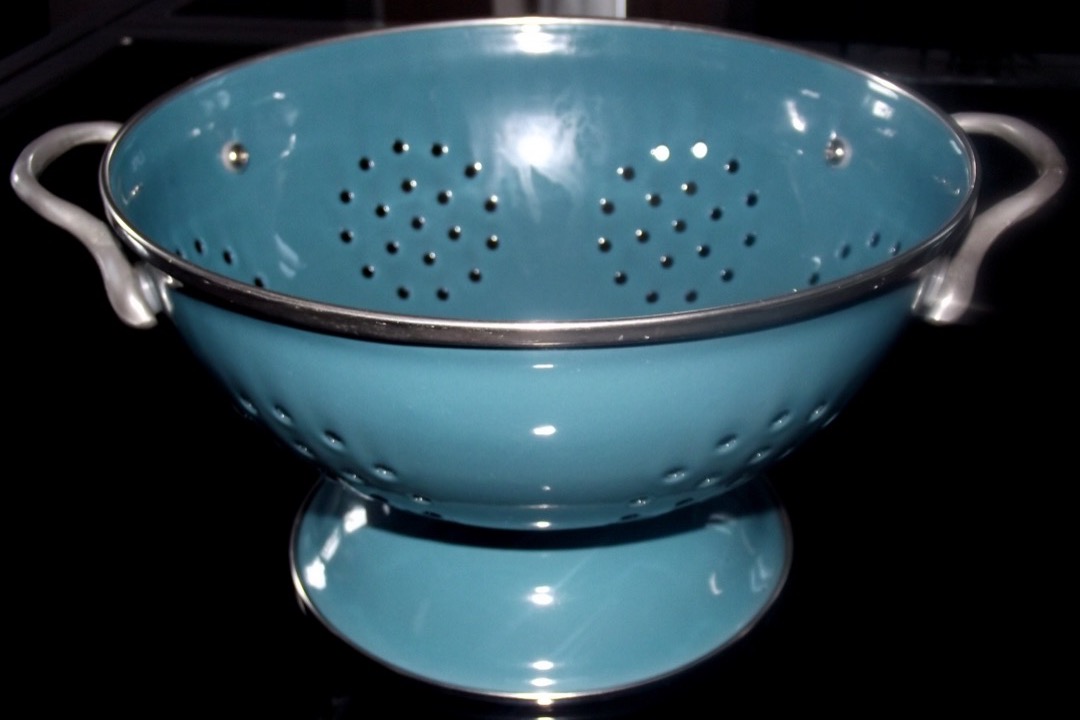
A colander is the tool every kitchen owns and almost nobody chooses. It arrives in a housewarming box or gets grabbed off a shelf on the way to the checkout, and then one morning you tip a pot of rinsed rice into it and watch a third of your breakfast disappear down the drain. That is not bad luck. It is the one specification that decides whether a colander works for you, and it is the one almost no listing in this category will tell you: how big the holes are relative to what you are putting in.
Standard punched perforations are larger than a grain of rice. They are larger than quinoa, couscous, amaranth and orzo too. Only a true woven-mesh sieve holds those reliably, and the labelling in this category actively works against you, because titles routinely say mesh strainer over a photograph of a stamped steel bowl. In a restaurant test kitchen the fix was simply owning both tools and knowing which was which. At home, most people own one bowl and expect it to do everything. So the best colander for you depends less on brand than on whether you are draining pasta, rinsing grains, or trying to do both with one purchase. If grains are the main event in your kitchen, our rice to water ratio guide covers the other half of that problem.
I compared eight options for 2026 across every format that makes sense: rigid footed steel at three price tiers, an over-the-sink expandable basket, a collapsible silicone bowl, a genuine fine-mesh sieve set, a microwave pasta cooker for kitchens with no stovetop, and a lightweight plastic strainer for anyone who finds a full steel bowl of boiling pasta hard to lift. Every listing was verified live in a browser before it went on this page. One product came out of the lineup late for a reason worth stating: it was live and buyable, but invisible to Amazon’s own product API, which means its displayed price could never be kept current here. I would rather show you eight products whose prices stay honest than nine where one quietly rots.
| Product | Price | Buy |
|---|---|---|
| OXO Good Grips Strainer - 5 Qt Capacity, Stainless SteelBest Overall | $31.95 | View on Amazon |
| EXCELSTEEL Heavy Duty Stainless Steel Colander 5 QtBudget Pick | $12.99 | View on Amazon |
| Bellemain Stainless Steel Colander for Kitchen, 5 Qt Pasta & Rice StrainerPremium Pick | $23.95 | View on Amazon |
| U.S. Kitchen Supply Stainless Steel Colander Strainer, 6 QtRunner-Up | $19.99 | View on Amazon |
| Comfify Gray Collapsible Silicone Over-Sink Colander - 6 QtRunner-Up | $18.99 | View on Amazon |
| Cuisinart Mesh Strainers, Stainless Steel, Dishwasher Safe, 3-CountRunner-Up | $15.88 | View on Amazon |
| Fasta Pasta Original Microwave Pasta Cooker with Built-In StrainerRunner-Up | $19.95 | View on Amazon |
| OXO Good Grips Plastic Strainer - 3 Qt Capacity, WhiteRunner-Up | $11.99 | View on Amazon |
Find the Best Colander for Your Need
Jump straight to the job you are actually trying to do.
- Best colanders overall
- Best stainless steel colander
- Best colander for pasta
- Best collapsible colander
- Best over-the-sink colander
- Best colander for rice and small grains
- Best non-toxic colander
- More use cases
How We Chose These Colanders
America’s Test Kitchen sets the methodology bar in this category, and it is a high one: weighed loads of a pound of angel hair and a pound of orzo to see what passes through, three drop tests onto a hard floor, and ten dishwasher cycles to see what dulls or loosens. What their testing does not do is cover much ground, since it reviews six products with a paragraph each. So the useful contribution here is breadth and specificity rather than a duplicate bench test, and I have been explicit throughout about which statements are physical facts about a design and which are claims a manufacturer makes.
Four things were weighed for every product. Hole size against grain size, because that is the decision that actually determines whether a colander is right for your kitchen. Base stability under a full pot, treated as the burn risk it genuinely is rather than a note about wobble. Stated steel grade versus vague stainless, which separates the listings that specify an alloy from the ones that use adjectives. And handle attachment, because riveted handles through a bowl outlast handles spot-welded to it, and a sheared weld is what turns a full colander into a spill. Every ASIN was then verified as a live, buyable, in-stock listing in a browser rather than trusted from an API. Ratings and review counts are recorded as they stood at publication, and prices refresh automatically, so the table is current rather than frozen at the day this was written.
Best Colanders Overall
Eight picks, each reviewed once, in the order I would consider them.
OXO Good Grips 5 Qt Stainless Strainer: Best Overall
The detail that earns this the top spot is not visible in a photograph and matters more than anything that is. The three feet are formed as part of the bowl rather than welded on as separate pieces. Welded feet are the classic failure of cheap footed colanders: one shears off, usually while the bowl is full and hot, and what was a stable pedestal becomes a tipping bowl. A molded foot cannot fail that way. It is the sort of construction choice you only appreciate on the third colander you have owned.
Five quarts is the right size for most households. A pound of dried pasta plus the water it came with fits without riding the rim, and the bowl still washes and stores sensibly. The nesting is a genuine convenience rather than a marketing line, since it drops inside OXO’s mixing bowls and takes up shelf space that was already committed. The 3 Qt version of the same design exists too, which means you can own the small one for berries and herbs and the large one for pasta rather than compromising on a single middling size. It is also sold and shipped by Amazon, which in a category where third-party storefronts rotate constantly is worth real money in returns and replacements.
The limitation is the one that applies to nearly everything here. The perforations are standard size, so this drains pasta, potatoes, greens and beans beautifully and passes rice, quinoa and couscous straight through. Buy it as your primary colander and buy a fine sieve alongside it. The soft handle inserts also collect a grease film that a rinse will not shift, so they want an occasional scrub with the rest of the washing up.
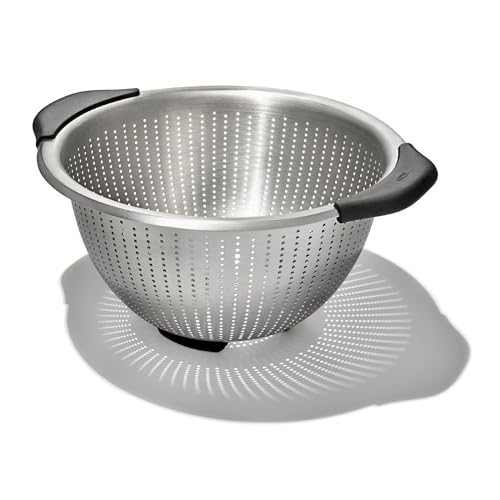
OXO Good Grips Strainer - 5 Qt Capacity, Stainless Steel
by OXO
The best colander overall: molded feet that will not snap off, a size ladder so you are not draining a handful of berries in a five-quart bowl, and the cleanest ownership path in the category.
Pros
- The three feet are molded as part of the bowl rather than welded on afterwards, and a snapped-off welded foot is the single most common way a cheap footed colander dies
- It nests inside OXO's mixing bowls, so a five-quart colander stores in space a five-quart bowl already occupies instead of eating a whole cupboard shelf
- The same design is sold in a 3 Qt size, so you can match the bowl to the batch rather than washing a large one to drain a cup of berries
- Sold and shipped by Amazon, which in a category full of rotating third-party storefronts means a return or a replacement is a two-click job
Cons
- The perforations are standard size, so rice, quinoa, couscous and orzo will go straight through them; this is a pasta and vegetable colander, not a grain strainer
- Five quarts is the practical ceiling, and a full pound of long pasta plus its water sits close to the rim
- The soft handle inserts hold a grease film and want a scrub rather than a rinse
ExcelSteel Heavy Duty 5 Qt Colander: Best Budget
At the price where most of the shelf turns to plastic, this is real mirror-polished steel with a self-draining footed base, and that combination is unusual enough to be the whole argument. A footed base at this price means the bowl sits above whatever is pooled in the bottom of your sink rather than in it, which is the difference between drained pasta and pasta sitting back in its own starchy water. More than eight thousand reviews is also the deepest owner record in the budget tier by a wide margin, and it has accumulated over years rather than in one launch window.
It is fulfilled by Amazon, which matters more at this end of the market than anywhere else. Cheap kitchen steel is exactly where reseller and open-box buy boxes cause trouble, and a listing that ships from Amazon directly removes that variable. For a household that wants a functional steel colander and nothing more, this is the sensible stopping point.
Two things to be straight about, and they are related. The listing names no steel grade at all. There is no 304 and no 18/8 claim on it, so you are trusting a finish rather than a specification. The gauge is also visibly thinner than the premium picks, which you feel as flex when you carry the bowl full, and thin steel is where riveted handles start to work loose over a few years. None of that makes it a bad buy at this price. It does mean the premium tier is buying you metal thickness and, in fairness, no more clarity about the alloy.
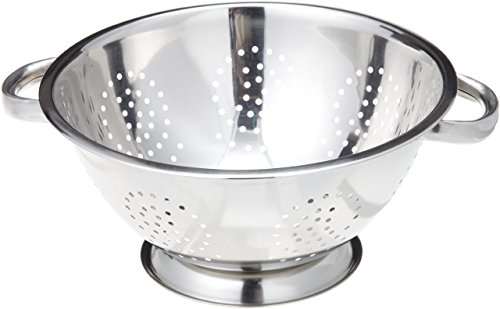
EXCELSTEEL Heavy Duty Stainless Steel Colander 5 Qt
by ExcelSteel
The best value colander here: real polished steel and a self-draining footed base at a price where most of the shelf is plastic, with the honest caveat that no alloy grade is stated anywhere.
Pros
- More than eight thousand reviews is by far the deepest owner record in the budget tier here, and it spans years rather than one listing's launch window
- A self-draining footed base is unusual below the twenty-dollar mark, and it is what keeps the bowl clear of the starchy water that just came off your pasta
- It is genuinely mirror-polished steel rather than the plastic bowls that dominate this price band, so it will not warp against a hot pot or scuff white under a spoon
- Fulfilled by Amazon, which matters more at this price than at any other, because cheap kitchen steel is where reseller buy boxes do the most damage
Cons
- The listing names no steel grade at all, so there is no 304 or 18/8 claim to hold it to; the finish is right and the alloy is simply unstated
- The gauge is visibly thinner than the premium picks, and a thin bowl flexes noticeably when you carry it full
- Handle rivets are the wear point at this tier, and a rivet working loose is the failure owners report most often
Bellemain 5 Qt Stainless Colander: Best Upgrade
The upgrade pick buys you three specific things: a heavier bowl, a solid ring base instead of three feet, and perforations noticeably finer than anything else rigid on this page. The ring base is the one I would pay for. Three feet are stable in a level sink; a continuous ring is stable everywhere, because contact is distributed all the way around rather than at three points, and that matters when six quarts of boiling water arrives at once and you are holding the bowl by two handles. Handles are riveted through the bowl rather than welded to it, which is the attachment that survives.
The interesting claim, and the one buyers should understand precisely, is that those micro-perforations are safe for rice and quinoa. That would be unusual for a bowl that is punched rather than woven. The holes are genuinely fine, so the claim is plausible, but it is the manufacturer’s claim and not a result we tested. If rinsing rice is a regular job in your kitchen, buy the fine-mesh sieve set below for that specific task and treat this as your pasta colander. If it happens once a month, the Bellemain will probably manage it and the risk is a small amount of rice.
The other honest note is about the steel. The listing describes premium-grade steel, which is an adjective rather than a certification, and no alloy number appears on it anywhere. That puts it in the same position as the budget pick: a fine finish, an unstated alloy. Almost eight thousand reviews at 4.7 stars is the second-deepest record on this page and the strongest reason to trust the build. The buy box is third-party, so returns run through the seller rather than Amazon.

Bellemain Stainless Steel Colander for Kitchen, 5 Qt Pasta & Rice Strainer
by Bellemain
The upgrade pick: a heavier bowl on a no-tip ring base with the finest perforations of any colander here, and the only one that even claims to hold rice.
Pros
- Close to eight thousand reviews holding at 4.7 stars is the second-deepest record on this page, which is unusual for a product sitting at the premium end of a commodity category
- The perforations are visibly finer than a standard colander's, which is the basis for the brand's claim that it holds rice and quinoa
- A solid no-tip ring base keeps the bowl level in a sink rather than rocking on three contact points, which is what you want when six quarts of boiling water arrives at once
- Riveted handles through a heavier bowl, and a polished interior that does not hold onion or garlic odour the way a brushed finish does
Cons
- The rice and quinoa claim is the manufacturer's, not a result we tested; for grains specifically a true woven-mesh sieve remains the safer buy
- The listing's premium-grade steel language is marketing phrasing rather than a certification, and no alloy number appears anywhere on it
- The buy box is held by a third-party seller, so returns and replacements run through them rather than Amazon
U.S. Kitchen Supply 6 Qt Stainless Strainer: Best Over-the-Sink
Over-the-sink colanders solve a specific irritation. A bowl set down in the sink drains into standing water and needs a free hand to steady it; a basket bridging the rim drains straight to the plughole and leaves both hands free to shake it. The sub-category is otherwise almost entirely anonymous sellers with three-figure review counts, and this one is the exception worth knowing about: better than ten thousand owners on a design that has been sold unchanged for years.
The part that makes it more useful than the rest of the format is the basket itself. It is fine woven mesh rather than a punched sheet, which means it does the one job a standard colander cannot: rice, quinoa and orzo stay in it instead of going down the drain, so it doubles as the sieve you would otherwise buy separately. Six quarts across a thirteen by nine rectangle, on handles that extend from fourteen to twenty-one inches, covers most domestic single-bowl and double-bowl sinks. If you cook a lot of pasta and your sink is deep, this format also spares you the awkward lift of a heavy bowl out of a low basin, which is worth as much as the drainage.
Three limits worth knowing before you buy. The basket is three and a half inches deep, which is shallow next to a bowl colander, so a full pot of pasta wants pouring in two goes rather than one confident dump. The rubber grips on the handles are the wear point on every expandable strainer and they are not a replaceable part, which is the thing to check first on any model in this format. And U.S. Kitchen Supply is not a household name, with the listing sold by TCP Global Corp rather than by the brand, so the warranty path here is thinner than it would be behind an OXO. If most of your draining happens next to the hob rather than at the sink, our best wok guide covers the pan side of that workflow.

U.S. Kitchen Supply Stainless Steel Colander Strainer, 6 Qt
by U.S. Kitchen Supply
The best over-the-sink colander: a six-quart fine-mesh stainless basket on rubber handles that extend to bridge almost any sink, with a ten-thousand-review record behind it and a mesh fine enough to rinse rice.
Pros
- The rubber handles extend from fourteen to twenty-one inches, so one basket bridges most single-bowl and double-bowl domestic sinks
- The basket is fine woven mesh rather than punched perforations, which means it holds rice, quinoa and orzo that a standard colander pours straight down the drain
- Draining over the sink rather than into it means food never sits in the water it just left, and both hands stay free to shake the basket
- Resting feet under a flat thirteen by nine basket keep it stable when it is loaded, and the whole unit goes in the dishwasher
Cons
- The basket is three and a half inches deep, so a full pot of pasta wants pouring in stages rather than all at once
- Rubber handle grips are the wear point on every expandable strainer, and they are not a replaceable part
- U.S. Kitchen Supply is not a household name and the listing is sold by TCP Global Corp rather than the brand, so the warranty path is thinner than a KitchenAid or an OXO
Comfify Collapsible Silicone 6 Qt Colander: Best Collapsible
Collapsible colanders exist for one reason: storage. This one folds to about an inch and a half flat, which means it lives in a drawer, an RV cabinet or a camper galley instead of consuming the shelf that a rigid bowl demands. What makes it genuinely interesting is that it manages six quarts while doing so, which is the largest capacity of anything on this page. A folding silicone bowl outsizing every rigid steel colander here is a slightly absurd outcome, and it says more about the current state of the category than about silicone.
The listing deserves credit for something rare. It states outright that the bowl is not for fine grains. Nearly every other product in this category either says nothing about hole size or actively muddies it with mesh in the title, so a manufacturer telling you plainly what its product cannot do is a signal worth rewarding. The handles also extend to bridge a sink of up to roughly twenty-five inches, so it doubles as an over-the-sink basket when it is open.
Silicone has a known wear pattern and it is worth planning for. The fold crease is where the material fatigues, and splitting after one to two years of heavy use is what owners report across every brand using this format, not just this one. Food debris trapped in the folds can also grow mould if the bowl goes away damp, so it wants opening out to dry. There is no pour spout either, so tipping a full bowl back to serve tends to spill down the side. Treat it as a storage-first colander with a finite life rather than a lifetime purchase.
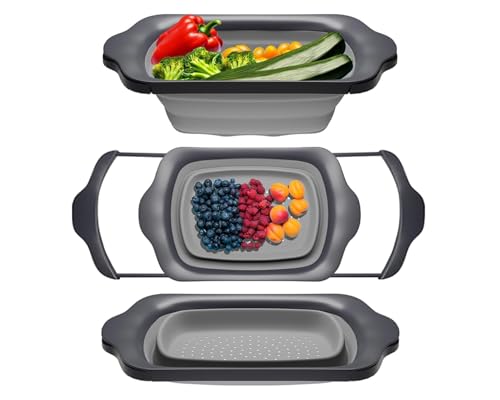
Comfify Gray Collapsible Silicone Over-Sink Colander - 6 Qt
by Comfify
The best collapsible colander and, oddly, the highest-capacity bowl here: six quarts that fold flat into a drawer, with a listing honest enough to warn you off grains.
Pros
- Six quarts is the largest capacity on this page, which is a strange thing to find on a colander that folds down to about an inch and a half flat
- It collapses into a drawer, an RV cabinet or a camper galley, which is the entire reason this format exists and the one thing no rigid bowl can do
- The handles extend to bridge a sink up to roughly twenty-five inches, so it works over the sink as well as in it
- The listing states plainly that it is not for fine grains, and almost nothing else in this category is honest enough to say so
Cons
- Silicone eventually splits along the fold crease, and one to two years of heavy use is the pattern owners report across every brand using this format
- There is no pour spout, so tipping a full bowl back to serve tends to spill down the side
- The holes are medium to large, so rice, couscous and orzo go straight through
Cuisinart 3-Piece Mesh Strainer Set: Best for Rice and Small Grains
This is the tool that fixes the problem the rest of this page cannot. It is genuinely woven mesh, not a punched bowl with a mesh label, and woven wire is the only construction that reliably holds rice, quinoa, couscous, amaranth and small seeds. If you have ever lost rice down the drain, this is the purchase that ends it, and it costs less than most single colanders.
Three sizes is the right answer rather than a bundling trick. The smallest handles a tea infusion or catching lemon seeds out of a dressing. The middle one is the everyday grain rinser. The largest takes a full batch of rice for a household. A fine sieve also does jobs a colander cannot touch at all: sifting flour, straining a stock or a custard, dusting sugar over a tart, and sitting over a frying pan as a splatter screen. Nearly thirty-five thousand reviews is the deepest owner record on this page by a wide margin, which is what you would expect from a design that has been in kitchens for years. It pairs naturally with a rice cooker, since rinsing is the step that decides how the finished grain behaves.
Understand what you are giving up. There is no base of any kind. Every sieve here is held in one hand or balanced on the rim of a bowl, which is a real ergonomic difference from setting a footed colander down in the sink and walking away. This is also not a colander substitute when a whole pot of pasta and four quarts of boiling water is coming at it, and trying to make it one is how people get burned. Buy it alongside a colander, not instead of one. Starch and seeds also lodge in the weave, so it wants a brush and a back-flush under the tap rather than a wipe.

Cuisinart Mesh Strainers, Stainless Steel, Dishwasher Safe, 3-Count
by Cuisinart
The only thing on this page that will actually hold rice: true woven mesh in three sizes, backed by the deepest review record in the category.
Pros
- This is genuinely woven mesh rather than a punched bowl, which is the only construction that reliably holds rice, quinoa, couscous and small seeds
- Nearly thirty-five thousand reviews is the largest owner record of anything on this page, by a wide margin
- Three sizes from about three inches to just under eight cover straining tea, catching lemon seeds and rinsing a full batch of grain
- Fine mesh doubles as a flour sifter and a splatter screen, so one set retires two other tools in a small kitchen
Cons
- There is no base at all, so every sieve has to be held or balanced on a bowl rim, which is a real ergonomic difference from a footed colander
- It is not a substitute for a colander when a whole pot of pasta and its boiling water is coming at it
- Starch and small seeds lodge in the weave and need a brush and a back-flush rather than a wipe
Fasta Pasta Microwave Pasta Cooker: Best for a Microwave
This is not a colander and it should not be judged as one. It is a cooking vessel with a strainer designed into it, and the reason it belongs on this page is that a lot of people searching for a way to drain pasta do not actually have a stovetop. Dorm rooms, office kitchens, hotel suites, boats and RVs all have a microwave and a tap and nothing else. In those kitchens this solves the whole problem in one object.
The reservoir design is the clever part. Rather than tipping four quarts of boiling water over a sink you may not be able to reach, the drained water collects in a separate chamber and the pasta stays behind. More than five thousand reviews for a single-purpose niche product is a real long-run record rather than a launch spike, and it is the same design that has been sold for years instead of a rotating anonymous mould. The listing states it is made in the USA.
Its limits are the obvious ones. Capacity is about a pound of pasta and it does not scale past that, so it is a one-or-two-serving tool rather than a family batch. The printed cooking times are the other catch, and it is the one that generates most of the complaints: they assume a microwave near 1,100 watts, and a dorm or office unit is often 700, which leaves the pasta genuinely undercooked through no fault of the cooker. Our free microwave wattage converter turns the box time into the time your own oven needs, and will measure your wattage with a jug of water if the label only gives you the input figure. It will not take a colander’s other jobs, so washed salad greens, drained beans and rinsed berries all still want a bowl with holes in it. And the buy box is third-party, so returns run through the seller rather than Amazon. Buy it because you have no hob, not as an upgrade over a colander.

Fasta Pasta Original Microwave Pasta Cooker with Built-In Strainer
by Fasta Pasta
The answer for a kitchen with no stovetop: cook and strain a pound of pasta in the microwave, in a design that has quietly sold for years.
Pros
- It cooks and strains pasta in a microwave with no stovetop involved, which genuinely solves a dorm room, an office kitchen, a hotel suite or an RV
- The patented reservoir holds the drained water in a separate chamber, so you are not tipping boiling water over a sink you may not have
- More than five thousand reviews for a single-purpose niche product is a real long-run record rather than a launch spike
- Made in the USA per the listing, and it is the same design that has been sold for years rather than a rotating generic mould
Cons
- It is a cooking vessel with a strainer built in rather than a colander, so it will not take a batch of washed greens or drained beans
- Capacity sits well under a family batch; it handles about a pound of pasta and does not scale past that
- The buy box is held by a third-party seller, so returns run through them
OXO Good Grips 3 Qt Plastic Strainer: Best Lightweight
There is a buyer for this product that the rest of the category ignores, so I will name them plainly. If you have wrist pain, arthritis, reduced grip strength, or you are cooking one-handed, the weight of a full steel colander of boiling pasta is not a minor detail. It is the reason the pot gets left on the hob until someone else can help. This weighs a fraction of every steel bowl on this page, and that is a genuine accessibility argument rather than a compromise.
The rest of the design supports the same idea. The non-slip handles stay grippy when they are wet, which is precisely the moment a heavy colander slips out of somebody’s hands. The feet are contoured into the base rather than raised on a pedestal, so it is stable in the sink but stacks and stores easily. Plastic will also never rust or pit, so putting it away slightly damp does no harm, and it will not hold onion odour. At three quarts it is the right size for berries, herbs, a tin of beans or a couple of servings of pasta.
Two honest limits. Three quarts fills fast, and a full pound of long pasta is more than it takes comfortably, so this works better as a second colander in a busy kitchen or as the only colander in a small one. And plastic scratches and discolours over years of tomato sauce and other high-acid food, which is cosmetic rather than structural but it does happen. The holes are standard elongated perforations, so grains go through them like every other punched bowl here.
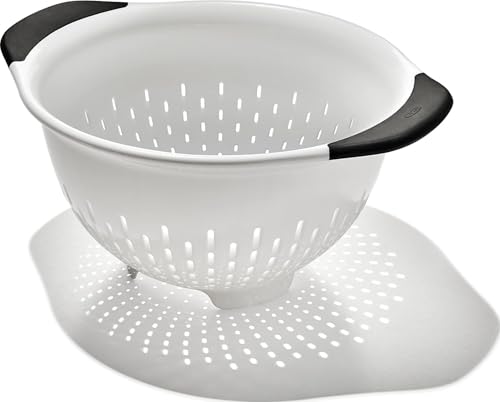
OXO Good Grips Plastic Strainer - 3 Qt Capacity, White
by OXO
The lightest colander here and the one I recommend for anyone who finds a full steel bowl of boiling pasta genuinely hard to lift.
Pros
- It weighs a fraction of every steel bowl here, which is a real accessibility point for anyone with wrist pain or limited grip strength lifting a colander of hot pasta
- The non-slip handles stay grippy when they are wet, which is precisely the moment a heavy colander gets dropped
- Contoured feet give it stability in the sink without the tall pedestal that makes footed colanders awkward to stack
- Plastic will not rust, pit or hold onion odour, so it survives being put away slightly damp in a way thin steel does not
Cons
- Three quarts fills fast, and a full pound of long pasta is more than it takes comfortably
- Plastic scratches and discolours over years of tomato sauce and other high-acid use
- The elongated holes are standard size, so grains go through them like any other perforated bowl
Best Stainless Steel Colander
Steel is the default for good reasons. It will not warp when boiling water hits it, it does not scratch pale under a metal spoon, it does not stain, and it does not put any plastic or silicone against hot food. What steel will not tell you, at least not in this category, is what alloy it is. 18/8 and 304 are two names for the same thing, eighteen percent chromium and eight percent nickel, and that is the grade you want for anything meeting salt, tomato and boiling water. The budget pick here names no grade at all, and the premium pick uses adjectives rather than a number. That absence is the honest finding, and it is why review depth and construction details are doing the work that a spec sheet should.
Choose on base and gauge instead. A solid ring base is the most stable and the safest under a full pot; three molded feet are nearly as good and easier to store; and gauge is what you feel as flex when you carry the bowl full. As a rough field check on any steel bowl, a strong magnet clings hard to the ferritic 400-series steels and only weakly, if at all, to 304.
| Product | Price | Buy |
|---|---|---|
| OXO Good Grips Strainer - 5 Qt Capacity, Stainless SteelBest stainless colander overall Molded feet rather than welded ones, so the classic footed-colander failure cannot happen | $31.95 | View on Amazon |
| EXCELSTEEL Heavy Duty Stainless Steel Colander 5 QtBest value in steel Real polished steel with a self-draining base at the price where the shelf turns to plastic | $12.99 | View on Amazon |
| Bellemain Stainless Steel Colander for Kitchen, 5 Qt Pasta & Rice StrainerBest premium steel Heavier gauge on a solid no-tip ring base, with the finest perforations of any rigid bowl here | $23.95 | View on Amazon |
Best Colander for Pasta
Pasta is the load that decides a colander. It arrives hot, heavy and all at once, so what matters is a bowl that does not shift as it lands, holes large enough that four quarts of water leaves faster than it pours in, and enough capacity that you are not shaking a bowl filled to the rim. Five quarts handles a pound of dried pasta and its water without drama, which is why that size is the everyday answer for most households.
There is something worth saying plainly about capacity here. The biggest bowl on this page is not a rigid steel colander, it is a silicone one that folds flat, and that is not an accident of my selection. A single-piece steel colander above five quarts with a review record deep enough to trust is genuinely hard to buy right now, which is a real gap in the category rather than an oversight in this guide. If you cook for a crowd, the six-quart folding bowl is the honest recommendation, with the trade-off that silicone has a finite life. And if you have no stovetop at all, the third option below cooks and drains in a microwave.
| Product | Price | Buy |
|---|---|---|
| OXO Good Grips Strainer - 5 Qt Capacity, Stainless SteelBest everyday pasta colander Five quarts takes a pound of pasta and its water on a stable molded-foot base | $31.95 | View on Amazon |
| Comfify Gray Collapsible Silicone Over-Sink Colander - 6 QtBest for a large batch Six quarts is the largest capacity here, from a silicone bowl that folds into a drawer afterwards | $18.99 | View on Amazon |
| Fasta Pasta Original Microwave Pasta Cooker with Built-In StrainerBest with no stovetop Cooks and strains about a pound of pasta in a microwave, for a kitchen with no hob | $19.95 | View on Amazon |
Best Collapsible Colander
Only one product on this page genuinely folds flat, and I would rather say that than pad the section. Two listings here carry the word collapsible; on the U.S. Kitchen Supply strainer it means the handles retract, not that the basket folds. The Comfify silicone bowl folds to roughly an inch and a half and holds six quarts open, which is the combination that makes the format worth owning at all: full working capacity that stores like a chopping board. Buy it if a drawer is all the space you have, or if the kitchen in question is in a camper, a boat or a holiday let.
Since the true folding options thin out fast, the sensible alternatives are the next-best space savers rather than pretenders. An over-the-sink basket takes no cupboard space while draining because it bridges the sink and stows against a wall or in a deep drawer when its arms are retracted. A small plastic strainer nests and stores close to flat, weighs almost nothing, and is the easiest thing here to keep in a caravan locker. Neither one folds, and neither will pretend to.
| Product | Price | Buy |
|---|---|---|
| Comfify Gray Collapsible Silicone Over-Sink Colander - 6 QtBest collapsible colander Folds to about an inch and a half flat and still holds six quarts open, the only true collapsible here | $18.99 | View on Amazon |
| U.S. Kitchen Supply Stainless Steel Colander Strainer, 6 QtNext best space saver Its title says collapsible, but what collapses is the handles: they retract so the basket drops inside the sink basin to store | $19.99 | View on Amazon |
| OXO Good Grips Plastic Strainer - 3 Qt Capacity, WhiteBest light and stackable option Does not fold either, but it is light, nests, and stores nearly flat in a small kitchen | $11.99 | View on Amazon |
Best Over-the-Sink Colander
Measure your sink before you shop, because this is the one format where a specification can simply not fit. Take a tape across the rim at the widest span you would want the colander to bridge, inside edge to inside edge, and write that number down. Then check it against the extension range rather than the maximum figure in the listing title. An expandable colander that only just reaches has almost no bearing surface on each rim, which is precisely the setup that slips when a full basket lands on it.
Both picks bridge a sink, and they do it differently. A rigid stainless basket on extending handles gives the most secure seat and holds its shape under a full load, and it is the only one of the two whose mesh is fine enough to rinse grain. A silicone bowl on extending handles is more forgiving of an odd sink shape and stores far smaller, at the cost of a basket that flexes more when it is loaded. Handles that sag, loosen or lose their grips is the failure to watch for on either, and it is the reason to check the review depth rather than the listing photograph in this format.
| Product | Price | Buy |
|---|---|---|
| U.S. Kitchen Supply Stainless Steel Colander Strainer, 6 QtBest over-the-sink colander Rubber handles extend from fourteen to twenty-one inches, on a fine mesh basket that also holds rice and quinoa | $19.99 | View on Amazon |
| Comfify Gray Collapsible Silicone Over-Sink Colander - 6 QtBest over-sink option that also stores flat Handles extend to bridge a sink up to about twenty-five inches, then the whole bowl folds away | $18.99 | View on Amazon |
Best Colander for Rice and Small Grains
This section has a clear answer and it is not a colander. Rinsing rice, quinoa, couscous, amaranth or orzo needs woven wire mesh, because punched perforations in a standard colander are simply larger than the grain. The Cuisinart set is real woven mesh in three sizes, it costs less than most single colanders, and it is the purchase that ends the problem permanently. Use the largest sieve for a household batch and the middle one for a cup or two.
Two other options on this page get partway there. The U.S. Kitchen Supply over-sink strainer is genuine woven mesh and will hold grain, though a rectangular basket bridging the sink is a clumsy way to rinse a single cup. And the Bellemain, whose listing claims its micro-perforations are safe for rice and quinoa. That is the manufacturer’s claim rather than a tested result, and it is worth flagging that the mislabelling in this category runs the other way too: plenty of products carry mesh in the title over a photograph of a stamped bowl. Look at the picture and decide whether you are seeing woven wire or a punched sheet. If rinsing grain happens daily in your kitchen, buy the mesh. If it happens occasionally and you would rather own one bowl, the fine-perforated colander is a reasonable bet. Rinsing changes how the finished grain behaves, which our rice to water ratio guide gets into properly. Weighing the grain rather than scooping it removes the other half of the guesswork, and our free kitchen conversion chart prints what a cup of each grain actually weighs alongside the volume ladder, in whichever cup your recipes are written for.
| Product | Price | Buy |
|---|---|---|
| Cuisinart Mesh Strainers, Stainless Steel, Dishwasher Safe, 3-CountBest for rice and small grains True woven mesh in three sizes, the only construction here that reliably holds rice and quinoa | $15.88 | View on Amazon |
| Bellemain Stainless Steel Colander for Kitchen, 5 Qt Pasta & Rice StrainerBest colander that claims to hold rice Micro-perforations the brand states are safe for rice and quinoa; plausible, but the claim is theirs, not our test result | $23.95 | View on Amazon |
Best Non-Toxic Colander
The real question behind this search is straightforward: what touches my food when it is hot. Stainless steel is the answer, because it puts no plastic or silicone against boiling pasta or water, it does not leach, and it does not absorb odours or stain. That holds regardless of alloy grade, and it is why all three picks here are steel bowls. If this is your priority, buy steel and stop thinking about it.
The rest deserves a calm framing rather than an alarm. The plastic and silicone picks on this page are BPA-free and made of food-grade materials, which means choosing steel over them is a preference about what you want against hot food, not a safety warning about the alternatives. Practical hygiene matters more than material anxiety in a colander: dry steel before you put it away so the chromium layer stays intact, open silicone out to dry so the folds do not grow mould, and replace any bowl whose surface is visibly pitted or deeply scratched, since damage is what gives residue somewhere to sit.
| Product | Price | Buy |
|---|---|---|
| OXO Good Grips Strainer - 5 Qt Capacity, Stainless SteelBest non-toxic colander All-steel bowl with molded feet, so nothing plastic meets hot food or hot water | $31.95 | View on Amazon |
| EXCELSTEEL Heavy Duty Stainless Steel Colander 5 QtBest value all-steel option Mirror-polished steel throughout at a price where most of the shelf is plastic | $12.99 | View on Amazon |
| Bellemain Stainless Steel Colander for Kitchen, 5 Qt Pasta & Rice StrainerBest premium all-steel option Heavier polished bowl on a solid steel ring base, with a finish that resists odour | $23.95 | View on Amazon |
Best Colanders by Use Case
A few more situations that come up often enough to name, each with the pick I would actually point you at.
| Product | Price | Buy |
|---|---|---|
| Cuisinart Mesh Strainers, Stainless Steel, Dishwasher Safe, 3-CountBest colander set and best berry colander Three woven-mesh sizes in one box, and fine enough to rinse berries and small seeds without losing any | $15.88 | View on Amazon |
| OXO Good Grips Strainer - 5 Qt Capacity, Stainless SteelBest colander with a handle Two sturdy handles on a five-quart steel bowl, which is what you want carrying a hot load from hob to sink | $31.95 | View on Amazon |
| OXO Good Grips Plastic Strainer - 3 Qt Capacity, WhiteBest small colander and best plastic colander Three quarts of light BPA-free plastic that nests, stores nearly flat and never rusts | $11.99 | View on Amazon |
Buyer's Guide
Almost nobody chooses a colander deliberately, which is why so many kitchens own one that cannot do the job they bought it for. Six things decide whether you end up with the right bowl, and the first one is the one nearly every listing declines to talk about.
Hole size versus what you are actually straining
This is the decision the category hides from you. Standard punched perforations are larger than a grain of rice, so rice, quinoa, couscous, amaranth and orzo pour through them. Only true woven mesh holds those reliably. Micro-perforated bowls sit in between and some claim to manage grains, but the claim is rarely tested and never specified in millimetres. Compounding this, product titles in this category routinely say mesh strainer when the item is a punched bowl, which is precisely how buyers end up watching rice disappear down the drain. Look at the photograph and decide for yourself whether you are seeing woven wire or a stamped sheet.
Footed versus flat base
This reads like a footnote and it is really a burn-and-stability question. Six quarts of pasta water weighs a good deal and arrives fast, and a bowl that shifts or tips as it lands puts boiling water on your wrist. Feet or a solid ring also lift the bowl clear of whatever is already pooled in the sink, so drained food is not sitting back in its own starchy water. A solid ring is the most stable because it distributes contact all the way around; three feet are nearly as good and store more easily; a flat-bottomed bowl with holes in the base drains poorly in a sink with standing water.
Steel grade and what stainless actually promises
18/8 and 304 are two names for the same alloy, eighteen percent chromium and eight percent nickel, and it is the grade you want for anything that meets salt, tomato and boiling water. The problem is that the cheap end of this category simply declines to state a grade at all, and the premium end often substitutes marketing phrasing like premium-grade steel with no alloy number attached. Neither absence proves anything is wrong, but it does mean you are trusting a finish rather than a specification. As a rough field check, a strong magnet clings hard to the ferritic 400-series steels and only weakly, if at all, to 304. Pitting or rust spots on a bowl sold as stainless mean the chromium layer has been broken, usually by prolonged contact with salt or by being stored wet.
Capacity matched to your household
Five quarts is the sweet spot for most homes: it takes a pound of dried pasta plus its water without riding the rim. Three quarts is right for one or two people and for berries, herbs and a tin of beans, and it washes and stores far more easily. Six quarts and up starts to be genuinely useful for a family batch, and it is worth knowing that a single-piece rigid steel colander above five quarts with a review record worth trusting is surprisingly hard to buy at the moment. Undersizing is the more common mistake, because a colander filled to the brim spills as you shake it.
Colander or strainer, and why you probably want both
These are two tools, not two names for one. A colander takes weight and volume and stands on its own, which is what a whole pot of pasta needs. A sieve is fine woven mesh on a handle, which is what rice, stock, custard and flour need. Buying only the colander means grains go down the drain; buying only the sieve means you are trying to catch four quarts of boiling water in something you have to hold. Together they cost less than most single premium colanders and cover the whole range of jobs.
Cleaning, staining and long-term wear
Each construction fails in its own way and knowing which one tells you what to inspect. Riveted handles on thin steel work loose, so check whether handles are riveted through the bowl or spot-welded to it, since welds are the ones that shear. Collapsible silicone splits along the fold crease after a year or two of heavy use, and food debris trapped in the folds can grow mould if the bowl is put away damp. Plastic scratches and yellows against high-acid food. Woven mesh traps starch and seeds in the weave and needs a brush and a back-flush under the tap rather than a wipe. Steel simply needs to be dried before it is put away, and it will outlast everything else here.
How to Choose the Best Colander
Start with what you strain most often, because that single answer decides the shape of your purchase. Pasta, potatoes, greens and beans mean a rigid five-quart bowl on feet or a ring, and any of the steel picks here will serve for years. Rice and small grains mean woven mesh and nothing else will do. If both are regular jobs, buy both; a mesh sieve set costs less than most single colanders and the pair covers everything a home kitchen throws at it.
Then work through three practical filters. Capacity, where five quarts suits most households and three quarts suits one or two people and small jobs, remembering that undersizing is the more common regret. Base, where a solid ring is the most stable under a hot load, molded feet are nearly as good and store better, and anything welded on is the part that eventually shears. Storage and weight, which is where over-the-sink baskets, folding silicone and light plastic each earn their place. And if you are working the other end of the prep, our best food processor picks handle what happens before anything reaches the colander.
Final Verdict
The OXO Good Grips 5 Qt stainless strainer is the colander I would put in most kitchens. Feet molded into the bowl remove the failure that ends cheap footed colanders, five quarts is the right size for a pound of pasta and its water, it nests inside mixing bowls instead of claiming its own shelf, and it ships from Amazon so a problem is easy to resolve. If you want to spend as little as possible, the ExcelSteel 5 Qt is the value pick: real polished steel and a self-draining footed base at a price where most of the shelf is plastic, with the honest caveat that no alloy grade appears on the listing anywhere.
Whichever bowl you buy, add a fine woven-mesh sieve. Every perforated colander on this page, including the best and the most expensive, will pass rice and quinoa, and the Cuisinart three-piece set fixes that for less than the price of a decent colander. That pairing, one rigid bowl for volume and one mesh basket for anything small, is what a working kitchen actually runs on. For the other half of a grain routine, our best rice cooker guide is the next thing to read, and if breakfast in your house is more shake than starch, our best blenders for protein shakes picks cover that instead.
Frequently Asked Questions
What is the best colander?
Is a metal or plastic colander better?
What is the difference between a colander and a strainer?
Can you use a colander for rice?
What is a colander used for?
Related Articles
Best Blenders for Protein Shakes of 2026
small-appliances
Best Food Processors of 2026
small-appliances
The 9 Best Rice Cookers of 2026, Tested by a Chef
small-appliances
8 Best Woks of 2026, Tested by a CIA-Trained Chef
cookware
Rice to Water Ratio: The Chart for Every Type of Rice (Stovetop, Rice Cooker, Instant Pot)
small-appliances
About the Reviewer

Nora Whitfield, CIA Culinary Arts, ServSafe Certified
A.O.S. Culinary Arts, The Culinary Institute of America
Nora Whitfield trained at the Culinary Institute of America and spent twelve years in professional kitchens, the last four running the test kitchen for a regional restaurant group where her job was to decide which equipment could survive a dinner service and which could not. She has seasoned more carbon-steel woks than she can count, boiled water in every kettle worth owning, and broken enough cheap gear to know exactly where manufacturers cut corners. She reviews kitchen equipment the way she specified it professionally: cook on it, clean it, and see what it looks like after a month.