Best Stainless Steel Juicers of 2026
Chef Nora Whitfield reviews the 12 best stainless steel juicers of 2026, checking which parts are actually steel, the alloy grade, and which listings only look stainless.
Updated
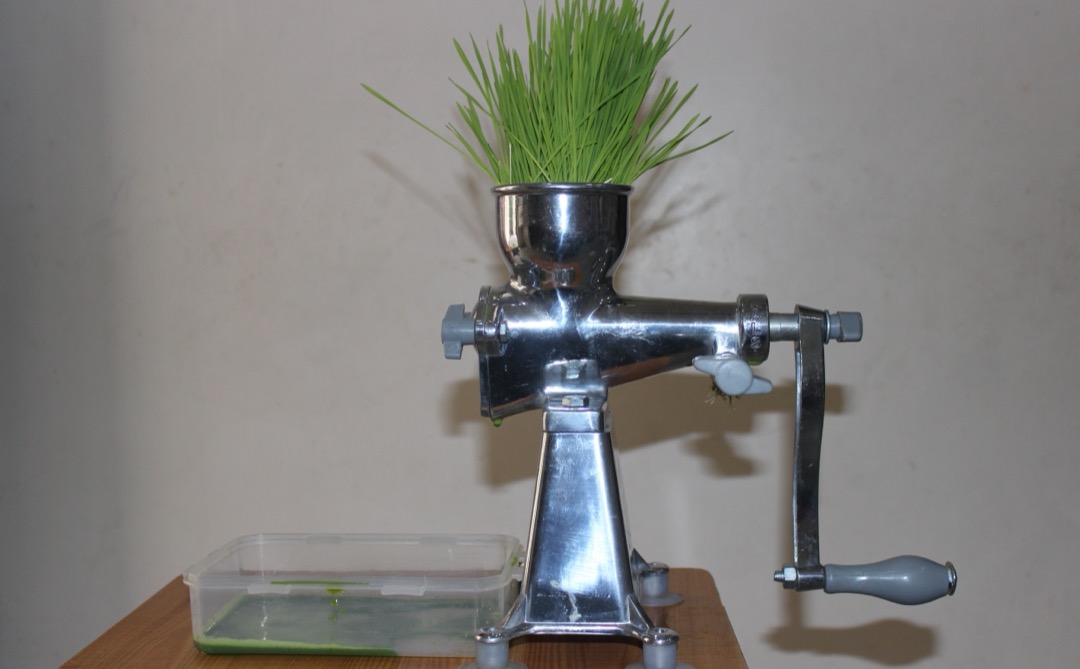
Stainless steel is the reason most people search for this category, and it is the most abused word on a juicer box. A machine can be sold as a stainless steel juicer because its outer shell is wrapped in brushed metal while the auger, the filter and every other part that touches your juice is plastic. That is not a small distinction. The shell never meets an orange.
I have specified juicers for a restaurant test kitchen and replaced the ones that could not survive a breakfast service, and the question I ask first is never what the housing is made of. It is which components do the grinding and the straining, and what those are made of. This guide sorts the stainless steel juicers worth buying by that standard, from an entry-level centrifugal machine with a real steel disc up to an NSF-certified press with no plastic in it anywhere.
Every product here has been checked against its live listing, and where a manufacturer names an alloy grade I have said so, because 304 and 201 are not the same metal and only one of them shrugs off citric acid. If you are still deciding between juicing and blending, our guide to the best blender and food processor combos covers the machine that does the opposite job.
Find the Best Stainless Steel Juicer for Your Need
What counts as the best stainless steel juicer depends entirely on what you are juicing and how much plastic you are willing to live with. If it is mostly citrus, check the volume first: our citrus juice yield calculator tells you how many oranges a cup of juice actually takes, and a motor only starts earning its counter space past about a dozen fruit. Jump straight to your situation:
- Best stainless steel juicers overall
- Best stainless steel manual juicers
- Best stainless steel citrus juicers
- Best stainless steel cold press juicers
- Best stainless steel juicers with no plastic in the juice path
- More stainless steel juicers by use case
How We Chose These Stainless Steel Juicers
I started from the parts list rather than the marketing. For every candidate I read the listing bullets, not the material field in Amazon’s spec table, because that field is unreliable in this category: one premium masticating juicer lists its material as acrylic, and the Cuisinart here reads man-made-material despite bullets that clearly describe a die-cast and stainless housing. Anything whose only steel was a badge or a collection cup was cut.
From there I weighted four things. Which juice-contact parts are steel, and the alloy grade where it is published. Whether the machine actually suits the produce people buy it for, since a centrifugal basket cannot juice a leaf no matter how many watts sit under it. The review record, because a juicer is a motor and a bearing and you want other people to have found the failure point first. And cleanup, which is the reason most juicers end up in a cupboard.
Two traps are worth naming, because both outrank the honest products for these searches. The first is the cast iron lever press sold with stainless steel in the title: the collection cup is steel and the pressing mechanism, the part under load, is painted cast iron. The second is subtler. The highest-reviewed citrus squeezer on Amazon carries the same brand name as one of my picks below and is made of coated aluminium, not steel, on a different listing entirely. If you search that brand you will land on the aluminium one first. Check the material line, not the badge.
I also cut a whole category that shows up under this search and does not belong in it. Stovetop steam juicers, the tall stacked pots used for canning fruit, are a different appliance that happens to share the word.
Best Stainless Steel Juicers Overall
These are the twelve juicers that cleared the parts test, in the order I would consider them. Every one is reviewed once here with its full specification, and the use-case sections further down draw on this same set.
Best Overall: Breville JE98XL Juice Fountain Plus
The JE98XL wins this category on the only test that matters here: the two parts that touch your juice are both stainless steel, and Breville says which ones. The cutting disc is titanium-reinforced steel and the filter basket is an Italian-made micro mesh, also steel. Everything else, the chute, the pusher, the jug, is plastic, and that is true of every electric juicer at this price. The difference is that on this machine the plastic never does any work.
Eight hundred and fifty watts across two speeds is the right amount of motor. The low setting exists for soft fruit, where full speed just atomises a pear against the basket wall and gives you froth. The high setting has the torque to keep a beet moving instead of stalling against it. The three-inch chute is the feature you will actually notice day to day, because it takes a whole apple, and the difference between feeding whole fruit and quartering everything is the difference between a juicer you use and one you resent.
The honest limitations are the ones every centrifugal machine shares. It cannot juice leaves. Kale, spinach and wheatgrass go in and come out damp, because a spinning basket has nothing to grip a leaf with, and no amount of wattage changes the physics. It is loud. And the mesh basket wants a stiff brush within a minute of finishing, not after breakfast, because dried pulp in fine steel mesh is genuinely difficult to shift. Accept those three things and this is the most machine anyone needs.
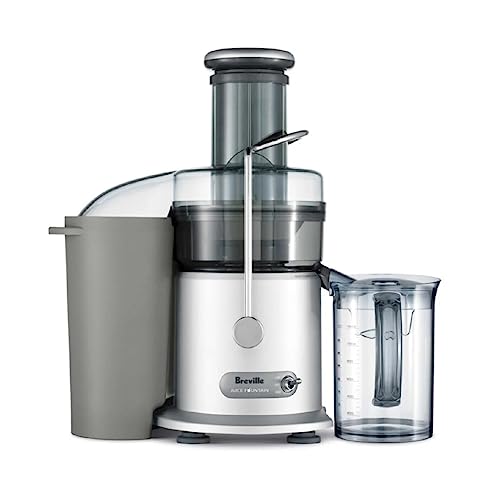
Breville JE98XL Juice Fountain Plus Centrifugal Juicer, Silver
by Breville
The stainless juicer I would hand to almost anyone: the two parts that touch your juice are real steel, the chute takes whole fruit, and nearly seventeen thousand owners have already found its limits for you.
Pros
- The cutting disc and the mesh filter basket are both genuine stainless steel, which matters more than the housing because those are the two parts that actually grind and strain your juice
- A three-inch feed chute takes a whole apple or a whole orange, so a morning batch is a few minutes of feeding rather than a cutting-board session
- Two speeds with a real purpose: the low setting presses soft fruit without spraying it around the basket, the high setting has the torque for carrots and beets
- The deepest review pool of any juicer in this guide by a wide margin, which means the failure modes are thoroughly documented before you spend anything
Cons
- Like every centrifugal machine it is weak on leafy greens and useless on wheatgrass, because a spinning basket cannot get a grip on a leaf
- The mesh basket needs a brush and a couple of minutes after dense produce, and it needs it immediately rather than after breakfast
- It is loud in the way all high-speed centrifugal machines are loud, and there is no quiet mode
Budget Pick: QCen 800W Centrifugal Juicer
This is the cheapest electric juicer I am willing to put on the page, and the reason it clears the bar is that the disc and the filter basket are steel rather than the coated plastic you find at the very bottom of the category. Eight hundred watts at this price is also genuinely unusual. Most juicers at this end of the market run a motor around four hundred watts, which is enough for an orange and not enough for a carrot, and the gap shows up the first time you feed it something dense.
You also get the three-inch wide mouth that the expensive machines have, two speeds rather than one, and a safety lock arm that will not let the motor spin with the lid off. For the money, that specification list is close to unreasonable.
What you give up is stated plainly in the manufacturer’s own bullets: thermal protection cuts the motor after five continuous minutes. This is a machine for one or two glasses, not a Sunday batch for the week, and if you try to push past that limit you will spend the morning waiting for it to cool. The housing is substantially plastic, the listing claims stainless at the material level without itemising which parts, and the build quality is what the price buys. As a way to find out whether you will actually keep juicing, it is hard to argue with.

QCen Juicer Machine, 800W Centrifugal Juicer with Wide Mouth Feed Chute
by QCen
The cheapest electric juicer here with a real steel disc and filter behind it, bought at the cost of a five-minute run limit and a plastic body.
Pros
- Eight hundred watts at this price is genuinely unusual, and it is enough motor to get through carrots rather than stalling against them
- The same three-inch wide mouth as juicers costing four times more, so you are not quartering fruit to save money
- Two speeds rather than the single-speed motor most budget juicers ship with, which is what lets it handle soft fruit without flinging it
- A safety lock arm that refuses to spin with the lid off, which is not a given at this end of the market
Cons
- Thermal protection shuts the motor off after five continuous minutes, so this is a machine for one or two glasses, not a Sunday batch
- The listing claims stainless steel at the material level without itemising which parts, and the housing is substantially plastic
- Build quality is what you would expect for the money, and it will not outlast the name-brand machines here
Upgrade Pick: Angel Juicer AG-5500 Twin Gear
The Angel is the machine on this page with the strongest claim to the phrase stainless steel juicer, and it answers the question that sends most people looking for one. The listing states that every part is SUS-304 food-grade stainless, and the two pieces that usually give a premium juicer away, the pusher and the juice cup, are wood and glass here. Inside, twin steel gears mesh against each other at 82 RPM and crush produce between them. That mechanism is the reason it handles wheatgrass and leafy greens properly, and it is why juice bars that sell green juice buy twin-gear machines rather than centrifugal ones.
It took this slot in October 2026, when the Tribest Greenstar Elite that held it went unavailable new on Amazon in both colours. The warranty is split by part: ten years on the motor and drive gears, five on the twin gears and the housing filter, which among the electric juicers here only the Nama J2’s fifteen years beats. It comes apart in three steps, the listing calls the parts dishwasher safe, and a built-in clutch plus a manual reverse lets you clear a jam without straining the motor.
It asks a lot in return. It costs more than ten times our Best Overall pick, and that money buys a material and a mechanism, not more juice from your apples. Twin-gear juicers are slow to feed and the chute is narrow, so a morning glass takes noticeably longer than it does on the Breville and produce needs cutting first. Its review pool is the thinnest of any electric juicer here, so you are trusting Angel’s decades of building twin-gear machines, and that warranty, more than a deep owner record. Buy it if you already drink green juice every day and you want steel everywhere the juice goes.

Angel Juicer AG-5500 Stainless Steel Twin Gear Cold Press Slow Juicer
by Angel
The upgrade for anyone whose real goal is celery, kale and wheatgrass, and the only electric machine on this page whose listing claims stainless steel for every part.
Pros
- Twin stainless gears turning at 82 RPM, the mechanism that reliably extracts wheatgrass and leafy greens rather than spitting them out damp
- The listing states every part is SUS-304 food-grade stainless, and it ships with a wooden pusher and a glass juice cup, so this is the one electric machine here that earns the phrase stainless steel juicer outright
- Ten years of warranty on the motor and drive gears and five on the twin gears and filter, beaten among the electric juicers here only by the Nama J2's fifteen years
- It comes apart in three steps and the listing calls the parts dishwasher safe, with a built-in clutch and a manual reverse to clear a jam
Cons
- Twin-gear machines are slow to feed and the chute is narrow, so a morning glass takes noticeably longer than it does on a centrifugal juicer and produce needs cutting first
- Its review pool is the thinnest of any electric juicer here, so you are trusting the brand's long record and the warranty rather than a deep owner history
- It costs more than ten times the Best Overall pick, and the money buys a material and a mechanism rather than more juice from your apples
Runner-Up: Cuisinart CJE-1000P Die-Cast Juice Extractor
If your juice is mostly root vegetables, this is arguably a better buy than my top pick. A thousand watts is the strongest motor in the mid-price tier here, and the place you feel it is on beets and dense winter carrots, where lighter machines audibly bog down and start throwing wet pulp. The five-speed dial is more useful than it sounds too, because the gap between what an apple wants and what a soft pear wants is wider than a two-speed switch can express.
The two-litre pulp bin is a quietly practical piece of design: it is large enough to get through a full batch without stopping to empty it, which is exactly the interruption that makes people stop juicing. The adjustable anti-drip spout is a small thing that keeps the counter clean between glasses.
One warning that has nothing to do with the machine and everything to do with the listing. Amazon’s material field for this product reads man-made-material, while the bullets clearly describe a die-cast and stainless steel housing. If you are shopping this category by filtering on the spec table, this juicer will not appear, and that is a cataloguing error rather than a materials one. It is also heavy and takes more counter than the plastic-bodied competition, and like every centrifugal machine here it is not the tool for greens.

Cuisinart CJE-1000P Die-Cast Juice Extractor
by Cuisinart
The runner-up and the one to buy if your juice is mostly root vegetables: the most motor in its price bracket, in a housing built to take the load.
Pros
- A thousand watts, the strongest motor in the mid-price tier here, and it shows on beets and hard carrots where weaker machines bog down
- Five speeds on a dial rather than the usual two, which gives you somewhere to go between crushing an apple and coaxing juice out of a soft pear
- A two-litre pulp bin, big enough that a full batch does not need emptying halfway through
- An adjustable anti-drip spout, a small thing that stops the counter getting sticky between glasses
Cons
- Amazon's material field for this listing reads man-made-material even though the bullets state a die-cast and stainless housing, so the spec table alone will mislead you
- The die-cast body is heavy and takes up more counter than the plastic-bodied competition
- It is not marketed for leafy greens and does not do well with them
Nama J2 Hands-Free Cold Press Juicer
The J2 solves a different problem from the rest of this page. Every other electric juicer here requires you to stand over it and push produce down a tube for the length of the batch. The J2 has a hopper you load with an entire recipe, and then it feeds itself while you do something else. That is not marketing language, it is the design purpose, and it is the single most effective answer to the reason juicers get abandoned.
Fifty revolutions per minute is genuinely slow, which is what keeps the juice cool and stops it separating within minutes. Two hundred watts is quiet enough to run before the household is awake. And the fifteen-year warranty is longer than most people keep a kitchen, let alone an appliance.
Be clear about the materials, because at this price people assume they are buying metal. The stainless is the auger and the drive mechanism. The hopper and the housing are Tritan, a hard plastic. That is a perfectly reasonable engineering choice and it is not a full-metal machine, so if your reason for shopping this category is to eliminate plastic, the Angel and the Nemco are the honest options and this is not. Judged as a hands-free cold press juicer with a steel auger, it is excellent, and only the Angel costs more here.

Nama J2 Hands-Free Cold Press Juicer
by Nama
The machine to buy if what stops you juicing is standing there pushing produce down a tube, with the honest caveat that its body is plastic and only the auger is steel.
Pros
- The self-feeding hopper is not marketing language: you load an entire recipe, close the lid and walk away, which is the only genuinely hands-free machine in this guide
- A fifteen-year warranty, which is longer than most people keep a kitchen
- Fifty revolutions per minute, slow enough that the juice comes out cool and separates far more slowly than anything centrifugal
- Two hundred watts of quiet, which matters more than it sounds when you juice before anyone else is awake
Cons
- The stainless is the auger and the working mechanism, while the hopper and housing are Tritan plastic, so this is not a full-metal machine despite the price
- Only the Angel costs more on this page
- Cleaning is the standard masticating routine of several parts and a brush, and the hopper adds one more
VITAPLUS Cold Press Juicer with Stainless Steel Auger
This is on the page for one specific reason: the auger is stated as food-grade stainless steel rather than plastic, and in this price bracket that is uncommon enough to be worth knowing about. On almost every mid-priced masticating juicer, the auger, the single part doing all the crushing, is plastic. Paying for steel usually means stepping up to a twin-gear machine like the Angel, at roughly ten times the price.
The 5.8-inch chute is the widest opening of any machine in this guide, which cuts the knife work down to almost nothing, and the machine is built and marketed around fibrous produce specifically, which is where cheap masticating juicers normally give up and clog. It doubles as a nut milk maker using the same slow crushing action with no extra parts.
The caveats are about evidence rather than design. The listing never publishes a wattage, so you are buying the auger claim without a verified power figure behind it. Among the electric juicers I am recommending here, only the Angel has a thinner review pool, this one has been shrinking rather than growing, and VITAPLUS has no long-run reputation to fall back on the way Breville, Cuisinart and Angel do. If you want a steel auger and cannot spend Angel money, this is the route. If you want certainty, spend more.

VITAPLUS Cold Press Juicer with Stainless Steel Auger
by VITAPLUS
The cheapest route to a steel auger rather than a plastic one, and the compromise is a thin review record instead of a thin build.
Pros
- The auger is stated as food-grade stainless steel rather than plastic, which is genuinely uncommon at this price and is the whole reason it is here
- A 5.8-inch chute, the widest opening of any machine in this guide, so whole fruit goes in with almost no knife work
- Built and marketed around fibrous produce specifically, which is where cheap masticating machines usually give up
- Doubles as a nut milk maker, which uses the same slow crushing action and needs no extra parts
Cons
- The listing never publishes a wattage, so you are buying the auger claim rather than a verified power figure
- Its review record is one of the thinnest of anything recommended here
- VITAPLUS has no long-run reputation to fall back on the way Breville, Cuisinart and Angel do
Breville BJE830BSS Juice Fountain Cold XL
This slot used to hold Breville’s commercial Juice Fountain, and that machine is no longer sold on Amazon in any condition. Breville’s commercial juicers now go through foodservice distributors, and nothing from Waring or Omega on Amazon comes close to the same duty. The Juice Fountain Cold XL is the heavy-duty machine a home buyer can actually order, and it is built for households that juice in batches.
Twelve hundred watts drives a stainless cutting disc and a stainless basket lined with Italian micro-mesh, and the three-and-a-half-inch chute is the widest on any centrifugal machine here. Capacity is the real reason to buy it. A seventy-ounce jug and a pulp bin of nearly four quarts are the largest in this guide, so a few days of juice is one session rather than three rounds of stopping to empty things. There is also a quiet setting, which Breville rates at around forty percent less noise than full speed, and that is rare on a centrifugal machine with this much motor. Owners rate it well for speed and for how quickly it comes apart and cleans.
The costs are plain. It is a heavy-duty home juicer, not NSF-rated commercial equipment, so a café should buy through a distributor instead. None of its parts are rated for the dishwasher, which is a real annoyance at this price, and the extra spend over the JE98XL buys capacity and quiet rather than better juice. Like every centrifugal machine here, it will not do much with leafy greens.
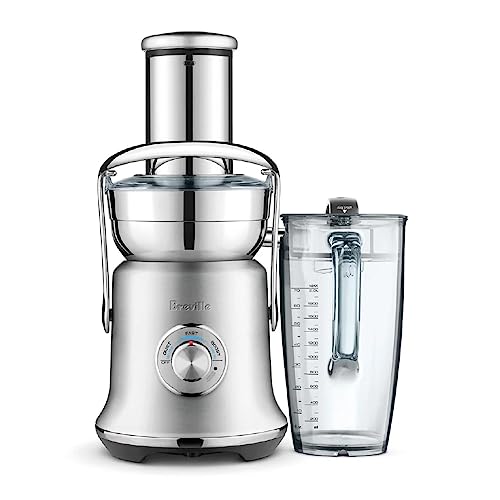
Breville BJE830BSS Juice Fountain Cold XL Centrifugal Juicer, Brushed Stainless Steel
by Breville
The machine for batch juicing at home: twelve hundred watts, a seventy-ounce jug and the biggest pulp bin here, with the steel where it counts and a quiet setting for early mornings.
Pros
- Twelve hundred watts through a three-and-a-half-inch chute, the widest on any centrifugal machine here, so a whole apple or a large beet goes in without a knife
- A seventy-ounce jug and a pulp bin of nearly four quarts, the largest capacity in this guide, which is what makes batch juicing tolerable
- A stainless cutting disc and stainless basket behind an Italian micro-mesh filter, wrapped in a brushed steel body rather than plastic
- A quiet setting that Breville rates at about forty percent less noise than full speed, which is rare on a centrifugal machine this powerful
Cons
- None of the parts are rated dishwasher safe, a surprise at this price, so the disc and mesh get hand-scrubbed after every batch
- It is a heavy-duty home machine rather than NSF-rated commercial equipment, because Breville's commercial juicers are not sold on Amazon
- Owners split on value, and the extra money over the JE98XL buys capacity and quiet rather than better juice
Breville BJE200XL Juice Fountain Compact
The BJE200XL is the same idea as my top pick with the footprint cut down, and it uses the identical extraction system: a titanium-reinforced stainless disc and an Italian steel mesh basket. If your objection to juicers is that they colonise a counter, this is the answer, because the pulp collects inside the body rather than in a separate bin sitting alongside it. One appliance, one patch of counter, and the cord wraps underneath.
Seven hundred watts is real power for something this small and it still takes a whole apple through a three-inch chute, so the compromises are not where you would expect them. Nearly thirteen thousand reviews on a design that has been on sale for years without needing a redesign is its own kind of endorsement.
The compromise is capacity, and it is a real one. The jug holds twenty-five ounces, the smallest here, and the internal pulp chamber fills faster than an external bin would on high-pulp produce like carrot and beet. Between those two limits, any batch beyond a couple of glasses means stopping to pour and empty. It shares the centrifugal weakness on greens with the rest of the Breville line. For one or two people in a small kitchen, none of that will bother you.
One thing to check before you order. Amazon Resale lists used units on the same page as the new machine, sometimes at a price close enough to be mistaken for it. Read the condition line before you add anything to the cart.
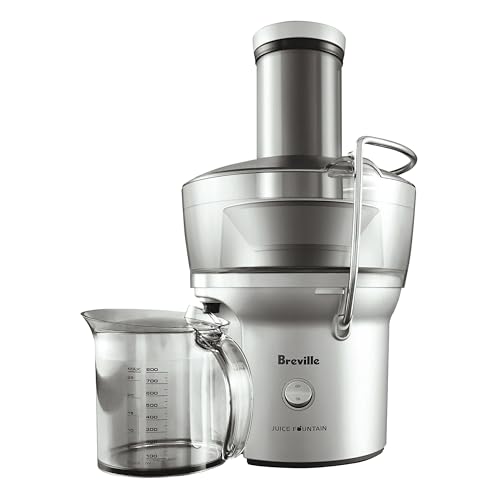
Breville BJE200XL Juice Fountain Compact Centrifugal Juicer, Silver
by Breville
Breville's stainless extraction system shrunk to fit a small kitchen, and still the cheapest way onto this page from a brand with a real service record.
Pros
- The same titanium-reinforced stainless disc and Italian mesh filter as Breville's larger machines, in the smallest footprint here
- Pulp collects inside the body rather than in a separate bin, so the machine takes one patch of counter and not two
- Seven hundred watts is real power for something this small, and it still takes a whole apple
- A five-figure review pool on a design that has been on sale for years without needing to change
Cons
- A twenty-five-ounce jug, the smallest here, which means stopping and pouring during any real batch
- Internal pulp collection fills quickly on high-pulp produce and then you have to stop anyway
- Same centrifugal weakness on greens as the rest of the Breville line
- Amazon Resale used units also sit on this listing, so read the condition line before you add one to the cart
Nemco 55850 Manual Crank Heavy Duty Citrus Juicer
The rack-and-pinion mechanism, the posts and the strainer cone are all steel, which makes this fundamentally different from the cast iron lever presses sold under the same search term with a stainless cup bolted to them. Those are the listings you will meet first, and the biggest of them puts both cast iron and stainless steel in the same title while the pressing mechanism is painted iron. It is NSF certified, meaning it has been assessed against commercial food-safety standards rather than simply described as food-safe by its own marketing.
The engineering is built for repetition. Self-lubricating bronze bearings keep the lever pressure even over years of daily pulls instead of going notchy the way a cheap press does after a few months, and the strainer cone lifts straight out for cleaning. There is no motor, which means there is nothing to burn out; this is a tool that will outlast every electric machine on this page combined.
The case against it is the price and the scope. Commercial pricing for something with no motor is difficult to justify unless you are juicing citrus daily or you have decided you want one object that lasts thirty years. Its review pool is in the dozens, because its buyers are cafés rather than home cooks. And it does citrus, halved, and nothing else, so it will never be your only juicer. If you want no plastic near your juice, the hand presses further down do that for a tiny fraction of the money. What this buys instead is a duty cycle: a mechanism that will take a thousand pulls a week for years without going slack.

Nemco 55850 Manual Crank Heavy Duty Easy Citrus Juicer, Stainless Steel, NSF Certified
by Nemco
The commercial answer to the no-plastic question: NSF certified, stainless through the whole mechanism, and built for a café's daily volume rather than a household's.
Pros
- Genuinely stainless throughout the rack-and-pinion mechanism and the posts, not a cast iron press wearing a steel cup, which is what most presses sold under this search term actually are
- NSF certification, meaning it has been assessed against commercial food-safety standards rather than simply described as food-safe
- Self-lubricating bronze bearings, so the lever pressure stays even over years of daily pulls instead of getting notchy
- Nothing to burn out, because there is no motor, and the strainer cone lifts out for cleaning in seconds
Cons
- It costs more than twenty times what an all-stainless hand press costs, and the extra buys duty cycle rather than a cleaner juice path
- A review pool in the dozens, since the buyers are mostly cafés rather than home cooks
- Citrus only, and only halved citrus, so it will never be your one juicer
Eurolux Premium Electric Orange Juicer
The Eurolux occupies the sensible middle of the citrus category, and its argument is that you will actually use it. A lever press is better at extraction and asks you to commit to the ritual; a spinning reamer with a hundred and sixty watts behind it asks for nothing except that you halve the fruit. On a weekday morning that difference decides whether anyone gets fresh juice.
The stainless construction is stated on the listing, though no alloy grade is given, and almost thirteen thousand reviews make this the deepest track record of any citrus-specific juicer with a genuine steel claim. Auto shutoff and adjustable pulp control are the features that separate juice you like from juice you tolerate, and the parts are dishwasher safe, which is unusual for this style and is the reason it stays in rotation rather than migrating to a cupboard.
The limits are structural. A spinning reamer never extracts as completely from thick-skinned grapefruit as a lever press does, because it cannot apply the same pressure to the rind. It does citrus and nothing else, so it is a second appliance rather than a main one. And motorised reamers in this style are the ones owners most often report dripping from the spout over time. For daily orange juice at this price, none of that is disqualifying.

Eurolux Premium Electric Orange Juicer, Stainless Steel Citrus Squeezer
by Eurolux
The sensible middle of the citrus category: motorised so you will actually use it on a Tuesday, with a stainless body and enough owners to trust the rating.
Pros
- The deepest review record of any citrus-specific juicer carrying a real stainless claim
- A hundred and sixty watts of motor, so it spins the reamer for you rather than asking your forearm to do it
- Auto shutoff and adjustable pulp control, which is the difference between orange juice you like and orange juice you tolerate
- Dishwasher-safe parts, unusual for a citrus machine and the reason it gets used on weekday mornings
Cons
- A spinning reamer never extracts as completely from thick-skinned grapefruit as a lever press does
- Citrus and nothing else, so it is a second appliance rather than a main one
- Motorised reamers in this style are the ones people report dripping from the spout over time
Zulay Kitchen Stainless Steel Lemon Squeezer
The hinged squeezer is the format most people picture when they think of a manual citrus juicer, and it is also the format with the worst material honesty. The overwhelming majority sold on Amazon are coated aluminium or zinc alloy with a metallic finish, and the coating is doing the work of looking like steel. This one states 18/8 stainless for the bowl and the body, which is a real alloy specification rather than the phrase food-grade with no number behind it, and it is why it is here instead of the several cheaper ones ranked above it.
The practical case is simple. It halves a lemon’s worth of effort compared with a reamer, it inverts the fruit so the pith blocks most of the seeds, it goes in the dishwasher, and it stores in a drawer. Its review pool runs to five figures and it sits in the top handful of Amazon’s manual juicer category, so the build quality is thoroughly attested rather than taken on trust. The lifetime warranty is easy to offer on a tool with one hinge and no motor, and it is still worth having.
Two limits. The bowl is sized for lemons, limes and small oranges, so a grapefruit simply will not seat in it and you should buy a press instead. And the grips are silicone rather than bare steel, which is a comfort decision rather than a compromise, but it does mean this is not metal from end to end. One oddity to ignore: the listing’s spec table reports a wattage for a tool with no motor, which is a template artefact rather than a specification.

Zulay Kitchen Lemon Squeezer, Stainless Steel Heavy Duty Large Manual Citrus Press
by Zulay Kitchen
The hinged squeezer I would keep on a restaurant pass: real 18/8 stock instead of coated aluminium, at a price where buying the honest version costs almost nothing extra.
Pros
- The bowl and body are stated as 18/8 stainless, an actual alloy specification rather than the phrase food-grade with no number behind it
- A five-figure review pool and a top-five ranking in Amazon's manual juicer category, which is a far deeper record than most kitchen tools at this price
- Dishwasher safe on the top rack, so the one genuine advantage a press has over a machine, cleaning in under a minute, survives contact with real life
- Backed by a lifetime warranty, which is easy to offer on a tool with no moving parts to fail and still worth having
Cons
- The bowl tops out at lemons, limes and small oranges, so a grapefruit will not fit and you will be pressing it in halves that do not seat properly
- The handle grips are silicone rather than steel, which is a comfort choice rather than a compromise but does mean the tool is not metal end to end
- The listing's spec table lists a wattage for a tool with no motor, a template error worth ignoring rather than a real specification
Etinslant 304 Stainless Steel Citrus Juicer
This is the quiet answer to the question that brings most people to this page, and it costs less than anything else in this guide. The reamer, the slitted strainer and the ten-ounce bowl are all stated 304 stainless, which means there is no plastic anywhere in the juice path. Not a plastic screen, not a plastic cone, not a plastic cup. Outside the commercial tier, nothing else here can say that.
The reamer has eleven teeth rather than a smooth cone, and the difference is real: teeth grip and tear the membrane so the juice comes out of the segments, where a smooth cone tends to slide over the surface and leave a third of it behind. Two pour spouts mean decanting into a glass without running juice down the outside of the bowl, and the whole assembly goes in the dishwasher because there is nothing in it that is not steel.
What you are giving up is scale and pedigree. The bowl holds ten ounces, so anything beyond a glass or two means stopping to pour. Etinslant is an Amazon-native brand with no kitchenware reputation off the platform, so you are buying the stated alloy and the review record rather than a name. And it is a reamer, which means your hand and wrist do the work, and it will never touch anything that is not citrus. For the price of a couple of coffees, it is the most direct route on this page to juice that has never met plastic.
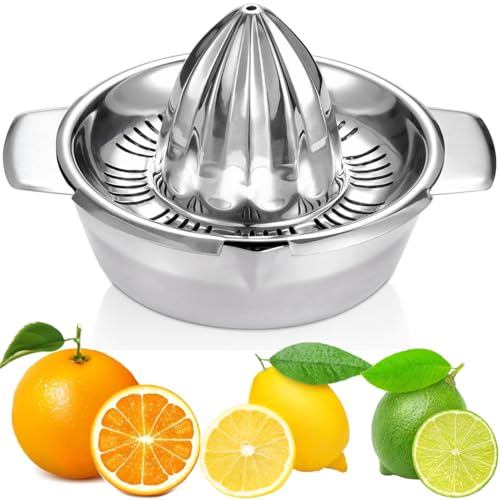
Etinslant 304 Stainless Steel Citrus Juicer, Manual Reamer Press with Strainer and Bowl
by Etinslant
The cheapest honest answer on this page to the no-plastic question: pull the cone off and it is 304 the whole way through, for less than the cost of a bag of oranges a month.
Pros
- The reamer, the strainer sieve and the bowl are all stated 304 stainless, so there is no plastic anywhere in the juice path, which nothing else on this page outside the commercial tier can claim
- An eleven-tooth reamer grips and tears the membrane rather than sliding over it, which is where a smooth cone leaves juice behind
- Two pour spouts, so decanting into a glass does not run down the outside of the bowl
- The cheapest genuinely all-stainless option here by a wide margin, which makes the no-plastic question affordable rather than aspirational
Cons
- A ten-ounce bowl means stopping to pour during anything larger than a glass or two
- Etinslant is an Amazon-native brand with no kitchenware reputation outside the platform to fall back on
- It is a reamer, so it needs your hand and wrist doing the work and it will not touch anything that is not citrus
Best Stainless Steel Manual Juicers
A manual juicer is the only part of this category where an all-metal build is normal rather than exotic. There is no motor to house, so there is no reason for plastic beyond cost, and a good press is a single piece of cast or pressed steel with nothing to wear out. That also makes it the cheapest honest answer to the no-plastic question. The trade-off is that manual juicers only work on citrus and soft fruit, they take your forearm rather than a wall socket, and press geometry matters far more than it looks: a shallow cone leaves juice in the rind, and a hinged squeezer that flexes under load wastes half your effort.
| Product | Price | Buy |
|---|---|---|
| Zulay Kitchen Lemon Squeezer, Stainless Steel Heavy Duty Large Manual Citrus PressBest stainless steel manual juicer Stated 18/8 bowl and body, dishwasher safe, and the deepest review record of any honest hand squeezer | $24.99 | View on Amazon |
| Etinslant 304 Stainless Steel Citrus Juicer, Manual Reamer Press with Strainer and BowlBest all-stainless hand press 304 steel through the cone, strainer and bowl, so nothing plastic touches the juice | $16.59 | View on Amazon |
| Nemco 55850 Manual Crank Heavy Duty Easy Citrus Juicer, Stainless Steel, NSF CertifiedBest commercial-grade manual press NSF certified with bronze bearings, built for daily pulls rather than occasional ones | $499.95 | View on Amazon |
Best Stainless Steel Citrus Juicers
Citrus is where stainless earns its money rather than just looking tidy. Citric acid is genuinely hard on materials, and it is what hazes and crazes a plastic reamer over a couple of years until the surface holds odour that no rinse removes. It also rules out aluminium, which reacts and leaves a metallic edge on the juice, and which a surprising number of gold-coloured presses are actually made of. What separates these three is how much of the work you want to do and how thick the skins are: a spinning reamer is the weekday answer, a lever press is what gets the last of the juice out of a grapefruit.
| Product | Price | Buy |
|---|---|---|
| Eurolux Premium Electric Orange Juicer, Stainless Steel Citrus SqueezerBest electric citrus juicer A motor does the reaming, which is what makes it get used on a weekday morning | $79.99 | View on Amazon |
| Zulay Kitchen Lemon Squeezer, Stainless Steel Heavy Duty Large Manual Citrus PressBest handheld citrus squeezer Fast, dishwasher safe, and sized for lemons, limes and small oranges | $24.99 | View on Amazon |
| Nemco 55850 Manual Crank Heavy Duty Easy Citrus Juicer, Stainless Steel, NSF CertifiedBest citrus press for grapefruit Lever pressure is what gets the last of the juice out of a thick rind | $499.95 | View on Amazon |
Best Stainless Steel Cold Press Juicers
Cold press, slow, and masticating all describe the same mechanism: an auger turning slowly enough to crush produce rather than shred it. It matters here because the auger is the part doing the work, and on most mid-priced machines that auger is plastic. Slow juicing also produces less foam and juice that separates hours later rather than minutes later, which is the real reason people move up to it. Expect to spend longer feeding and longer cleaning than any centrifugal machine on this page.
| Product | Price | Buy |
|---|---|---|
| Angel Juicer AG-5500 Stainless Steel Twin Gear Cold Press Slow JuicerBest stainless steel cold press juicer Twin steel gears, the mechanism that actually extracts leafy greens and wheatgrass | $1,670.00 | View on Amazon |
| VITAPLUS Cold Press Juicer with Stainless Steel AugerBest affordable stainless auger A stated food-grade steel auger at a price where plastic augers are the norm | $169.99 | View on Amazon |
| Nama J2 Hands-Free Cold Press JuicerBest hands-free cold press Load the hopper once and walk away, with a steel auger inside a Tritan body | $599.00 | View on Amazon |
Best Stainless Steel Juicers With No Plastic in the Juice Path
This is what most people actually mean when they type stainless steel juicer, and almost nobody answers it directly. The honest position is that almost every electric juicer has plastic in it somewhere: the chute, the pusher and the jug are plastic on nearly all of them, and the rare all-steel machine costs more than ten times our Best Overall pick. What you can control is whether the grinding and straining parts are metal, and how long juice sits against plastic before it reaches your glass. Seconds in a chute is not the same as minutes against a plastic screen. These three get closest. The first two have no plastic in the juice path at all, and one of them is the cheapest product in this guide, which is the part nobody tells you.
| Product | Price | Buy |
|---|---|---|
| Etinslant 304 Stainless Steel Citrus Juicer, Manual Reamer Press with Strainer and BowlBest juicer with no plastic in the juice path 304 cone, strainer and bowl, and the cheapest product in this guide | $16.59 | View on Amazon |
| Nemco 55850 Manual Crank Heavy Duty Easy Citrus Juicer, Stainless Steel, NSF CertifiedBest commercial no-plastic press Stainless rack-and-pinion mechanism throughout, NSF certified | $499.95 | View on Amazon |
| Angel Juicer AG-5500 Stainless Steel Twin Gear Cold Press Slow JuicerBest electric juicer for minimal plastic Listed as SUS-304 in every part, with a wooden pusher and a glass juice cup | $1,670.00 | View on Amazon |
Best Stainless Steel Juicers by Use Case
A few more matches for narrower needs, each pointing back to a machine already reviewed above.
| Product | Price | Buy |
|---|---|---|
| Breville JE98XL Juice Fountain Plus Centrifugal Juicer, SilverBest electric stainless steel juicer Steel disc and mesh filter with a three-inch chute, on the deepest review record here | $149.95 | View on Amazon |
| Breville BJE830BSS Juice Fountain Cold XL Centrifugal Juicer, Brushed Stainless SteelBest commercial stainless steel juicer Breville's commercial line is not sold on Amazon; this is its heavy-duty home model, with the largest jug and pulp bin in this guide | $399.95 | View on Amazon |
| Angel Juicer AG-5500 Stainless Steel Twin Gear Cold Press Slow JuicerBest stainless wheatgrass juicer Twin gears are the only mechanism that extracts wheatgrass properly | $1,670.00 | View on Amazon |
| Cuisinart CJE-1000P Die-Cast Juice ExtractorBest heavy-duty stainless juicer A thousand watts and a die-cast body built to take beets and winter carrots | $199.95 | View on Amazon |
Buyer's Guide
Stainless steel is the reason most people search for this category and it is the most abused word on a juicer box. A machine can be sold as a stainless steel juicer because the outer shell is wrapped in brushed metal while every part that touches your juice is plastic. These are the six things I check before I believe the label, in the order I weigh them.
Which Parts Are Actually Stainless
Ask which components contact the juice, not what the housing looks like. On a centrifugal machine the parts that matter are the cutting disc and the mesh filter basket. On a masticating machine it is the auger and the screen. On a manual press it is the cone, the strainer and the bowl. Almost every consumer juicer sold as stainless has a plastic feed chute, a plastic pulp bin and a plastic jug, and that is usually fine, because contact time there is seconds. What matters is whether the part doing the grinding or the straining is metal. A brushed steel exterior over a plastic auger is a cosmetic claim, and it is the single most common way this category misleads people.
The Grade Matters: 304, 201 and 430
Not all stainless is equal and nobody prints the grade on the front of the box. Type 304, sometimes written 18/8 or SUS-304, is the food-industry standard at roughly eighteen percent chromium and eight percent nickel, and that nickel content is what gives it real corrosion resistance against acidic juice. Type 201 substitutes manganese for much of the nickel to cut cost, and it pits and discolours faster in acid. Type 430 contains no nickel at all, is magnetic, and belongs in trim and housings rather than in anything soaking in citrus. If a listing says food-grade stainless with no number attached, assume the cheaper alloy and weigh it accordingly. If it names 304, that is a real specification and it is worth paying for.
Type Decides Everything Else
Centrifugal machines shred produce against a spinning disc and fling the juice through a mesh basket. They are fast, they take whole apples, they are loud, and they whip air into the juice so it separates sooner. Masticating machines, also sold as slow or cold press juicers, crush produce with a turning auger at low speed. They take longer, they handle leafy greens and celery properly, and the juice keeps better because less air goes into it. Manual presses have no motor at all: a lever multiplies your hand strength through a cone or a straining basket. They are the only category where an all-metal build is common, they are silent, they clean in under a minute, and they only work on citrus and soft fruit. Choose the type before you choose anything else, because no amount of wattage lets a centrifugal basket juice a leaf.
Feed Chute Width, or Press Capacity
On an electric juicer, chute width is the difference between juicing and prepping. A three-inch chute takes a whole apple and most of a beet, so a morning batch is a few minutes of feeding rather than a session with a cutting board. A narrow chute around an inch and a half means quartering everything, which is where most juicers end up unused in a cupboard. The trade-off is real though: wide chutes on masticating machines need a bigger auger and usually cost more, and on centrifugal machines a wide chute encourages feeding too fast, which drops your yield. On a manual press the equivalent question is cone or cup diameter, and whether it will take a grapefruit or only a lime.
Cleanup: Part Count, Strainer Design and Dishwasher Safety
Cleanup is the reason juicers get abandoned, and the honest metric is how many pieces come apart and how bad the worst one is. Every juicer here has one part that decides the whole experience: the mesh filter basket on a centrifugal machine, or the screen on a masticating one. Those are fine steel mesh packed with pulp and they need a stiff brush, not a rinse. A machine with six parts and a good brush is genuinely faster to clean than one with four parts and a screen you have to pick at. Check dishwasher safety part by part rather than as a headline, because on most machines the housing and the auger are hand wash while the jug and the bin are not, and a top-rack claim rarely covers the filter.
Acid, Staining and What Stainless Actually Protects You From
The practical case for metal in the juice path is not that plastic is dangerous, it is that acid and pigment are hard on plastic in ways you can see. Citrus, tomato, ginger and beet will haze, stain and eventually craze a plastic auger or screen over a couple of years, and once that surface is scratched it holds residue no rinse removes. Good stainless does not stain, does not scratch as easily and does not hold odour. It is not immune, though. Leaving acidic pulp sitting overnight in a cheap 201 basket will pit it, and chloride from salt does the same. Rinse the juice-contact parts straight after use and any decent stainless part will outlive the motor it came attached to.
How to Choose the Best Stainless Steel Juicer
The short version: decide what you are juicing before you decide anything else, then check which parts are metal, and only then look at price. If it is mostly apples, carrots and beets, buy a centrifugal machine and enjoy the speed. If it is celery, kale or wheatgrass, a centrifugal juicer will disappoint you every morning and you need an auger. If it is citrus and only citrus, do not buy a machine at all, buy a press.
Then read the parts list rather than the headline. On a centrifugal juicer the disc and the mesh basket should be steel and usually are. On a masticating juicer the auger is the part that matters and is usually plastic, so a stated stainless auger is worth paying for. On a press it is the cone and the strainer. And if a listing names an alloy grade, believe it and prefer it, because 304 is a real specification and food-grade with no number attached is a phrase that means nothing. If you have settled on an auger machine and material is not the deciding factor, my best cold press juicers guide covers the wider field by auger design and feed style.
Last, be honest about cleanup. Every juicer has one part that decides whether you keep using it, and it is always the mesh screen. Rinse it within a minute of finishing and any of these machines is a two-minute job. Leave it until the pulp dries and you will own an expensive cupboard ornament by spring.
Final Verdict
The Breville JE98XL is my best overall pick for 2026 and the one I would hand to most people. The two parts that decide juice quality, the cutting disc and the mesh filter basket, are genuinely stainless, the three-inch chute means whole apples go in without knife work, and its review pool is deep enough that owners have mapped its limits already. It is a centrifugal machine, so it will not juice your kale, and you should know that going in. If money is tight the QCen does the same job with a real steel disc behind it for a fraction of the price, provided you accept a five-minute run limit and a plastic body.
Two situations change the answer completely. If you are buying a juicer because of celery, greens or wheatgrass, skip every centrifugal machine here and buy the Angel AG-5500: twin stainless gears are the mechanism that works on leaves, the listing claims steel for every part, and the motor carries a ten-year warranty. If that price is out of reach, the VITAPLUS gets you a stated steel auger for a fraction of it. And if your goal is that nothing plastic touches your juice, the answer is cheaper than anyone expects: the Etinslant reamer is 304 steel through the cone, the strainer and the bowl, and it costs less than a week of shop-bought juice. The Nemco does the same job to commercial standards, and you only need it if you are pulling that lever every day.
Whichever way you go, the juicer is one appliance among several fighting for the same counter. If you are still working out whether you want juice or something thicker, read our comparison of the best food processors, and if the counter is already crowded, our best rice cookers guide covers the other single-purpose machine most kitchens are weighing at the same time. Get the produce match right and any competent juicer on this list will serve you. Get it wrong and the most expensive one will still disappoint.
Frequently Asked Questions
Is there a stainless steel juicer?
What is the best non-toxic juicer?
What is the healthiest juicer to buy?
Are manual juicers worth it?
Is stainless steel good for citrus juicers?
Related Articles
Best Blender Food Processor Combos of 2026
small-appliances
Best Food Processors of 2026
small-appliances
The 9 Best Rice Cookers of 2026, Tested by a Chef
small-appliances
8 Best Woks of 2026, Tested by a CIA-Trained Chef
cookware
The 9 Best Stainless Steel Rice Cookers of 2026, Tested by a Chef
small-appliances
About the Reviewer

Nora Whitfield, CIA Culinary Arts, ServSafe Certified
A.O.S. Culinary Arts, The Culinary Institute of America
Nora Whitfield trained at the Culinary Institute of America and spent twelve years in professional kitchens, the last four running the test kitchen for a regional restaurant group where her job was to decide which equipment could survive a dinner service and which could not. She has seasoned more carbon-steel woks than she can count, boiled water in every kettle worth owning, and broken enough cheap gear to know exactly where manufacturers cut corners. She reviews kitchen equipment the way she specified it professionally: cook on it, clean it, and see what it looks like after a month.