How Long Does Fresh Juice Last
By Nora Whitfield, CIA Culinary Arts, ServSafe Certified Updated
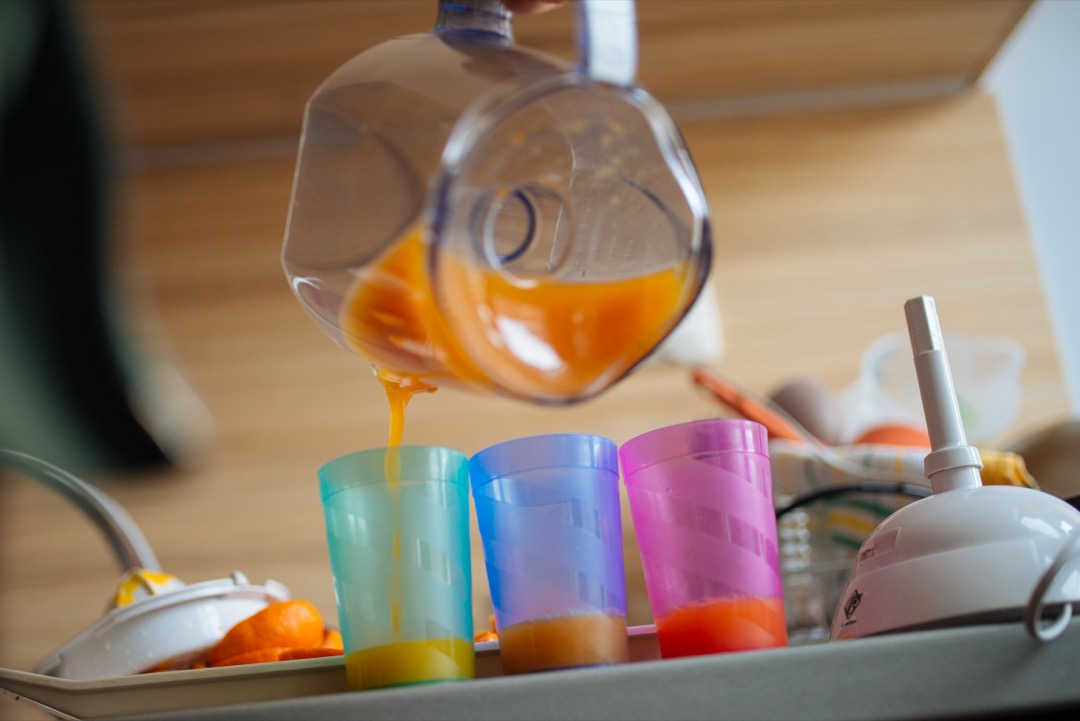
This article covers kitchen storage of homemade juice. It is not medical advice. If you are pregnant, over 65, cooking for young children, or have a weakened immune system, follow the FDA’s guidance for at-risk groups and stick to pasteurized juice.
Fresh juice you make at home lasts 24 to 48 hours at its best in a fridge set to 40°F or below, and 72 hours is the hard cap for unpasteurized home juice. At room temperature the limit is 2 hours, or 1 hour when it is above 90°F. The time limits come from USDA rules for perishable food. The 48-hour window comes from what storage studies show about flavour, colour and vitamin C. No regulator publishes a fridge shelf life for homemade juice, which is why advice online swings from “drink it in 15 minutes” to “it keeps five days.” Here is where each figure comes from, what your juicer changes, and how to store, freeze and judge juice.
The Short Answer
| Where the juice is | How long | What the figure rests on |
|---|---|---|
| Counter, room temperature | 2 hours | USDA FSIS rule for perishable food |
| Counter, above 90°F | 1 hour | USDA FSIS rule for perishable food |
| Fridge at 40°F or below, best quality | 24 to 48 hours | Storage studies on flavour and vitamin C, kitchen practice |
| Fridge at 40°F or below, hard cap | 72 hours | Conservative limit for an unpasteurized, untested liquid |
| Freezer at 0°F | 8 to 12 months for most fruit juice, 4 to 6 for citrus | Colorado State University Extension, quality not safety |
| Store-bought pressure-treated (HPP) bottle | The date on the bottle | Commercial processing and the maker’s testing |
The fridge numbers assume clean produce, a clean machine, and juice chilled as soon as it was made. An hour on the counter before bottling is time already spent.
Why Homemade Juice Has Such a Short Clock
Almost all the juice in a supermarket has been through a kill step. Federal rules under 21 CFR 101.17(g) require any packaged juice that has not been treated to reduce pathogens by a factor of 100,000 (a “5-log” reduction) to carry this exact label: “WARNING: This product has not been pasteurized and, therefore, may contain harmful bacteria that can cause serious illness in children, the elderly, and persons with weakened immune systems.”
Your kitchen juice is the untreated kind. So is juice bought by the glass. The FDA’s juice safety page says plainly that it “does not require warning labels for juice or cider that is sold by the glass,” which covers juice bars, orchards, farmers’ markets and some restaurants. The same page explains where the risk starts: “When fruits and vegetables are fresh-squeezed or used raw, bacteria from the produce can end up in your juice or cider.”
A common assumption is that citrus or apple juice is too acidic for bacteria. The FDA disagrees. Its food safety guidance for pregnancy says acid “doesn’t always kill bacteria, often it only slows or stops bacterial growth,” and that “E. coli O157:H7 can survive in acidic juices, like orange or apple, for a long time.” The outbreak record backs that up. In 1996 the CDC reported 45 cases of E. coli O157:H7 infection, including 12 cases of hemolytic uremic syndrome, tied to unpasteurized commercial apple juice. In 1999 unpasteurized orange juice was linked to 207 confirmed Salmonella cases across 15 states and two Canadian provinces. Both were commercial products. The lesson for a home cook: acid did not protect those juices, and contamination came in on the produce.
Low-acid vegetable juices carry a second, rarer risk. Food-safety rules draw the line between high-acid and low-acid foods at pH 4.6, and carrot, celery, beet, cucumber and most green juices sit above it. In 2006 the CDC investigated botulism cases tied to commercial carrot juice, and wrote that “a lapse in refrigeration of the carrot-juice bottle during transport or storage was suspected.” Keep vegetable juice cold the whole time and keep the window short. That is the entire defence.
What the Research Says About Quality in the Fridge
Two studies are useful here, and neither one is a safety study.
The first is Khaksar, Assatarakul and Sirikantaramas, published in Heliyon in 2019. They stored cold-pressed pineapple, guava, carrot, red dragon fruit and white dragon fruit juice at 4°C (about 39°F) for seven days. Total aerobic bacteria and yeast and mold counts “did not vary significantly during the storage period.” Vitamin C and total phenolics held until a significant drop “at day 6 of storage for all juices except for the red dragon juice.” That is the source of the day-5 figure you see quoted. The study tracked chemistry and general spoilage counts on lab-made juice. It did not test for E. coli, Salmonella or Listeria, so it says nothing about whether a day-5 home juice is safe. It shows that quality holds better than the “drink it in 15 minutes” crowd claims. Our masticating vs centrifugal juicer comparison covers the study’s extraction results and reaches the same habit: home juice is a two-day item.
The second is a smaller study by Ahmad and Sarbini in the Innovare Journal of Food Science (2019), which measured vitamin C in juices held at 4°C.
| Juice | Day 0 | Day 1 | Day 2 | Day 3 | Day 7 |
|---|---|---|---|---|---|
| Orange (mg/100 ml) | 58.2 | 56.8 | 53.4 | 51.3 | 47.0 |
| Watermelon (mg/100 ml) | 6.7 | 5.8 | 2.5 | 1.7 | 1.2 |
Orange juice lost about 12 percent of its vitamin C by day 3 and 19.2 percent by day 7. Watermelon lost 82.1 percent by day 7, from a very low starting point. The authors’ advice was that watermelon juice “is best consumed within 24 h.” The nutrient case for drinking juice instantly is weak. Flavour is the better reason, and safety sets the outer limit.
Does Your Juicer Change How Long Juice Lasts
You will read that centrifugal juice lasts 24 hours, masticating juice 72, and twin-gear juice four to five days. Those figures trace back to juicer makers and blogs repeating each other. No study gives day counts by juicer type, and I am not going to publish one.
What the machine does change is real, and you can see it in the jar:
- A centrifugal juicer spins at thousands of RPM and whips air into the juice. Air drives oxidation, which dulls colour and flattens flavour.
- That air shows up as a cap of foam, which keeps oxygen against the surface.
- Friction from a fast blade warms the juice slightly on the way out. A slow auger adds very little heat.
- Aerated juice separates into cloudy and watery layers faster, so it looks old sooner.
A slow press like those in our cold press juicer roundup gives juice that looks and tastes fresher on day two. It pasteurizes nothing, and bacteria on the produce reach the jar from either machine. My own habit, which is also on our celery juice recipes page: centrifugal juice the same day, auger juice within 48 hours, 72 at a push. That is a quality rule built on how the juice tastes. The 72-hour cap applies to both machines. If you batch juice for several days, a slow machine from our stainless steel juicers guide is the better buy, and for fibrous greens our juicers for celery page covers which augers handle stringy stalks without clogging.
How Long Each Type of Juice Keeps
No regulator publishes per-juice fridge times. The table below is the honest version: what limits each juice and how strong the evidence is.
| Juice | Acidity | What limits it | Practical window | Evidence |
|---|---|---|---|---|
| Orange, grapefruit | High-acid | Flavour turns bitter, vitamin C drifts down | 24 to 48 hours, 72 cap | Vitamin C study; FDA says pathogens survive the acid |
| Lemon, lime | High-acid | Sharpness fades | 48 hours, 72 cap | Kitchen practice, no juice-specific study |
| Apple, pear | High-acid | Browns within hours | Same day for looks, 72 cap | FDA juice warnings; apple outbreak history |
| Carrot, beet | Low-acid | Low acid, botulism precedent in carrot juice | 24 to 48 hours, keep very cold | CDC 2006 carrot juice report |
| Celery, cucumber, greens | Low-acid | Low acid, separates and goes grassy | 24 to 48 hours | General food-safety principle, no juice-specific study |
| Ginger shots | Varies with what is added | Spice fades, low acid unless mixed with citrus | 48 hours | Expert and maker guidance only, no study |
| Watermelon | Low-acid | Watery, loses vitamin C fastest | Within 24 hours | Vitamin C study |
| Steam-extracted juice | Heated | Spoils once opened and cooled | Up to 1 week refrigerated | UC Master Food Preservers |
Green and vegetable juices usually hold their colour better than apple-heavy ones. Colour tells you nothing about safety, and those vegetable juices are the low-acid ones, so give them the shorter end of the range. If you make carrot juice often, press small batches.
Citrus is the easy case. A hand press juicer gets you a glass in under a minute, so there is little reason to store it at all. Our lemon juice calculator tells you how many lemons a recipe needs so you squeeze what you will use. For ginger shots, a juicer that handles ginger well makes two-day batches quick enough that a week’s worth is never tempting.
How to Store Fresh Juice So It Lasts
Most of what decides the 48 hours happens in the first ten minutes.
- Start clean. The FDA’s home-juicing advice is to wash your hands for at least 20 seconds, cut away bruised areas, and wash produce under running water, scrubbing firm produce with a brush. Soap and produce washes are not recommended.
- Clean the juicer before pulp dries in the screen. Leftover pulp is a culture you will press into tomorrow’s juice.
- Get the juice cold fast. Chilled produce gives you a head start, though dense roots like carrots yield a little more juice at room temperature, so for those, chill the jar instead.
- Bottle straight away in glass, filled to the rim. Headspace is oxygen. If a batch will not fill a big jar, use two small ones.
- Seal it and put it at the back of the fridge, since the door is the warmest spot. Check the temperature with a thermometer rather than trusting the dial.
- Label it with the date and time. Restaurant kitchens label everything because nobody remembers what day they made something.
- Pour a glass rather than drinking from the jar, which adds mouth bacteria to the whole batch.
A squeeze of lemon slows browning in apple and green juice. It improves colour and flavour and does nothing for the safety window.
If you blend whole fruit rather than juicing, the same rules apply, and a blender with a glass jar avoids the stain and smell carry-over that plastic jars pick up from beet and ginger.
Freezing Fresh Juice
Freezing is the only home method that buys you real time. Colorado State University Extension says “Most fruits maintain high quality for eight to 12 months at 0 degrees or below. Citrus fruits and citrus juices may be stored for four to six months.” The same guide adds that “Longer storage will not make the food unfit for use, but may impair its quality.”
Juice expands as it freezes, so leave room. The National Center for Home Food Preservation gives these headspace figures for juice:
| Container | Pint | Quart |
|---|---|---|
| Wide mouth | ½ inch | 1 inch |
| Narrow mouth | 1½ inch | 1½ inch |
Freeze juice the day you make it, not on day three. Freezing pauses bacteria but does not kill them, so the clock resumes when it thaws. Thaw in the fridge, shake hard because it will separate, and drink it within a day. Ice cube trays work well for ginger and lemon, since you rarely need more than a cube or two at a time.
Steam Juice and Canned Juice Are a Different Case
A steam juicer heats the fruit, so its juice comes out hot. The UC Master Food Preservers of El Dorado County’s steam juicing guide says to “Store juice in the refrigerator for up to one week; for longer storage, freeze it.” It also warns against the shortcut some manuals still print, siphoning hot juice into sterilized jars, capping them and storing them at room temperature: “This is not safe!”
For shelf-stable juice you need a tested canning process. The National Center for Home Food Preservation’s apple juice method brings juice to a boil, fills hot jars with ¼-inch headspace, and processes pints or quarts for 5 minutes in a boiling water canner at up to 1,000 feet, longer at altitude. If preserving a harvest is the goal, our stainless steel steam juicer guide covers the pots worth buying.
How to Tell When Juice Has Gone Off
Throw juice out if it smells sour or alcoholic, fizzes when you open it, tastes sharp or fermented, has mold on the surface, or the lid of a sealed jar has bulged. Separation alone is normal. Shake it, and if it comes back together and smells fine, it is only settling.
Spoilage organisms make juice smell and taste bad. The pathogens behind the outbreaks above generally do not, so a jar of juice can smell perfect and still make someone ill. That is why the rule is time and temperature: 2 hours on the counter, 48 hours in the fridge for the best glass, 72 at the outside, and when in doubt, pour it out.
Frequently Asked Questions
Can you drink fresh juice after 3 days?
Can fresh juice be left out overnight?
How long does cold-pressed juice from the store last?
Does fresh juice lose nutrients in the fridge?
Can you freeze fresh juice?
Related Articles
About the Reviewer

Nora Whitfield, CIA Culinary Arts, ServSafe Certified
A.O.S. Culinary Arts, The Culinary Institute of America
Nora Whitfield trained at the Culinary Institute of America and spent twelve years in professional kitchens, the last four running the test kitchen for a regional restaurant group where her job was to decide which equipment could survive a dinner service and which could not. She has seasoned more carbon-steel woks than she can count, boiled water in every kettle worth owning, and broken enough cheap gear to know exactly where manufacturers cut corners. She reviews kitchen equipment the way she specified it professionally: materials and construction first, then what owners report after months of real cooking.