Masticating vs Centrifugal Juicer: The One Difference That Decides Everything
Masticating vs centrifugal juicer, settled by mechanism. One shreds and flings, one crushes and squeezes. Yield, noise, greens and shelf life all follow from that.
Updated
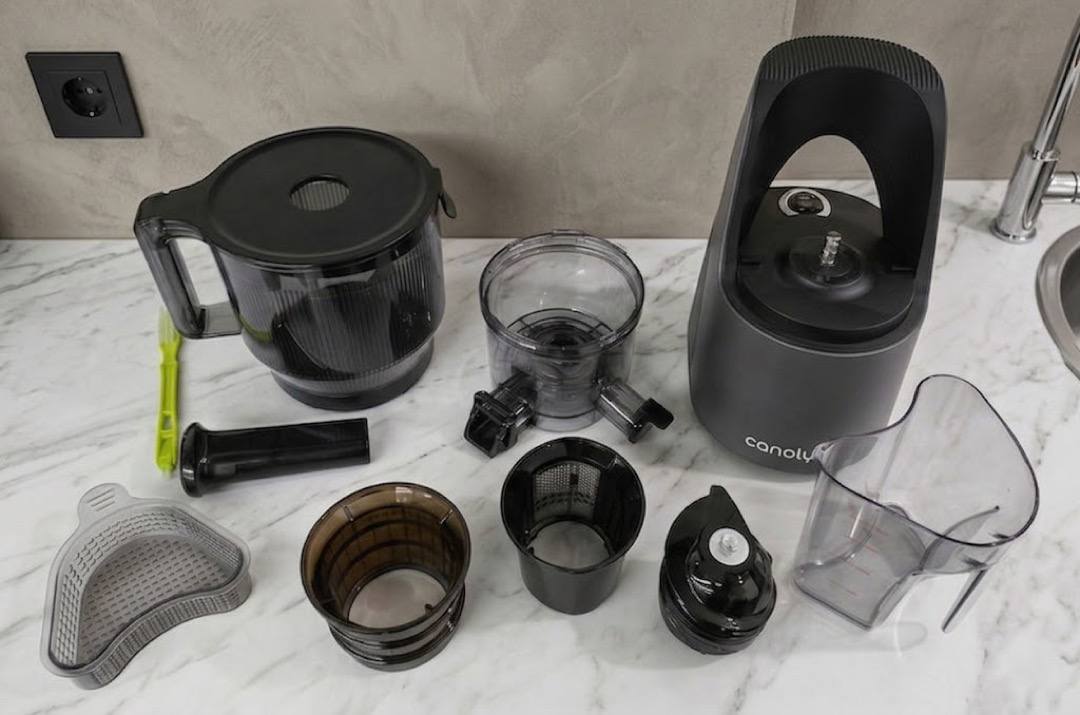
Nearly every juicer comparison I read sorts the two machines into a good one and a cheap one, then defends the ranking with nutrition claims that no one sources. That framing is wrong in a way that costs people money, because it sends someone who juices apples and carrots before work toward a slow machine they will resent, and it sends someone with a daily wheatgrass habit toward a fast machine that will hand them a wet green disc and about a teaspoon of juice.
I ran a restaurant group’s test kitchen for four years, and juice programs were part of that. The only thing that ever mattered when specifying a machine was one variable: how it separates liquid from fibre. Centrifugal machines shred produce with a fast flat blade and fling the mash outward against a spinning mesh basket, letting centrifugal force push juice through the holes. Masticating machines drive produce into a slow-turning auger that crushes and squeezes it against a fixed screen. Speed, air, heat, yield, noise, prep, cleanup and which produce works all fall out of that single difference. Get it straight and every contested question in this comparison answers itself.
The Short Answer
Centrifugal juicers buy you speed. Masticating juicers buy you yield, quiet, and leafy greens.
Reach for a centrifugal juicer:
- Hard produce: apples, carrots, beets, cucumber, pears, firm citrus segments
- A single glass made fast on a weekday morning
- Your first juicer, when you are still finding out whether the habit sticks
- The lowest price of entry into real juicing
- Whole apples that fit a wide chute with no chopping
Reach for a masticating juicer:
- Leafy greens, herbs, sprouts, and wheatgrass
- Soft fruit and berries
- Maximum yield from expensive organic produce
- Early mornings in a house with thin walls or a sleeping baby
- Juice you want to keep in the fridge for a day or two
| Centrifugal | Masticating (slow) | |
|---|---|---|
| Mechanism | Flat blade shreds, spinning mesh basket flings the mash outward, centrifugal force pushes juice through | Slow auger crushes produce and squeezes it against a fixed screen |
| Speed | Roughly 6,000 to 14,000 RPM | Roughly 40 to 110 RPM |
| Best produce | Hard produce: apples, carrots, beets, cucumber | Leafy greens, herbs, wheatgrass, soft fruit, plus all hard produce |
| Yield | Lower, damp pulp leaves the machine after one pass | Higher, typically cited as around 30 percent more |
| Pulp | Wetter, coarser, still squeezable by hand | Drier, finer, close to spent |
| Foam and separation | Heavy foam cap, layers separate within minutes | Little foam, stays integrated noticeably longer |
| Noise | Roughly 80 to 90 dB, comparable to a blender | Roughly 45 to 65 dB, closer to conversation |
| Prep | Minimal for hard produce, wide chute swallows whole apples | More chopping, narrower chute, greens fed in with harder produce |
| Cleanup | Fewer parts, but the mesh basket needs a stiff brush every time | More parts, though the screen usually rinses more easily |
| Price tier | Entry-level to mid | Mid to premium |
| Footprint | Compact and tall | Vertical models compact, horizontal models long |
How Each One Actually Works
Centrifugal: Shred and Fling
Lift the lid off a centrifugal juicer and you find a flat disc with rasping teeth sitting in the floor of a conical mesh basket. The motor drives that assembly at something in the region of 6,000 to 14,000 RPM. Food pressed down the chute meets the teeth, gets shredded into wet confetti in a fraction of a second, and is thrown outward by rotation against the sloped mesh wall. Spinning that fast generates enough force at the wall to push liquid through thousands of small holes, while the solids climb the slope and drop off the top edge into a pulp bin.
Three consequences follow immediately. The chute can be wide, because the disc destroys anything you drop on it and nothing has to be sized to fit a gap, which is why these machines take a whole apple and why they are so much faster in practice than the RPM difference alone suggests. Each piece of produce is separated once, in a single outward pass, so whatever juice does not clear the mesh in that instant leaves with the pulp. And the whole process happens inside a small chamber full of moving air, so the juice arrives in the jug aerated, foamed, and already in contact with oxygen.
The blade is also the reason thin leaves fail. A kale leaf has no mass to speak of. It hits the teeth, gets pinned flat against the basket by rotation before it can be cut properly, and rides up and out largely intact. You can improve this by rolling greens tightly and sandwiching them between two carrots so hard produce drives them into the blade, and it will still not match what an auger does.
Masticating: Crush and Squeeze
A masticating juicer has no blade in the cutting sense. It has an auger, a thick tapered screw of hard plastic or steel, turning at roughly 40 to 110 RPM inside a fixed perforated screen. Produce is drawn in by the auger flight, broken open by the ridges, then carried along a passage that narrows steadily. As the space shrinks, the produce is crushed against the screen under real pressure, juice is forced out through the holes, and the compressed fibre is extruded from a pulp port at the far end.
That is a press with continuous feed rather than a batch of separate pulses, and it explains the numbers people quote without explaining. Yield is higher because squeezing under pressure extracts more from the same fibre than one outward fling does. Foam is lower because there is barely any air movement inside the chamber at 60 RPM. Heat is lower for the same reason, since heat comes from friction and friction scales with speed. The auger handles greens easily because a leaf caught between an auger flight and a screen has nowhere to escape to, which is precisely the situation a spinning basket never creates.
The costs are equally direct. The chute has to be narrow, because the auger can only pull in what fits between its flight and the chamber wall, so you chop more. The machine works slowly by design, and pushing it faster by stuffing the chute just jams it. Fibrous produce can wrap around the auger shaft if you feed long stringy pieces, which is why celery and kale stems should go in as short lengths. And with more internal geometry there are usually more parts to wash, even though the screen itself tends to rinse more easily than a fine centrifugal mesh.
What the Science Actually Says
This is where most comparisons stop being useful, because the nutrition claim is the reason people spend the extra money and almost nobody sources it.
The most directly relevant controlled study is Khaksar, Assatarakul and Sirikantaramas, published in Heliyon in 2019 under the title “Effect of cold-pressed and normal centrifugal juicing on quality attributes of fresh juices.” They ran pineapple, guava, carrot, red dragon fruit and white dragon fruit through cold-pressed juicing, centrifugal juicing and a blender, then measured ascorbic acid, total phenolics, total carotenoids, and antioxidant capacity by both FRAP and DPPH. Across those measures they found no significant difference in bioactive compounds or antioxidant capacity between cold-pressed and centrifugal juice, and they wrote that the results “strongly question the claim regarding the superior quality of cold-pressed juices.” The full paper is open access at PMC6587058.
The same study is the best available data on storage, and that part is more actionable than the extraction comparison. Juice held at room temperature, around 28C, degraded significantly within 48 hours. Refrigerated at 4C, quality held through day 5, declined at day 6, and was at its lowest by day 7.
Now the limits, because a study used as a hammer is worth less than a study read honestly. This one tested fruit and carrot. It did not test leafy greens or wheatgrass, which are exactly the produce where the mechanical difference between the two machines is largest. The centrifugal run times were short, which means less blade contact and less aeration than a long session with a heavy load would produce. And it is one study. A different one, Kim and colleagues in 2017 working with grape juice, did find an advantage for masticating extraction.
The conclusion that survives both papers is narrower than either camp wants. The variable that matters is RPM and how long the juice is exposed to air and blade heat, not the category label on the box. A slow machine reduces both, so a real difference can exist in the right conditions. Where researchers have measured it directly on common produce, the difference has been small enough that it should not be the deciding factor in a purchase. Buy on yield, produce type, noise and how likely you are to use the thing.
One claim deserves to be retired outright: live enzymes. The idea that slow juicing preserves enzymes that fast juicing destroys is raw-food folklore going back to the Norman Walker era, and it does not survive contact with digestion. Dietary plant enzymes are proteins, and stomach acid denatures the great majority of them regardless of which machine made the juice. The precise-sounding tables that circulate on brand blogs, the ones promising something like 94 percent enzyme retention against some lower figure, cite sources that cannot be verified when you go looking for them. Numbers that specific with no traceable method behind them are marketing, and treating them as data is how buyers end up paying for the wrong machine.
The 72-Hour Shelf Life Claim, Untangled
You will see it stated as a hard specification: centrifugal juice lasts 24 hours, masticating juice lasts 72. It is borrowed from the wrong industry.
Commercial cold-pressed juice does get several days of shelf life, and the reason is HPP, high pressure processing. Sealed bottles are placed under enormous hydrostatic pressure after filling, which inactivates most spoilage organisms without heat. That is a post-bottling step, it requires industrial equipment, and no home juicer of any type performs it. The shelf life belongs to the process, not to the auger.
Juice from either machine at home is the same food-safety problem: an unpasteurised, nutrient-rich liquid at room temperature. Refrigerate it immediately in a container filled to the top and sealed, since headspace is oxygen. The Heliyon data above is the most useful benchmark available, holding quality to about day 5 at 4C, with a clear decline after that.
What is true is that masticating juice looks fresher for longer. Less air goes in, so there is less foam and slower separation into layers, and a glass poured from yesterday’s batch still looks like juice rather than like sediment under a cloudy cap. That is a genuine advantage for anyone who batches. It is a difference in appearance and oxidation rate, not a licence to keep it three days when you would have thrown out the other. I treat any home juice as a two-day item and drink most of it the day it is made.
Yield, Pulp and the 30 Percent Claim
The “roughly 30 percent more yield” figure follows every masticating juicer around. The direction is right: crushing and squeezing against a screen extracts more per pass than shredding and flinging, and it is not a subtle effect when you are juicing something expensive. The precision is not right, because not one of the sites citing that number names a study, a produce list, or a test method. Treat it as a typical order of magnitude rather than a specification, and expect the real gap to swing widely with what you are juicing. On soft berries and leafy greens it can be much larger. On a bag of carrots into a good centrifugal machine, much smaller.
There is a test you can run in your own kitchen that beats every published figure, because it uses your produce and your machine. Take a handful of spent pulp out of the bin and squeeze it hard over a bowl. If liquid runs, that is juice you paid for and threw away, and it is the honest measure of how well your machine is extracting. Wet pulp from a centrifugal machine is normal. Wet pulp from a masticating machine usually means you fed it too fast, packed the chute, or need to clean the screen.
Pulp is worth keeping either way, and the drier masticating pulp is actually the less useful of the two in the kitchen because so little is left in it. Carrot and celery pulp goes into vegetable stock, and it is the cheapest stock addition in the kitchen given you already bought it. Fruit pulp goes into muffins and quick breads in place of some of the liquid. Vegetable pulp dehydrated with seeds and a little oil makes a passable cracker. Everything else goes to compost. If you dislike texture in the glass, pouring finished juice through a fine mesh strainer does more for the mouthfeel of centrifugal juice than any setting on the machine.
Noise
This is the factor people underweight before buying and complain about within a week.
Typical ranges, and they are ranges rather than absolutes since load and build both move the number:
- Centrifugal: roughly 80 to 90 dB
- Vertical masticating: roughly 45 to 60 dB
- Horizontal masticating: roughly 50 to 65 dB
- Twin-gear triturating: roughly 55 to 70 dB
The mechanism explains the gap completely. Noise here comes from two sources: motor speed, and the impact of a cutting edge striking produce. A centrifugal machine has both at maximum, a small motor spinning at thousands of RPM and a blade hammering an apple hundreds of times a second, inside a plastic housing that acts as a resonator. A masticating machine has a motor turning slowly through gear reduction and an auger that crushes rather than strikes. There is no impact event to make noise.
In practice, 85 dB is the same neighbourhood as a blender or a food processor. It is a sound that travels through floors and shared walls, and it lasts the whole time the machine runs. A 6am centrifugal juicer wakes a household, and that single fact has decided more of the juicer purchases I have advised on than any nutrition argument. If your juicing happens early and other people are asleep, buy masticating and stop reading comparisons.
The Third Category Nobody Mentions: Twin-Gear (Triturating)
Every comparison treats this as a two-way choice. There is a third mechanism, and for a small group of people it is the right answer.
A twin-gear or triturating juicer runs two interlocking metal gears at roughly 60 to 160 RPM, turning inward against each other. Produce is drawn into the mesh point, sheared between the gear teeth, then pressed as the closing gap squeezes what is left. It is a two-stage action, shear and then press, where a single auger does both jobs at once in a taper.
The result is the highest yield of any home mechanism, and the widest gap shows up exactly where you would predict: wheatgrass, fibrous greens, herbs and sprouts, where shearing the cell structure before pressing releases far more than pressing alone. Twin-gear machines also grind. Fitted with the right plate they make nut butters, grind seeds, and handle frozen fruit for sorbet, which no centrifugal machine and few single-auger machines will do properly.
The costs are real. These are the most expensive home juicers by a clear margin, they have the most parts to disassemble and scrub, they are heavy, and they are slow to feed. Who they are actually for: someone running a serious daily green program, particularly with wheatgrass, who already knows the habit has stuck and is spending enough on organic produce that a yield difference pays back in groceries. For everyone else it is more machine than the job needs.
Horizontal vs Vertical Masticating
Once you have decided on masticating, this is the next real choice, and it gets far less attention than it deserves.
Vertical machines stand the auger upright in a tall chamber. The footprint is small, which matters on a crowded counter. Gravity assists feeding, so produce drops toward the auger rather than needing to be pushed along a tube, and that makes them noticeably quicker to work with. Most vertical models are simpler to rinse because the chamber lifts off as one piece. Their weakness is very fibrous greens, where long strands can wrap the auger and clog the chamber, so you cut greens short and alternate them with harder produce.
Horizontal machines lay the auger on its side in a long tube. They take more counter length, and feeding requires more deliberate pushing since gravity does not help. What they give back is better handling of wheatgrass and stringy greens, because the long straight chamber lets fibre travel and exit rather than balling up around a vertical shaft. Horizontal models also tend to carry the attachment ecosystem: homogenising screens for nut butter and frozen sorbet, pasta extrusion dies, mincing plates, baby food screens. If juicing is one of several jobs you want from the machine, horizontal is where that lives.
Simple rule: daily wheatgrass or a genuinely green-heavy program pushes horizontal. Mixed produce and a small kitchen pushes vertical. The best juicers for celery tend to land on the horizontal side for exactly this reason, since long celery fibre is the classic wrap-around case.
Which Produce Goes in Which
Hard produce works in both, and centrifugal is faster. Apples, carrots, beets, cucumber, celery, ginger, firm pears, fennel and hard root vegetables all have plenty of free water in cells that rupture easily, so both mechanisms get good juice out of them. The centrifugal machine does it in a fraction of the time and, on a wide-chute model, with almost no chopping. Carrots are the clearest case of a produce item where the fast machine is not a compromise at all, and if that is the bulk of what you drink the health case for carrot juice is worth reading before you spend more than you need on the machine. Ginger is the exception among hard produce: it is dense and stringy enough that fibre management matters, and the best juicers for ginger skew masticating for that reason.
Leafy greens, herbs, wheatgrass and sprouts strongly favour masticating. This is the largest performance gap between the two mechanisms and it is not close. Thin leaves have no mass to drive them into a spinning blade, so a centrifugal machine flattens them against the basket and discards them barely touched. Wheatgrass in a centrifugal juicer is close to a total loss. An auger squeezes them against a fixed screen with nowhere to escape. If greens are the point of your juicing, the mechanism decides the purchase on its own. Celery sits in an interesting middle position, hard enough to juice in either machine but stringy enough that a slow auger gets substantially more out of it, which is why so much of the celery juice crowd ends up on masticating machines.
Soft fruit and berries favour masticating. Strawberries, grapes, citrus segments, tomatoes, peaches and melon have delicate structure that a high speed blade turns to purée, and purée blinds a mesh basket. An auger presses them gently and the screen stays clear.
Citrus is really a press job. Both machines will juice oranges and grapefruit once you have removed the peel, and neither does it as well or as quickly as a dedicated press, which squeezes the segment directly and leaves the membrane behind. If a morning glass of orange juice is your main use, a hand press juicer costs a fraction of an electric machine, cleans in ten seconds, and gives better juice.
Nothing juices low-water fruit. Bananas, avocados, mango flesh, papaya and coconut have their water bound up in starch, pectin and fat rather than sitting free in cells, so there is nothing to separate. Either machine turns them into paste that clogs the screen. Those belong in a blender, where the whole fruit stays in the glass, which is the actual mechanism behind an acai bowl and the reason blending is a different food rather than a rougher form of juicing.
Large volumes of fruit for preserving are a fourth mechanism entirely. If you are processing bushels of apples, grapes or berries for canning rather than making a glass to drink now, neither of these machines is built for it. A steam juicer uses heat and gravity to extract juice from whole fruit in bulk and delivers it hot and ready to seal, which is a completely different job.
How to Choose: Four Real Cases
A morning glass before work, mostly hard produce. Buy centrifugal. Speed wins because the machine you actually use beats the machine that theoretically extracts more, and a masticating juicer that adds ten minutes of chopping and feeding to a rushed morning becomes a cupboard ornament by week three. Apples, carrots and beets juice well in a fast machine, the yield penalty on hard produce is at the smaller end of the range, and you can drink it immediately so the oxidation question never arises. Any decent stainless steel juicer in the entry to mid tier covers this well.
A leafy green and wheatgrass program. Buy masticating, and go horizontal if wheatgrass is a daily thing. This is the case where the mechanism difference is large enough to change what ends up in the glass rather than just how much. The extra cost pays for itself in produce you are no longer throwing into the pulp bin, and if you are buying organic greens the payback is faster than people expect. My picks by auger type are in the best cold press juicers guide.
Batch prep on Sunday for the week. Buy masticating, and adjust your expectations. Less aeration means slower separation and better appearance across a few days, and the storage data supports quality holding to around day 5 refrigerated at 4C in a filled, sealed container. Even so, the juice is at its best in the first day or two, and I would rather batch two or three days at a time than the full week. Two shorter sessions gets you better juice than one heroic one.
Shared walls, an early riser, or a sleeping baby. Buy masticating on noise alone and let every other factor sort itself out. Roughly 85 dB at 6am versus roughly 55 dB is not a preference, it is whether you can juice at all in the hours you are awake. This is the single most reliable predictor I have found of whether someone still owns their juicer a year later.
Two machines, two mechanisms, one dividing line. If it shreds with a fast blade and lets rotation push juice through a spinning mesh, that is centrifugal, and everything about it follows: quick, loud, foamy, cheaper, poor with leaves. If it crushes with a slow auger and squeezes against a fixed screen, that is masticating, and everything about that follows too: slower, quiet, higher yield, drier pulp, good with anything green. Match the mechanism to what you drink and when you drink it, and the nutrition argument you came here to settle turns out not to be the question worth asking.
Frequently Asked Questions
What are the disadvantages of a centrifugal juicer?
Should I get a masticating or centrifugal juicer?
What type of juicer is healthiest?
What fruits cannot go in a juicer?
Why can't you juice a banana?
Related Articles
About the Reviewer

Nora Whitfield, CIA Culinary Arts, ServSafe Certified
A.O.S. Culinary Arts, The Culinary Institute of America
Nora Whitfield trained at the Culinary Institute of America and spent twelve years in professional kitchens, the last four running the test kitchen for a regional restaurant group where her job was to decide which equipment could survive a dinner service and which could not. She has seasoned more carbon-steel woks than she can count, boiled water in every kettle worth owning, and broken enough cheap gear to know exactly where manufacturers cut corners. She reviews kitchen equipment the way she specified it professionally: cook on it, clean it, and see what it looks like after a month.