Best Stainless Steel Steam Juicers of 2026
The best stainless steel steam juicers of 2026, chosen by CIA-trained chef Nora Whitfield: 9 steam extractors compared on capacity, steel grade, drain design and why stainless matters here.
Updated
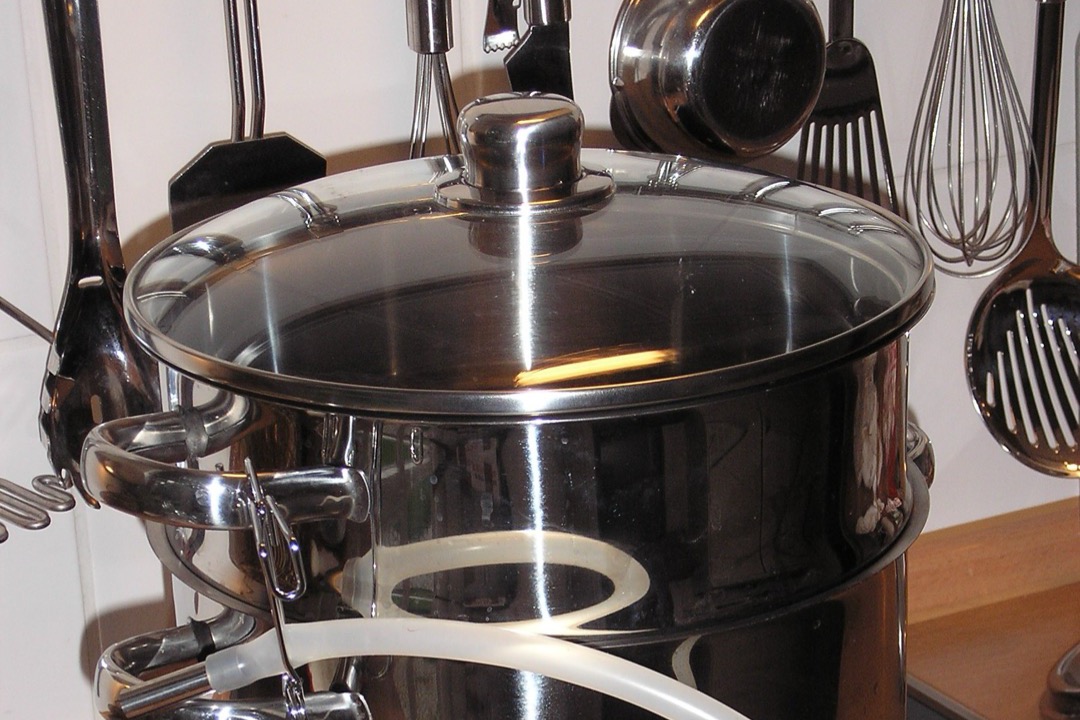
A steam juicer is the least fashionable pot in this guide and the only one that will still be doing its job in thirty years. It is three tiers stacked like an oversized double boiler: water boils in the bottom, steam rises through a cone in the middle chamber and into a perforated basket of fruit on top, the fruit bursts, and the juice runs back down into the middle chamber and out through a hose. There is no motor, no blade, no auger and nothing to burn out. The whole machine is a pot with a hole in it.
What it does that no electric juicer can is deliver large volumes of clear juice that is already hot, ready to go into jars for a water-bath canner, into a jelly pan, or into the freezer. That is the entire point. This is not a breakfast appliance and it is not competing with a cold press, which is a different machine for a different job and covered in our celery juicer guide. It is harvest equipment, for the September afternoon when a vine has given you more grapes than anyone can eat and the alternative is watching them spoil.
Which brings me to why the search term is stainless steel steam juicer rather than simply steam juicer, and to the one fact that should shape this purchase. The earliest units were aluminium, because the complex spun shapes were easy to make that way, and some were enamelled steel. Fruit juice is acidic, and in a steam juicer it sits hot in the collecting chamber for the length of the run. Long dwell times with acid juices in aluminium are specifically not recommended, and the industry’s move to stainless happened to stop aluminium leaching into the juice during preparation. That single fact turns stainless steel from a quality adjective into a functional requirement, and it also draws the distinction that matters most when you read these listings: an aluminium disc encapsulated in the base is good, because it spreads heat and stops the bottom scorching, and it never touches your juice. An aluminium body is what you are avoiding.
I compared nine stainless units for 2026, from a 5-quart stackable pot aimed at apartment kitchens to the original Finnish design in 18/10 steel with a ten-year warranty. Every ASIN was verified as a live, in-stock, buyable listing in a browser, and every price was cross-checked against Amazon’s own product API before publication. Two of these listings publish their steel alloy. The other seven do not, and that gap is the single most useful thing in the comparison table below.
| Product | Price | Buy |
|---|---|---|
| Cook N Home 11-Quart Stainless Steel Steam Juice ExtractorBest Overall | $112.49 | View on Amazon |
| Giantex 11-Quart Stainless Steel Juice Steamer ExtractorBudget Pick | $69.99 | View on Amazon |
| The Original Mehu-Liisa 11 Liter Stainless Steel Steam JuicerPremium Pick | $219.95 | View on Amazon |
| Cooks Standard 11-Quart Stainless Steel Steam Juicer PotRunner-Up | $79.99 | View on Amazon |
| VINEYARD Deluxe Stainless Steel Steam Juicer and Roaster SetRunner-Up | $139.99 | View on Amazon |
| Norpro 619 Stainless Steel Steamer and JuicerRunner-Up | $182.29 | View on Amazon |
| Euro Cuisine EC9500 Stove Top Steam JuicerRunner-Up | $92.99 | View on Amazon |
| Lehman's Mehu-Maija 11-Quart Stainless Steel Steam JuicerRunner-Up | $163.98 | View on Amazon |
| VIVOHOME 5-Quart Stainless Steel Steam JuicerRunner-Up | $66.49 | View on Amazon |
Find the Best Steam Juicer for Your Need
Jump straight to the job you are actually trying to do.
- Best stainless steel steam juicer overall
- Best steam juicers for canning
- Best steam juicers for grapes
- Best steam juicers for apples
- Best large capacity steam juicers
- Best compact steam juicers
- More use cases
How We Chose These Steam Juicers
The reliable information in this category does not come from kitchen review sites, which barely cover it. It comes from two places: university extension services, which teach steam juicing as part of home food preservation and publish tested guidance on how to run one safely, and the documented history of the design itself, which is Finnish, patented in its modern form in the 1980s, and manufactured under names most American buyers have never heard of.
That history is not trivia, it is buying information. It tells you which brands have actually been in this business, why the units that publish an alloy grade are the ones with European manufacturing lineage, and why the aluminium question exists at all. It also sets the expectation for what a good one costs, which is more than most people expect for a pot with no moving parts.
What this page contributes is breadth and verification. Nine units rather than the four or five most roundups manage, spanning 5 to nearly 12 quarts and 53 to 220 dollars, covering both drain systems and both traditional and modern manufacturing. Where a listing publishes a fact it is stated as one: 18/10, 18/8, 11.75 quarts, 500F, 4mm glass, a 17 inch hose. Where a maker makes a claim, it is attributed rather than asserted, which is why professional gauge appears in quotation marks in the table rather than as a grade. And where a listing declines to publish something, this page says not published, which is why that phrase appears in the steel grade column seven times out of nine.
Best Stainless Steel Steam Juicer Overall
Nine units, each reviewed once, in the order I would consider them.
Cook N Home 11-Quart Steam Juice Extractor: Best Overall
This is the one I would buy for most kitchens, and the argument is mostly about evidence. It carries 2,235 reviews at 4.8 stars, which is three times the depth of the next-best record in this guide. In most categories I would treat that as a nice-to-have. In this one it is close to decisive, because a steam juicer is used for a few weeks a year and its real failure modes take seasons to appear. A hose perishes in year three. A thin base warps after enough hard boils. A clamp starts weeping. A record of two thousand owners across many harvests has watched all of that happen or fail to happen, and that is a different quality of information than a 4.9 across two hundred reviews from one season.
The construction is right in the way that matters. There is an aluminium disc layered into the base, which is exactly where you want aluminium: it spreads heat across the bottom so the water boils evenly and nothing scorches, and it is nowhere near the juice. The kit is complete, with the water pan, juice pan, strainer pan, lid and hose with clamp all in the box, and it is induction compatible along with every other hob type.
The detail that earns it the top spot over the cheaper Giantex is what it does the rest of the year. Lift out the centre tier and the tube, and what remains is an ordinary 11-quart stockpot with a steamer insert. For a pot this size, in a normal kitchen, that is the difference between a tool and a storage problem.
Two things to hold against it, both about the listing rather than the pot. It never publishes a steel grade, so the alloy is unknown. And its own care guidance manages to describe the pot as dishwasher safe and recommend hand washing inside a single sentence, which is not a defect but does tell you how much attention the copy received.

Cook N Home 11-Quart Stainless Steel Steam Juice Extractor
by Cook N Home
The best stainless steel steam juicer overall: a complete 11-quart kit with an encapsulated aluminium base for even heat, behind a review record five times deeper than most of this category.
Pros
- 2,235 reviews at 4.8 stars is by far the deepest owner record in this category, which matters more than usual for a pot that only gets used a few weeks a year and takes seasons to reveal its faults
- A complete kit at a mid-range price: water pan, juice pan, strainer pan, lid, and hose with clamp, with nothing left to buy separately
- The aluminium disc is layered into the base rather than forming the body, which gives even heating without putting aluminium in contact with acidic juice
- The centre tier and tube lift out so the remaining pieces work as an ordinary stockpot and steamer, which is what stops a once-a-year pot dominating a cupboard
Cons
- The listing never publishes a stainless grade, so whether the body is 304 or 430 is unknown, and it is the specification that decides how it ages against fruit acid
- Its own bullet heading reads Sturdy Aluminum Construction before the text clarifies that the aluminium is a layer in the base, which is careless wording in a category where that distinction matters
- Care guidance contradicts itself, describing the pot as dishwasher safe and then recommending hand washing in the same sentence
Giantex 11-Quart Juice Steamer: Best Budget
The Giantex gives you the full 11 quarts, the capacity that makes a serious afternoon of processing worthwhile, at roughly a third of what the Finnish units cost and well under the Cook N Home. If the pot is going to be used a handful of times before you decide whether steam juicing is really for you, this is the sensible way to find out.
Two construction details are better than the price suggests. The loop handles on all three tiers are welded rather than riveted, and that matters specifically here: you are lifting a chamber full of scalding juice, and a riveted handle that works loose over seasons is the failure that actually hurts someone. The lid is tempered glass with a stainless protected edge, so you can watch the extraction without lifting it and dumping the steam you have spent twenty minutes building. The base is flat aluminium-clad for even heating and it works on induction.
The reservations are about what surrounds the pot rather than the pot itself. No steel grade is published, which at the budget end is where you would most like to know. The listing is written in dense marketing prose with an emoji heading every bullet, which makes the real specifications harder to extract than they should be. And Giantex is a general import house rather than a preserving specialist, so if something goes wrong in the middle of a harvest week there is no canning-side support to call on. At 746 reviews and 4.8 stars, though, the evidence says the thing works.

Giantex 11-Quart Stainless Steel Juice Steamer Extractor
by Giantex
The value pick: a full 11 quarts with a tempered glass lid and welded loop handles at roughly a third of the price of the Finnish units, with the alloy left unstated.
Pros
- A full 11 quarts at the lowest price of any large unit here, which is the capacity that makes a whole afternoon of grape processing worth setting up for
- The tempered glass lid has a stainless steel protected edge, so you can watch the extraction without lifting the lid and losing steam
- Loop handles are welded to all three tiers rather than riveted, and welded handles are what survive being lifted full of scalding juice
- 746 reviews at 4.8 stars is a strong record at this price, and tied for the highest score in the guide
Cons
- No stainless grade published anywhere, and at this price point the alloy question is the one you would most want answered
- The listing is written in heavy marketing language with an emoji before every bullet, which makes the genuine specifications harder to find than they should be
- Giantex is an import house rather than a preserving brand, so there is no canning-specific support behind it if something goes wrong mid-season
The Original Mehu-Liisa 11 Liter: Best Upgrade
This is the reference standard, and it is the unit every other pot in this guide is a version of. Mehu-Liisa is Finnish, steam juicing is genuinely domestic tradition there rather than a homesteading niche, and the design that spread across the world under a dozen brand names started here and at its sibling Mehu-Maija.
Three things justify the price, and only one of them is the name. The first is that the listing states 18/10 professional gauge stainless, which makes it one of only two units in this guide willing to publish an alloy at all, and the highest grade among them. In a pot whose job is holding hot fruit acid, the nickel content that 18/10 describes is the property that matters most. The second is a ten-year manufacturer warranty on all steel parts, which is an order of magnitude beyond anything else here and is the clearest possible statement of what the maker expects the pot to survive. The third is the drain: a silicone tube with a stainless clamp rather than the rubber hose almost everything else ships. Rubber perishes, hardens and discolours, and on most steam juicers it is the first component to fail. Silicone does not age the same way.
Two honest cautions. It costs about three times the Giantex for the same nominal capacity, and what the premium buys is alloy, warranty and longevity rather than a drop more juice, so the case for it rests entirely on using it every harvest for decades. And the listing never mentions induction compatibility anywhere, which on a pot at this price is a genuinely strange omission. If your hob is induction, confirm that before buying.

The Original Mehu-Liisa 11 Liter Stainless Steel Steam Juicer
by Mehu-Liisa
The reference standard: the original Finnish design in stated 18/10 steel with a ten-year warranty on the steelwork, for people who will use it every harvest for decades.
Pros
- 18/10 professional gauge stainless is stated explicitly, one of only two listings in this guide that publishes an alloy at all, and it is the highest grade here
- A ten-year manufacturer warranty on all steel parts, which is an order of magnitude beyond anything else in this category and tells you what the maker expects of it
- This is the original Finnish design the whole category copies, and Finland is where steam juicing is genuinely part of the domestic tradition rather than a niche
- A silicone tube with a stainless clamp rather than the rubber hose most units ship, and the hose is the component that degrades first on a steam juicer
Cons
- It costs roughly three times the Giantex for the same nominal capacity, and most of that premium buys alloy, warranty and provenance rather than more juice
- The listing does not state induction compatibility anywhere, which on a pot at this price is a strange thing to leave out and worth confirming before you buy for an induction hob
- 375 reviews is a modest record next to the Cook N Home, though it is deep for a unit at this price
Cooks Standard 11-Quart Steam Juicer Pot: Best for Canning
Most listings in this category treat juice as the finished product. This one is written for people who are going to put that juice in jars, and it shows in the details. It talks about Mason jar workflows explicitly, it positions itself as a steam canner as much as a juicer, and it is built around the idea that the afternoon does not end when the hose stops running.
The two hoses are the detail I would pay for. Every other unit here except the VIVOHOME ships a single hose, and the hose is the component most likely to perish. Having the spare in the box before you need it, rather than hunting for a replacement mid-harvest for a pot whose manufacturer may have moved on, is worth more than it costs. The oven rating is the other standout: 500F is a hundred degrees above anything else here, which makes the base pot a genuine roaster in the eleven months it is not juicing. Read that figure carefully, though, because the tempered glass lid is rated to 350F, so the 500 applies to the pot on its own.
Everything else is named and specified: the encapsulated aluminium base, the tempered glass lid, the stainless clamp, dishwasher safety, compatibility with induction, gas, electric, glass, ceramic and halogen. For a category this vague, that is unusually complete. The limitation is evidence. At 250 reviews it has the second-thinnest record here, so you are buying a well-specified pot rather than a well-proven one.

Cooks Standard 11-Quart Stainless Steel Steam Juicer Pot
by Cooks Standard
The canner's choice: built around Mason jar workflows, oven safe to 500F, and one of only two units here that ship a spare hose before you need one.
Pros
- Oven safe to 500F, which is the highest published figure here by a hundred degrees and turns the base pot into a genuine roaster between harvests
- Ships with two hoses rather than one, which sounds trivial until the single hose on a competitor perishes in year three and the unit is unusable
- The listing is explicit about Mason jar canning workflows rather than treating juice as an end product, which is the actual reason most people buy one of these
- An encapsulated aluminium base, tempered glass lid, stainless clamp and stated dishwasher safety, with every component named
Cons
- 250 reviews is the second-thinnest record on this page, so the long-run evidence is limited compared with the Cook N Home
- The glass lid is only rated to 350F against the pot's 500F, so the oven figure applies to the base without its lid and that distinction is easy to miss
- No stainless grade published, despite the listing being otherwise one of the most detailed here
VINEYARD Deluxe Steam Juicer and Roaster Set: Best Multi-Use
The strongest answer here to the question that decides whether a big pot stays in the cupboard: what does it do the rest of the year? Most steam juicers separate into pieces that are technically usable apart. This one separates into three vessels that are genuinely worth having on their own, an 8-quart stock pot, an 8-quart colander and a 4-quart juice kettle. That is a real colander, not a fruit basket you could use as one, and an 8-quart stockpot is the size most kitchens actually reach for.
It is also the only unit in this guide with silicone-coated handles. Every other pot here expects you to pick up scalding steel with a cloth. On a vessel that gets moved while full and hot, that is a meaningful safety and comfort difference, and it is strange that nobody else does it. The five-year warranty is second only to the Mehu-Liisa, and it comes from a brand whose actual business is home food preservation rather than cookware in general.
The compromise is proportion. The juice kettle is 4 quarts sitting under 8-quart tiers, which means a big load of fruit will fill the collector before the fruit is spent, and you will be draining mid-run. That is worth understanding beyond the inconvenience: juice drawn off partway through a run has a different composition from juice at the end, so a batch drained in stages is less consistent than one collected whole. The other gap is that the listing never states how the juice leaves the pot at all. No hose, no clamp, no spigot is named anywhere in the specifications, which on a steam juicer is a remarkable thing to leave out.

VINEYARD Deluxe Stainless Steel Steam Juicer and Roaster Set
by Kitchen Crop
The year-round pick: three vessels that genuinely work apart as a stock pot, a colander and a juice kettle, with insulated handles and a five-year warranty.
Pros
- The most genuinely multi-purpose unit here: an 8-quart stock pot, an 8-quart colander and a 4-quart juice kettle that all work independently year round
- Silicone-coated handles, which is the only unit in this guide that insulates its handles rather than expecting you to use a cloth on scalding steel
- A five-year warranty, second only to the Mehu-Liisa, from a brand whose business is home food preservation rather than general cookware
- Explicitly compatible with induction and smooth-top ranges, with a clad bottom, and the base pot is oven safe to 400F
Cons
- The juice kettle is 4 quarts against 8-quart tiers above it, so a big batch fills the collector before the fruit is spent and needs draining mid-run
- The listing never states how the juice actually leaves the pot, naming no hose, clamp or spigot anywhere in its specifications
- At this price the Cooks Standard offers a larger juice capacity and a higher oven rating, though with far less versatility
Norpro 619 Stainless Steel Steamer and Juicer: Best Large Capacity
If the constraint is how much fruit goes in at once, this is the pot. The steamer insert alone is 11.75 quarts, the largest published fruit capacity in this guide, sitting above a 7.25-quart water pot and a 4-quart juice container. For anyone processing a full lug of grapes or a tree’s worth of apples, fewer rounds is the whole game, and this does more per round than anything else here.
Norpro also has standing in this category that most of the brands on this page do not. It is one of the manufacturers named in the documented history of this design alongside the Finnish houses and Victorio, and it has been making preserving equipment for decades. The base pot is rated as an oven roaster, stovetop cooker and covered baker to 400F, so it works hard between harvests, and the encapsulated base handles induction. A recipe and instruction booklet is included, which is worth more than it sounds when the buyer has never done this before.
What holds it back is value rather than quality. It costs nearly as much as the Mehu-Liisa while describing its steel only as professional gauge, with no alloy published, and the Mehu-Liisa publishes 18/10 and backs it for ten years. It ships a rubber tube where the Mehu-Liisa ships silicone, and rubber is the part that perishes. At 367 reviews the record is respectable but thin for the money.
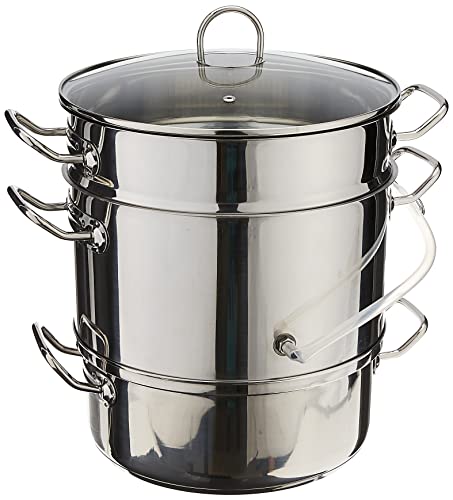
Norpro 619 Stainless Steel Steamer and Juicer
by Norpro
The biggest fruit basket here at 11.75 quarts, from a preserving specialist with real history in this design, held back by a rubber hose and an unstated alloy.
Pros
- The largest published fruit capacity in this guide at 11.75 quarts in the steamer insert alone, on top of a 7.25-quart water pot and a 4-quart juice container
- Norpro is a preserving-equipment maker with decades in the category, and it is one of the manufacturers named in the historical record of this design alongside the Finnish houses
- An encapsulated base for even heating on induction, and the base pot doubles as an oven roaster and covered baker rated to 400F
- A recipe and instruction booklet is included, which matters more than it sounds for a process most buyers have never done before
Cons
- It costs nearly as much as the Mehu-Liisa without publishing an alloy grade, describing the steel only as professional gauge
- The rubber tube is the weak point on any unit at this price, and rubber perishes where the Mehu-Liisa's silicone does not
- 367 reviews at 4.7 is a fair record but thin relative to what you are paying
Euro Cuisine EC9500 Stove Top Steam Juicer: Best Drain Design
Every other unit in this guide gets the juice out through a hose pinched shut with a spring clamp. This one has a spigot, a tap built into the wall of the juice chamber, and after you have done this once with a hose you will understand why that is worth a section of its own.
The hose method works, but the reality of it is holding a hot jar in one hand while releasing a clamp on a stiff tube with the other, trying to stop before the jar overflows, with scalding juice as the consequence of getting it wrong. A spigot is a tap. You put the jar underneath and you open it. It is also the only drain design here with nothing to perish: no rubber to harden, nothing to kink, nothing to discolour, and no replacement to source in five years for a pot the manufacturer may have discontinued.
The capacities support the same use case. The 8-quart juice container is the largest here, which means a full run of grapes collects in one go rather than needing to be drawn off in stages, and that gives you a consistent batch rather than one whose composition shifts from the first jar to the last.
Two trade-offs. A spigot is harder to clean properly than a hose, because a hose can be flushed through and hung up to dry while a tap body has internal geometry where fruit sugar can sit, so it needs deliberate attention rather than a rinse. And the 5-quart water reservoir is the smallest here relative to the juice capacity above it, so a long extraction may want topping up partway. The steel is described as professional gauge with no grade published.

Euro Cuisine EC9500 Stove Top Steam Juicer
by Euro Cuisine
The unit that solves the hose problem: a spigot you simply open, over the largest juice container in this guide, with no rubber tube to perish.
Pros
- A spigot instead of a hose and clamp, which is the single biggest usability difference in this guide: you open a tap rather than wrestling a pinched rubber tube over a jar
- An 8-quart juice container is the largest juice capacity here, so a full batch of grapes can run to completion without stopping to drain
- A spigot has no hose to perish, kink or discolour, removing the component most likely to end a steam juicer's life
- Compatible with induction, electric and gas, at a mid-range price from a brand that specialises in home preserving equipment
Cons
- A spigot is harder to clean thoroughly than a hose you can flush and hang to dry, and fruit sugars in a tap body are exactly where residue hides
- The 5-quart water reservoir is the smallest here relative to its juice capacity, so a long run may need topping up mid-extraction
- Professional gauge is the only description of the steel, with no alloy grade published
Lehman’s Mehu-Maija 11-Quart Steam Juicer: Best Published Dimensions
Mehu-Maija is the other original Finnish name in this category, the sibling to Mehu-Liisa, and Lehman’s is the American homestead and preserving supplier that carries it. If the Mehu-Liisa is the reference standard, this is the same tradition at three-quarters of the price.
It is also, by a distance, the best-documented listing in this guide. It publishes 18/8 stainless, making it one of only two here to name an alloy. It gives the dimensions of every chamber individually, the fruit basket at 5.5 inches high by 11 and 5/8 outer diameter, the juice and water kettles each at 5 and 5/8 high, and it even specifies the drain hose at 17 inches long by half an inch outer diameter. Nobody else in this category tells you the size of the hose. For anyone who needs to know whether a pot fits a particular burner or a particular shelf, this is the only listing that answers without a tape measure and a guess.
The reservations are straightforward. At 123 reviews it has the thinnest record on this page by a wide margin, which is a real limitation when you are spending this much. 18/8 is a step below the Mehu-Liisa’s 18/10 while costing only about a quarter less, which makes the gap to the better unit narrower than the gap down to the Cook N Home. And no warranty term is published, where both the Mehu-Liisa and the VINEYARD name theirs.

Lehman's Mehu-Maija 11-Quart Stainless Steel Steam Juicer
by Lehman's
The most precisely documented listing here, in stated 18/8 steel with every chamber dimensioned, on the thinnest review record in this guide.
Pros
- 18/8 stainless is published explicitly, making this one of only two listings in the guide that will name its alloy
- The only listing here that publishes the dimensions of every chamber individually, down to a 17 inch drain hose at half an inch outer diameter
- Mehu-Maija is the other original Finnish name in this category, and Lehman's is a preserving and homestead supplier rather than a general retailer
- Stated to work on any stove type including induction, with a glass lid for watching the extraction
Cons
- 123 reviews is the thinnest record on this page by a wide margin, which is a real limitation at this price
- 18/8 is a step below the Mehu-Liisa's 18/10, and the Lehman's costs only a quarter less
- No published warranty term, where both the Mehu-Liisa and the VINEYARD name theirs
VIVOHOME 5-Quart Steam Juicer: Best Compact
Every other pot in this guide assumes you have somewhere to put an 11-quart three-tier stack. This one does not, and it is the only sensible answer here for an apartment, a small kitchen or an RV. The tiers are a 5-quart colander, a 5-quart juice pot and a 4.3-quart cooking pot, and the listing is explicit that the modular design is meant to nest away in a cabinet rather than dominate one.
For a unit at the bottom of the price range it is better equipped than it needs to be. The tempered glass lid is 4mm with stainless edging, which is thicker glass than several units here at three times the price. It ships two hose and clamp kits, matching the Cooks Standard and beating everything else on spares. The handles are solid stainless welded on rather than riveted, and the aluminium sits as a disc in the base where it belongs, with a three-layer composite bottom that works on every hob type including induction.
Be clear about what the capacity means. Five quarts of fruit is a jam and jelly batch, not a canning session, and if the plan is to process a vine’s worth of grapes this pot will have you running four or five rounds where the Norpro runs one. Two listing cautions as well. The 509 reviews are pooled across the entire VIVOHOME capacity family, so the same number appears on the 9.3-quart and 11-quart versions and none of it is specific to this size. And the safety note at the bottom of the listing warns of a 500 degree Celsius tolerance and an 800 degree Celsius dry-heating risk, figures that are only coherent read as Fahrenheit. The advice underneath it, do not let the pot boil dry, is sound whatever the unit.

VIVOHOME 5-Quart Stainless Steel Steam Juicer
by VIVOHOME
The small-kitchen answer: a genuinely compact stackable three-tier unit with thick glass and spare hoses, on a review count pooled across every capacity in the range.
Pros
- The smallest footprint here by a distance, with a stackable modular design the listing specifically aims at apartments and RV kitchens
- A 4mm tempered glass lid with stainless edging, which is thicker glass than most units at any price in this guide
- Two hose and clamp kits included, matching the Cooks Standard and beating every other unit here on spares
- Handles are solid stainless welded rather than riveted, and the aluminium disc sits in the base rather than the body
Cons
- Its 509 reviews are pooled across the whole capacity family, so the identical count appears on the 5-quart, the 9.3-quart and the 11-quart listings and none of it is specific to this size
- Five quarts of fruit is a small batch, which makes this a jam-and-jelly unit rather than a serious canning pot
- The listing's own safety note is written in the wrong unit, warning of a 500 degree Celsius tolerance and 800 degree Celsius dry-heating risk, figures that only make sense in Fahrenheit
Best Steam Juicers for Canning
Canning is why most people buy one of these, and it changes what matters. Grapes, berries, apples, pears and tomatoes are the fruits and vegetables that extension services name as working well in a steam juicer, and tomatoes are worth remembering because they push this pot into savoury preserving as well as sweet, in the way that vegetable juices generally do. Steam extraction delivers juice hot, which speeds up filling jars, but it does not replace the canner. Iowa State’s extension service is explicit that draining juice into hot sterilised jars and capping them is not a safe practice; to be shelf-stable, the jars still go through a boiling water bath. What a canning-focused pot needs is a large juice collector so a batch runs to completion in one go, a drain you can operate one-handed over a hot jar, and a spare hose so a perished tube does not end your season. One more thing worth knowing before your first run: extension guidance is to steam for about 30 minutes, then give it another 15 if the fruit still holds juice, and to drop a few clean marbles into the water pot so they rattle as a warning before it boils dry.
| Product | Price | Buy |
|---|---|---|
| Cooks Standard 11-Quart Stainless Steel Steam Juicer PotBest steam juicer for canning Written around Mason jar workflows, oven safe to 500F, and one of only two units shipping a spare hose in the box | $79.99 | View on Amazon |
| Euro Cuisine EC9500 Stove Top Steam JuicerBest drain for filling hot jars A spigot you open one-handed over the largest juice container here, with no rubber tube to perish | $92.99 | View on Amazon |
| Cook N Home 11-Quart Stainless Steel Steam Juice ExtractorBest proven all-rounder for canning The deepest review record in the category on a complete kit that also works as a stockpot and steamer | $112.49 | View on Amazon |
Best Steam Juicers for Grapes
Grapes are the fruit this pot was designed around, and they are the easiest thing you will ever put in it. Small fruit goes in whole, so there is no destemming marathon: wash the clusters, pack the basket, and let the steam do the work. Extraction is finished when the fruit has completely collapsed, and it is worth leaving the collapsed grapes to sit for a while afterwards, because juice keeps running. If you have another load waiting, tip the spent fruit into a colander on the counter to finish draining while the next batch steams. One grape-specific step matters before the jars: let the juice stand so sediment settles, because grape juice is prone to tartrate crystals, the gritty deposit that otherwise turns up at the bottom of every jar and in your jelly. What a grape pot needs is a juice collector big enough to take a full run without draining partway, and enough basket to make a lug of Concords a manageable number of rounds.
| Product | Price | Buy |
|---|---|---|
| The Original Mehu-Liisa 11 Liter Stainless Steel Steam JuicerBest steam juicer for grapes Stated 18/10 steel against acidic grape juice, a silicone tube, and a ten year warranty for a pot that will see every harvest | $219.95 | View on Amazon |
| Euro Cuisine EC9500 Stove Top Steam JuicerBest for a full grape run in one go The 8 quart juice container is the largest here, so a full basket of grapes collects without draining partway | $92.99 | View on Amazon |
| Giantex 11-Quart Stainless Steel Juice Steamer ExtractorBest budget steam juicer for grapes A full 11 quart basket at the lowest large-unit price here, enough to work through a lug in a few rounds | $69.99 | View on Amazon |
Best Steam Juicers for Apples
Apples need a little more preparation than grapes and a lot more patience. Extension guidance is to cut apples and pears in half before steaming, and there is no need to peel or core them. They take longer to collapse than soft fruit, so a big load of apples is where a generous water pot and a large basket earn their keep. Set expectations on yield, too: home canners consistently report that a steam juicer gets less juice from apples than a press would, and the juice tastes cooked rather than fresh-pressed, which is why it suits canned juice and apple jelly better than a glass of morning cider. The upside is what is left behind. The spent apples are soft and intact, and pushing them through a food mill gives you applesauce or apple butter from the same afternoon’s work. Pears behave the same way and take the same advice.
| Product | Price | Buy |
|---|---|---|
| Norpro 619 Stainless Steel Steamer and JuicerBest steam juicer for apples An 11.75 quart basket over a 7.25 quart water pot, the most room here for bulky halved apples on a long run | $182.29 | View on Amazon |
| Cook N Home 11-Quart Stainless Steel Steam Juice ExtractorBest proven steam juicer for apples The deepest owner record in the category, on a full 11 quart kit that turns back into a stockpot after the harvest | $112.49 | View on Amazon |
| Giantex 11-Quart Stainless Steel Juice Steamer ExtractorBest budget steam juicer for apples Full 11 quart capacity for an apple batch at the lowest large-unit price, with a glass lid to watch the fruit collapse | $69.99 | View on Amazon |
Best Large Capacity Steam Juicers
Capacity is really a question about how many rounds you are prepared to run, and about which chamber the number on the box describes. A big fruit basket means less reloading. A big juice collector means the run finishes without you draining it partway, which matters for consistency as well as convenience, because the first juice off a batch is not the same as the last. As a planning figure, 9 to 10 pounds of grapes gives roughly 3 to 5 quarts of juice, so a serious harvest is several loads in almost anything on this page. If you are processing a full lug, buy the largest basket you can store.
| Product | Price | Buy |
|---|---|---|
| Norpro 619 Stainless Steel Steamer and JuicerBest large capacity steam juicer An 11.75 quart fruit basket, the biggest published here, from a preserving maker with real history in the design | $182.29 | View on Amazon |
| Euro Cuisine EC9500 Stove Top Steam JuicerBest large juice collector An 8 quart juice container so a full run collects in one go, drained through a spigot rather than a hose | $92.99 | View on Amazon |
| Giantex 11-Quart Stainless Steel Juice Steamer ExtractorBest large capacity on a budget A full 11 quarts with welded handles and a tempered glass lid at the lowest price of any large unit here | $69.99 | View on Amazon |
Best Compact Steam Juicers
A steam juicer is a genuinely large object, and the honest reason people give them away is storage rather than disappointment. If your kitchen is small, the choice is between a compact unit that runs more batches and a full-size unit that separates into pieces you will use for other things. Both are valid answers to the same problem. The VIVOHOME takes the first route with a stackable 5-quart design aimed at apartments and RVs. The VINEYARD takes the second, breaking down into a stock pot and colander good enough to earn their own shelf space. The Cook N Home sits between them, full size but reducing to an ordinary stockpot and steamer when the centre tier comes out.
| Product | Price | Buy |
|---|---|---|
| VIVOHOME 5-Quart Stainless Steel Steam JuicerBest compact steam juicer A stackable three-tier 5 quart unit aimed at apartments and RVs, with 4mm glass and two hose kits in the box | $66.49 | View on Amazon |
| VINEYARD Deluxe Stainless Steel Steam Juicer and Roaster SetBest small-kitchen unit that splits up Breaks into an 8 quart stock pot, a real colander and a juice kettle that each earn their own shelf space | $139.99 | View on Amazon |
| Cook N Home 11-Quart Stainless Steel Steam Juice ExtractorBest full size that stores as a stockpot Lift out the centre tier and tube and it is an ordinary 11 quart stockpot with a steamer insert | $112.49 | View on Amazon |
Best Steam Juicers by Use Case
A few more situations that come up often enough to name, each matched to the unit I would actually point you at.
| Product | Price | Buy |
|---|---|---|
| The Original Mehu-Liisa 11 Liter Stainless Steel Steam JuicerBest steam juicer for tomatoes Tomatoes are acidic too, and stated 18/10 steel is the grade best suited to long contact with hot tomato juice | $219.95 | View on Amazon |
| Lehman's Mehu-Maija 11-Quart Stainless Steel Steam JuicerBest documented steam juicer Every chamber dimensioned and an alloy published, down to the length and bore of the drain hose | $163.98 | View on Amazon |
| Cooks Standard 11-Quart Stainless Steel Steam Juicer PotBest steam juicer for jelly making Steam extraction pulls pectin above 165F, and this is the pot built around jars and set batches | $79.99 | View on Amazon |
| VINEYARD Deluxe Stainless Steel Steam Juicer and Roaster SetBest steam juicer and roaster An 8 quart stock pot, a colander and a juice kettle, with the base rated as an oven roaster to 400F | $139.99 | View on Amazon |
| Giantex 11-Quart Stainless Steel Juice Steamer ExtractorBest first steam juicer A full 11 quarts at the lowest large-unit price here, to find out whether steam juicing is for you | $69.99 | View on Amazon |
| VIVOHOME 5-Quart Stainless Steel Steam JuicerBest steam juicer for a small batch Five quarts and a stackable footprint, for jam batches in a kitchen with no room for an 11 quart stack | $66.49 | View on Amazon |
Buyer's Guide
A steam juicer is a simple machine with four things that can be wrong with it. It is bought once and used for decades, so the specifications that matter are the ones that determine how it ages rather than how it performs on day one.
Why stainless is the whole point of this search
The keyword people type is stainless steel steam juicer rather than steam juicer, and there is a real reason behind that even if most buyers could not name it. The original units were aluminium, because the complex spun shapes were easy to make that way, and some were enamelled steel. Fruit juice is acidic and it sits hot in the collecting chamber for the whole extraction, and long dwell times with acid juices in aluminium are specifically advised against. The move to stainless in modern units happened precisely to stop aluminium leaching into the juice. Understand the distinction that follows: an encapsulated aluminium disc in the base is good, because it spreads heat and prevents the scorching that ruins a batch, and it never contacts the juice. An aluminium body is what you are avoiding. Almost every unit here has the first and none has the second, which means the stainless question is really about grade rather than about presence.
Steel grade, which seven of nine listings will not tell you
Only two listings in this guide publish an alloy. The Mehu-Liisa states 18/10 and the Lehman's Mehu-Maija states 18/8, and those numbers are chromium and nickel percentages. Nickel is what gives stainless its resistance to acid attack, so it is exactly the property that matters when the pot's job is holding hot fruit acid for hours at a time, several days a season, for twenty years. Everything else on this page says stainless steel, or professional gauge, and stops. That is not a reason to avoid them, and the Cook N Home has 2,235 reviews demonstrating that whatever it is made from holds up. It does mean the two units that publish a grade are selling you something real for the premium, and it means an unpublished grade should be read as an unknown rather than as an assumption in the maker's favour.
How the juice actually gets out
Every unit here uses one of two systems and the difference is bigger than the listings suggest. A hose with a clamp is the traditional arrangement: a tube leaves the collecting chamber, a spring clamp pinches it shut, and you release the clamp to fill a jar. It is simple, it flushes clean easily, and the hose is the part that perishes, kinks or discolours and eventually needs replacing. Two units here ship a spare hose in the box, which is a quiet vote of confidence about how long the first one lasts. The alternative is the Euro Cuisine's spigot: a tap built into the chamber wall, which you simply open. Nothing to perish, nothing to kink, no fighting a stiff tube over a hot jar. The trade is cleaning, because a tap body with fruit sugar inside is harder to flush and dry than a hose you can hang up. One unit in this guide publishes no drain mechanism at all, which is a strange omission on a pot whose entire purpose is delivering juice into a jar.
Capacity, and which chamber the number describes
The quart figure on the box is almost always the fruit basket or the total stack, and the number that constrains a session is often the juice collector underneath it. The VINEYARD is the clearest illustration: 8-quart tiers above a 4-quart juice kettle, so a full load of grapes will fill the collector before the fruit is spent and force you to drain mid-run. The Euro Cuisine goes the other way with an 8-quart juice container, the largest here, so a batch runs to completion untouched. This matters for a reason that is not obvious: draining as the juice comes rather than at the end gives you a different composition from start to finish, since the first juice off is not the same as the last. If you want a consistent batch, you want a collector big enough to hold the whole run. As a planning figure, 9 to 10 pounds of grapes yields roughly 3 to 5 quarts.
What it does for the other eleven months
This is a large pot that gets used for a few weeks a year, and the single best predictor of whether people keep one is whether it earns its cupboard space the rest of the time. Every unit here separates, but they are not equally useful apart. The VINEYARD is the strongest case, with an 8-quart stock pot, a genuine colander and a juice kettle that all stand alone. The Norpro base pot is rated as an oven roaster and covered baker to 400F, and the Cooks Standard base goes to 500F, though note that its glass lid is only rated to 350F so the oven figure applies to the pot without it. The Cook N Home's tiers come apart into a stockpot and steamer. If storage is tight, weigh this more heavily than capacity, or buy the compact VIVOHOME and accept smaller batches.
Reading the listings, and one review count that is not what it looks like
Two cautions specific to this category. The first is review pooling: the VIVOHOME units share a single review count of 509 across the 5-quart, 9.3-quart and 11-quart listings, so the number attached to any one capacity tells you nothing about that capacity specifically. That is normal for a variant family and it is not deceptive, but it does mean the figure should not be compared like for like against the Cook N Home's 2,235. The second is that listings in this category are written loosely. One heads a bullet Sturdy Aluminum Construction before explaining in the body that the aluminium is a layer in the base, which is careless in a category where the aluminium question is the whole point. Another states its dishwasher safety and recommends hand washing in the same sentence. A third writes its temperature warning in Celsius when the numbers only make sense in Fahrenheit. Read the body text, not the headings.
How to Choose the Best Stainless Steel Steam Juicer
Start with the fruit, not the pot. Work out roughly how much you will process in a session, remember that 9 to 10 pounds of grapes gives about 3 to 5 quarts of juice, and then decide how many rounds you are willing to run in an afternoon. That answer sets your capacity, and it is a more honest starting point than the number on the box, because the number on the box usually describes the fruit basket while the chamber that limits you is often the juice collector underneath.
Then look for a published alloy, and treat its absence as information rather than as a dealbreaker. Two units here state a grade and seven do not. Since fruit acid sitting hot against metal is the fundamental stress on this pot, an 18/10 or 18/8 declaration is a real thing to buy, which is most of what the Finnish units are selling. If you go with an unpublished grade, lean on review depth instead, because a pot with two thousand owners across many harvests has already demonstrated what a spec sheet would have told you.
Decide next how the juice gets out, because this is the part you will actually operate with hot jars in your hands. A spigot is easier to use and has nothing to perish, and it is harder to clean thoroughly. A hose is simple and flushes clean and will eventually harden and need replacing, which is why the two units that ship a spare hose are quietly telling you something useful. Whichever you choose, check that the listing names a drain mechanism at all, since one on this page does not.
Finally, be honest about storage, because this is where steam juicers go to die. An 11-quart three-tier stack is a large object to house for a tool used a few weeks a year. Either buy one that genuinely breaks down into things you will use, a stockpot, a steamer, a colander, an oven roaster, or buy the compact unit and accept more batches. If what you actually wanted was fresh juice to drink this week rather than jars for the winter, a steam juicer is the wrong machine and our stainless steel juicers guide covers the cold press and centrifugal options, while our hand press juicers guide handles citrus.
Final Verdict
The Cook N Home 11-Quart Steam Juice Extractor is the stainless steel steam juicer I would put in most kitchens. It is a complete 11-quart kit at a mid-range price, the aluminium is in the base where it belongs rather than in the body where it does not, it reduces to a stockpot and steamer for the eleven months a year it is not juicing, and it carries 2,235 reviews at 4.8 stars, three times the depth of the next-best record in this category. For a pot whose faults take seasons to surface, that record is the strongest single argument available. If you want to spend as little as possible, the Giantex gives you the same 11 quarts with welded handles and a tempered glass lid at the lowest large-unit price here. And the Mehu-Liisa is the upgrade for someone who will use this every harvest for thirty years: the original Finnish design in stated 18/10 steel, with a silicone tube instead of rubber and a ten-year warranty on the steelwork.
Beyond that, buy to the job. The Cooks Standard if the jars are the point and you want the spare hose and the 500F base. The Euro Cuisine if you would rather open a tap than fight a clamp over a hot jar. The Norpro if the fruit basket is the constraint and 11.75 quarts saves you a round. The VINEYARD if the pot has to justify its shelf space all year. The Lehman’s Mehu-Maija if you want a published alloy and every dimension on the page. And the VIVOHOME if the kitchen is small and the batches are jam-sized. Whichever you pick, remember what steam juicing actually gives you: hot, clear juice in volume, ready for the water-bath canner or the jelly pan, at the cost of a cooked flavour that a cold press would not impose. That trade is the entire reason this pot exists.
Frequently Asked Questions
What is the best stainless steel steam juicer?
Does a steam juicer have to be stainless steel?
How much juice does a steam juicer produce?
Is steam juicer juice different from juice from a regular juicer?
What do you do with the pulp left in a steam juicer?
How does a steam juicer work, and how do you use one?
Related Articles
About the Reviewer

Nora Whitfield, CIA Culinary Arts, ServSafe Certified
A.O.S. Culinary Arts, The Culinary Institute of America
Nora Whitfield trained at the Culinary Institute of America and spent twelve years in professional kitchens, the last four running the test kitchen for a regional restaurant group where her job was to decide which equipment could survive a dinner service and which could not. She has seasoned more carbon-steel woks than she can count, boiled water in every kettle worth owning, and broken enough cheap gear to know exactly where manufacturers cut corners. She reviews kitchen equipment the way she specified it professionally: cook on it, clean it, and see what it looks like after a month.