How to Use a Food Processor
A 14-cup food processor bowl is rated for 14 cups of sliced vegetables but only 10 cups of thin liquid, and the assembly order decides whether it starts at all.
Updated
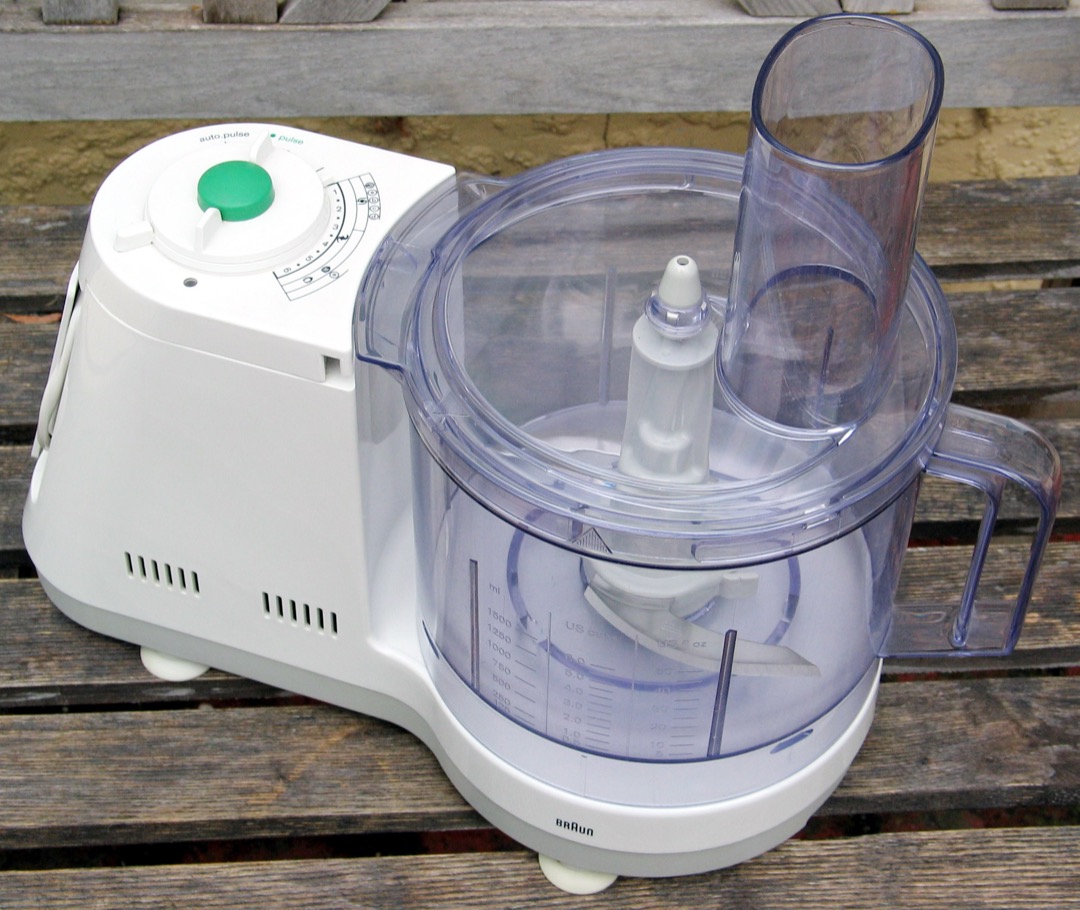
Almost nothing goes wrong with a food processor because of technique. It goes wrong because of order. The parts go on in one sequence and come off in the reverse of it, and the machine will refuse to start without ever telling you which step you missed. Four years of running a restaurant group’s test kitchen taught me that when a cook says the processor is broken, the fix is usually a quarter turn on a bowl or a disc sitting an inch too low.
This is the operating manual rather than the argument for owning one. If you want to know which jobs the machine is genuinely good at and which four it does badly, that is covered in what a food processor is used for. Everything below is the sequence: how it goes together, why it will not start, which cutter to fit, how full is too full, how to feed it, how to take it apart without cutting yourself, and what to do when it stops mid-job.
The facts here come from the manuals for four machines that between them cover most of the designs you will meet: the Cuisinart Core Custom 13-cup and Elite 14-cup, the KitchenAid 5KFP0719, the Breville Sous Chef 16, and the Hamilton Beach Stack and Snap 12-cup. Where they disagree, and they do disagree on some important things, I have said so rather than flattened it.
Assembly, in the Order the Interlock Expects
Bowl, blade, food, cover, plug. In that order, every time.
On a Cuisinart, set the bowl on the base with the handle just to the right of centre and turn it clockwise until it locks onto the base. That happens first, before anything else touches the bowl. Cuisinart’s own wording is blunt: never put the stem adapter into the work bowl until the work bowl is locked into place. Then the blade goes on the stem adapter and lowers into the locked bowl. Then the ingredients. Then the cover, with the feed tube just right of centre, turned clockwise to lock. Then the pushers, then the plug.
Blade before food is the step people reverse, and it is the one with a mechanical reason behind it. The blade has to drop all the way down the shaft and sit flat on the floor of the bowl. Load the food first and the blade lands on a chunk of onion instead of the bottom, sits a few millimetres proud, and then either the cover will not lock or the blade wobbles against the bowl while it runs. Cuisinart says it as an instruction rather than a tip: always insert the stem adapter with metal blade in the work bowl before putting ingredients in the bowl.
Three lock designs are common, and knowing which one you own saves a lot of frustration:
The Cuisinart twist. Bowl on base, handle right of centre, clockwise to lock. Cover on, feed tube right of centre, clockwise to lock. Two separate twists, and the machine checks both.
The KitchenAid hinge and latch. No twisting at all. The bowl clicks onto the base aligned with a raised button on the right, and it should sit flush against the base when properly aligned. The cover attaches by pushing the lid hinge into the handle hinge, closing it, and pushing the lid latch down into the locked position. KitchenAid also tells you to install the blade or disc before attaching the cover, which is the same rule in different words.
The Hamilton Beach stack and snap. The Stack and Snap 12-cup is built specifically to avoid the twist, with a bowl that sits directly on the base and a lid that snaps on with locking clips. If your wrists dislike the Cuisinart action, that design exists for exactly that reason, and it comes up when we compare mechanisms in the food processor roundup.
Breville sits with Cuisinart on the fundamental point regardless of lock style: always secure the processing bowl onto the motor base before attaching the blades or disks.
Why It Will Not Turn On
A food processor that does nothing when you press the button has almost certainly not lost its motor. It has failed an interlock check, and there are three places that check can fail.
The bowl is first. It has to be locked, not resting. A Cuisinart bowl that has been dropped on and not turned looks identical to a locked one from above. A KitchenAid bowl that is not flush against the base has not clicked. KitchenAid states the rule outright: the food processor will not operate unless the work bowl cover is fully closed and the work bowl is properly seated on the base.
The cover is second. Cuisinart covers turn clockwise to a stop. KitchenAid covers need the lid latch pushed fully down. If a cover refuses to close while a disc is fitted, stop pushing. KitchenAid’s troubleshooting names that symptom directly and the cause is a disc that is seated wrong, which the next section covers.
The third one is the good one, because almost nobody covers it. Breville warns not to overfill the feed chute, because if the chute is too full the pusher cannot travel far enough to activate the interlock safety catch. The machine reads a chute packed to the brim as an open lid and stays dead. Pull out a couple of carrot sticks and it starts. If your processor has started refusing to run only when the chute is loaded, that is your answer.
One symptom is not an interlock puzzle and is not something to work around. Cuisinart specifies that the motor must stop within four seconds of removing the cover assembly. If yours keeps spinning past that, the manual says to stop using the machine and contact service. That interlock is the only thing standing between a running blade and an open bowl, and a slow one is a failing one.
Blade or Disc, and the Disc Mistake Almost Everybody Makes
Start with the mistake, because it accounts for most complaints that a processor slices badly.
KitchenAid discs have two positions on the drive adapter. Process position sits high, level with the top of the bowl, which is where the disc has to be to meet food coming down the chute. Storage position sits low, inside the bowl. The manual is careful about this: while the disc will operate in storage position, it will not perform as well. So the machine runs, the food goes in, and what comes out is mangled rather than sliced. The fix takes two seconds. Lift the disc out, turn it 90 degrees, and lower it again so it drops into the high position. KitchenAid’s own troubleshooting entry for a processor not shredding or slicing properly lists exactly two causes: the raised blade side is not facing up, and the disc is in storage rather than process position.
The related tell is a cover that will not close. If a disc is seated wrong it stands too tall for the lid, and no amount of pressure on the latch fixes that.
The four cutters do genuinely different jobs:
The S-blade, sometimes called the chopping or multipurpose blade, sits at the bottom of the bowl and cuts what falls onto it. This is the one for chopping, mincing, puréeing and emulsifying.
The dough blade, usually plastic and blunter, drags dough around the bowl rather than cutting it. Not every machine ships one, and the ones that do publish separate flour limits for it.
The slicing disc cuts on the top face, so food has to arrive from above through the chute. Nothing gets sliced by putting it in the bowl.
The reversible shredding disc has a coarse side and a fine side, and the working side is the one with the raised blade facing up. Fitting it upside down produces nothing but noise. How many discs a machine ships with, and whether the slicer is adjustable, is one of the real dividing lines between models, and we go through the disc systems machine by machine in the food processor comparison.
How Full Is Too Full
The capacity printed on the box is a slicing number. Sliced and shredded food leaves the bowl through the disc immediately and stacks up underneath, so the bowl is acting as a receptacle rather than a working chamber. Every other job needs room for food to circulate, and every other job is derated. By a lot, and not by a consistent fraction.
Cuisinart publishes the whole table for the Elite 14-cup. Sliced or shredded fruit, vegetables or cheese: 14 cups. Chopped fruit, vegetables or cheese: 12 cups. Cooked food: 12 cups, dropping to 8 cups puréed. Chopped or puréed meat, fish or seafood: 2 and a quarter pounds. Thin liquid such as dressings and soups: 10 cups. White bread dough: 6 cups of flour, or 4 cups for whole wheat. Nuts for nut butter: 7 cups. And a footnote that catches people out: when processing egg-based liquids such as a custard base for quiche, reduce the maximum capacity by 2 cups, because the mixture foams and climbs.
The 13-cup Core Custom is not a slightly smaller version of that table. It is a much tighter one. Sliced or shredded 12 cups, but chopped fruit or vegetables only 6 cups, chopped cheese 4 and a half cups, thin liquid 9 cups, nuts for nut butter 4 cups. One cup smaller on paper, half the chopping capacity in practice.
Which is why the folk rule you see everywhere, fill it halfway for liquid and two thirds for solids, is worth dropping. It does not describe any machine in front of me. Liquid on the 14-cup runs to 10 of 14, which is closer to three quarters. Chopped vegetables on the 13-cup stop at 6 of 13, which is under half. The ratios move in opposite directions between two machines from the same brand.
Breville handles the same problem with hardware rather than a table, marking multiple maximum fill lines on the bowl and instructing you not to fill above the marked line for each type of ingredient. KitchenAid says not to fill above the marked maximum fill line or rated capacity, and gives the reason in safety terms: overfilling risks injury through damage to the cover or the bowl. That is the part worth remembering. An overfilled bowl is not just a messy result, it is load on a plastic cover that was never designed to contain it.
For anything you intend to drink, the processor is the wrong vessel entirely, and its liquid derate is the machine telling you so. A blender jar is sealed, tall and narrow for exactly that reason, which is why we keep drink work in the blenders for protein shakes and acai bowl guides rather than here. If counter space means you only want one machine, the blender and food processor combinations are the honest compromise.
Load Order
Dry and thick go in before anything fluid. Breville states it as a rule: always add drier or thicker ingredients to the processing bowl prior to adding fluids. A bowl with liquid already sitting in it will push that liquid out around the shaft and up the wall the moment the blade starts, and the solids float rather than falling onto the cutting edge.
Piece size does more for the result than run time does. Cuisinart’s prep instruction is to cut food into even pieces of half an inch to one inch, and the reason given is that even sizes give even results. Breville asks for 1-inch cubes for chopping and mincing.
Uneven pieces cannot be fixed by running the machine longer, and this is the single most useful thing to understand about how the bowl works. The blade cuts whatever is in its path, so the small pieces get hit first and get hit repeatedly. By the time a two-inch chunk of carrot has been reduced to a dice, everything that started at half an inch is already purée. Running longer widens the gap rather than closing it. Thirty seconds of knife work before the food goes in beats any amount of extra processing.
Frozen and hard ingredients get their own prep. Breville asks you to freeze proteins for 30 minutes before mincing so they cut cleanly instead of smearing, and softer cheeses for 45 minutes before grating. Fresh mozzarella is not recommended for grating at all, and hard cheese needs its rind removed first. Cuisinart wants cheese well chilled before it meets a disc.
Pulse Is the Control, Continuous Is the Commitment
Pulse and run are two different instructions, and most bad results come from using the second when the first was wanted.
Cuisinart defines the unit of pulse for you: a pulse should be about one second unless otherwise specified. Press, release, look. Four or five of those chop an onion. Eight or ten mince garlic. Twelve turn either into a wet paste, which is why counting matters. The pause between pulses is doing real work, because it lets everything riding up the bowl wall fall back onto the blade. A continuous run keeps that food pinned to the side where nothing touches it, which is how you get a bowl with purée in the middle and untouched chunks around the rim.
Continuous running is for the jobs where you want the texture gone: purées, nut butters, emulsions, batters. Those need sustained blade contact and there is no texture to overshoot.
On a KitchenAid, pulse runs at high speed only and stops the moment you release it. That is worth knowing because it means pulse is not a gentler setting, it is the same speed in short doses. Breville stops any continuous run at 20 minutes as a hard limit.
The equivalent logic on a blender works the other way round, and if you move between the two machines regularly the crossover is worth reading in how to use a Ninja blender. Where the line between the two tools actually falls is covered in food processor vs blender.
The Feed Tube
Everything that gets sliced or shredded arrives through the chute, and how you push it determines what comes out.
Pressure is matched to the food, and both Cuisinart and Breville quantify it. Light, even pressure for soft foods such as tomatoes and bananas. Medium, even pressure for firmer foods such as potatoes, cheese, deli meats and apples. Firm pressure for genuinely hard foods. Cuisinart’s addition is the important half: always process with even pressure. Uneven pressure is what produces slices that are thick at one end. Breville’s limit is equally clear: never force the food down the chute, because that damages the discs.
Chute size is a safety and quality decision rather than a convenience one. Breville is specific that hard produce like pumpkin and sweet potato goes through the small or medium chute, and that feeding hard produce through the large chute could damage the disks. Long thin foods such as carrots, cucumbers and zucchini also go in the small or medium chute, because a tall item in a wide chute tips over mid-slice and comes out as wedges. Place them vertically against the left side of the chute to minimise tilting. KitchenAid’s two-piece pusher works the same way: the small feed tube and small pusher are for slender items like a single carrot or a celery stalk.
The wide chute on the Sous Chef is 5.5 inches across, and Breville’s fit rule is the most useful sentence in the whole manual. Food should fit snugly so it is supported in an upright position in the chute, but not so tight that it could prevent the food from moving down. Snug, not jammed. That is what keeps a potato from rotating as the disc bites.
A few pieces of prep make round and awkward produce behave:
Cut a thick slice off the bottom of round produce so it sits flat and stands upright in the chute instead of rolling.
Trim the ends off small items like mushrooms, radishes and strawberries so they have a flat face to stand on.
Roll leafy greens into a tight cylinder and stand them up, which is what gives you an even chiffonade rather than shredded lettuce.
Chill cheese well before it goes anywhere near a disc, and freeze softer cheeses for 45 minutes.
The pusher has one more trick. On a KitchenAid, the small pusher has a hole in the bottom that drizzles oil at a constant rate, which is the whole mechanism for a stable mayonnaise or vinaigrette. Fill it, let it run, and the oil enters slowly enough to emulsify instead of splitting. Cuisinart calls the same feature a drizzle hole.
Dough, and the Blade That Climbs
Dough is the job where a food processor behaves least like every other job, and the rules are specific.
Use low speed for yeasted dough, on any machine that has more than one speed. Start the machine before adding liquid. Process the dry ingredients first, then add liquid in a slow steady stream, either down the feed tube or through the drizzle hole in the pusher. Cuisinart adds a detail that sounds fussy and is not: pour the liquid onto the dough as it passes under the feed tube opening, not directly onto the bottom of the bowl. Liquid that hits the bowl floor pools under the blade and turns into paste while the top of the dough stays dry.
Flour limits are lower than bowl capacity suggests, and they differ by machine. The Cuisinart Core Custom 13-cup allows no more than 4 cups of white or all-purpose flour for yeasted dough. The 14-cup Elite allows 6 cups for white bread dough and 4 for whole wheat. Breville’s dough blade maximum is 2 pounds, or 900 grams, of flour in the US and Canada. Exceed those and the motor is carrying a load it was not rated for.
Three failures come up constantly, and each has a specific fix:
The blade rises in the bowl. The dough is excessively sticky and is lifting the blade off its shaft. Reinsert the blade and immediately add 2 tablespoons of flour through the feed tube with the machine running.
A nub of dough forms on top of the blade and will not knead. Stop the machine, remove the dough, divide it into three pieces, and redistribute them evenly around the bowl before restarting.
The motor slows. Either the batch is over capacity, in which case split it in two, or the dough is too wet. Add flour one tablespoon at a time until the motor speeds up and the dough starts cleaning the sides of the bowl. That last phrase is the target: correctly hydrated dough in a processor pulls away from the wall and rides the blade as one mass.
Breville puts a time limit on the whole business. Stiff mixtures such as dough may cause the blade to rotate more slowly than normal, and if that happens you should not process for longer than one minute. A slow blade under load is heat going into the motor, and one minute is the budget.
Taking It Apart Without Cutting Yourself
Press Off, unplug, and wait for the blade to stop completely. Then reverse the assembly order.
The critical rule is that a loose blade must never be in a bowl you are tipping. Cuisinart words it as removing the work bowl from the base before you remove the blade or disc, and separately as removing the stem adapter with blade or disc before tilting the work bowl. KitchenAid words it the other way round: lift the lid latch and remove the cover, take the disc out first by holding its centre hub and lifting straight up, then remove the drive adapter with the blade attached, then lift the bowl off the base.
Those two sequences look contradictory and are not. The drive designs differ, so the order in which the parts come free differs. What both are protecting against is identical. The blade is not fixed to anything. Tip a bowl with a loose blade in it and the blade slides out first, edge down, into whatever you are pouring into or onto your hand on the way past. Get the cutter out before the bowl moves, however your machine wants that done.
The Hamilton Beach Stack and Snap is the genuine exception, and it is worth naming because it is the one machine where the universal rule does not apply. Its bowl is sealed with a pour spout, and the chopping blade locks in the bowl and stays put during pouring. That is a design decision aimed squarely at this hazard.
Handle blades and discs by the plastic hub in the centre. Both Breville and KitchenAid specify it, and it is the only part of either that is not an edge.
If the blade will not come off the stem adapter, it is food, not damage. Cuisinart’s fix is to soak the assembly in warm tap water to loosen whatever is trapped in the joint, then stand it on the counter and press down on the stem to free the blade.
Cleaning and Storing
Rinse everything the moment you empty the bowl. Dried purée in a blade hub or a disc slot is ten times the work an hour later.
Cuisinart’s drying instructions are more useful than they sound. Position the pushers and the work bowl upside down so water drains out instead of pooling in the shaft well, and set the cover down with the feed tube facing up. A bowl left the right way up holds a puddle around the centre hole that never dries.
Handle blades by the plastic hubs, and never leave them in a sink of soapy water where, in Cuisinart’s phrasing, they may disappear from sight. That is how people find a blade with their fingers. If parts go in the dishwasher, unload them carefully and deliberately rather than reaching into a basket.
Plastic holds smells. Breville flags garlic, fish and carrots specifically as foods that leave odour in the bowl. Washing promptly is most of the answer, and it is one of the reasons some cooks prefer glass where the vessel allows it, which we get into in the blenders with glass jars roundup.
Two storage rules matter more than they look:
Never store the machine with the cover or pusher assembly in the locked position. Cuisinart and Breville both give the same reason, which is possible malfunction of the work bowl switch. That switch is the interlock. Leaving it compressed for months is how a machine ends up refusing to start with nothing visibly wrong.
Never store a blade or disc on the stem adapter. Cuisinart says so directly. A cutter parked on the shaft is a cutter at hand height in a cupboard, sitting on a bearing surface it will mark.
When It Stops Mid-Job
Sort out which of three things happened, because the responses are different.
A motor that slows under a heavy load has not failed. Breville expects it with stiff mixtures and only asks that you stop after one minute in that state. Cuisinart expects some vibration under heavy loads such as slicing or shredding cheese, and treats it as normal.
A machine that shuts itself off has hit the thermal cutout. All three brands have one and all three want a different cooldown. Cuisinart describes a safety protector that prevents overheating caused by excessive strain and asks you to press Off, unplug, and wait 20 to 30 minutes. KitchenAid flashes the O/Pulse light and says the machine may take from 5 to 15 minutes to cool completely, and adds that if the speed light stays on while O/Pulse flashes, the motor may be locked and pressing O/Pulse resets it. Breville goes into standby with the overload protection icon flashing and asks for 30 minutes unplugged. That spread from 5 minutes to 30 is real and reflects genuinely different motors, so use your own manual’s number rather than the shortest one on the internet. If it trips more than once on the same job, Breville’s read is the right one: the bowl is overloaded, so process smaller batches.
A blade that stalls dead is the one to treat carefully. Something has wedged between the cutter and the bowl. Breville’s instruction is to stop immediately and unplug before clearing it, and that order is not negotiable, because clearing a jam is exactly the moment a machine that suddenly frees itself becomes dangerous.
Two more symptoms with simple causes. A machine that walks across the counter needs its rubber feet checked for grease and moisture, and its load checked against the capacity table. And a base that feels warm after a long run is normal, while a burning smell is not. Warm means the motor worked. Burning means you stop, unplug, and do not wait out a cooldown and try again. A processor under load is loud enough that the sounds telling you it is struggling get lost, which is a fair argument for buying on noise in the first place, the same way we weight it in the quiet blender testing.
The Short Version
- Bowl locks to the base first, blade second, food third, cover fourth, plug last. Reverse it to take apart.
- It will not start because of the interlock, not the motor. Check bowl seated, cover fully locked, and chute not packed so full the pusher cannot travel.
- If the motor runs on for more than four seconds after the cover comes off, stop using the machine.
- Discs cut on the top face and must sit in the high process position, level with the top of the bowl, raised blade facing up. A cover that will not close means the disc is wrong.
- The number on the box is a slicing number. Chopping, puréeing, liquid and dough all have lower limits, and they are printed in your manual.
- Dry and thick before fluid. Even half-inch to one-inch pieces. Running longer never fixes uneven prep.
- Pulse for about one second at a time when texture matters. Run continuously only when you want the texture gone.
- Match chute pressure to the food, light for soft and medium for firm, always even, and never forced. Hard and long produce goes in the small or medium chute.
- For dough, low speed, machine running before the liquid goes in, liquid onto the moving dough rather than the bowl floor, and stay under the flour limit.
- Blade or disc out before the bowl is tipped, held by the plastic hub, on every machine except a sealed-bowl design.
- Store with the cover and pusher unlocked, and never with a blade on the shaft.
Get those right and this becomes the fastest machine on the counter rather than the one that lives in a cupboard.
Frequently Asked Questions
How do you use a food processor for the first time?
Why won't my food processor turn on?
Why is my food processor leaking?
How full can you fill a food processor?
Why did my food processor stop in the middle of a job?
Related Articles
About the Reviewer

Nora Whitfield, CIA Culinary Arts, ServSafe Certified
A.O.S. Culinary Arts, The Culinary Institute of America
Nora Whitfield trained at the Culinary Institute of America and spent twelve years in professional kitchens, the last four running the test kitchen for a regional restaurant group where her job was to decide which equipment could survive a dinner service and which could not. She has seasoned more carbon-steel woks than she can count, boiled water in every kettle worth owning, and broken enough cheap gear to know exactly where manufacturers cut corners. She reviews kitchen equipment the way she specified it professionally: cook on it, clean it, and see what it looks like after a month.