Best Quiet Blenders of 2026
The best quiet blenders of 2026, chosen by CIA-trained chef Nora Whitfield: 10 machines ranked on published decibel data, sound enclosures, and what the numbers actually mean.
Updated
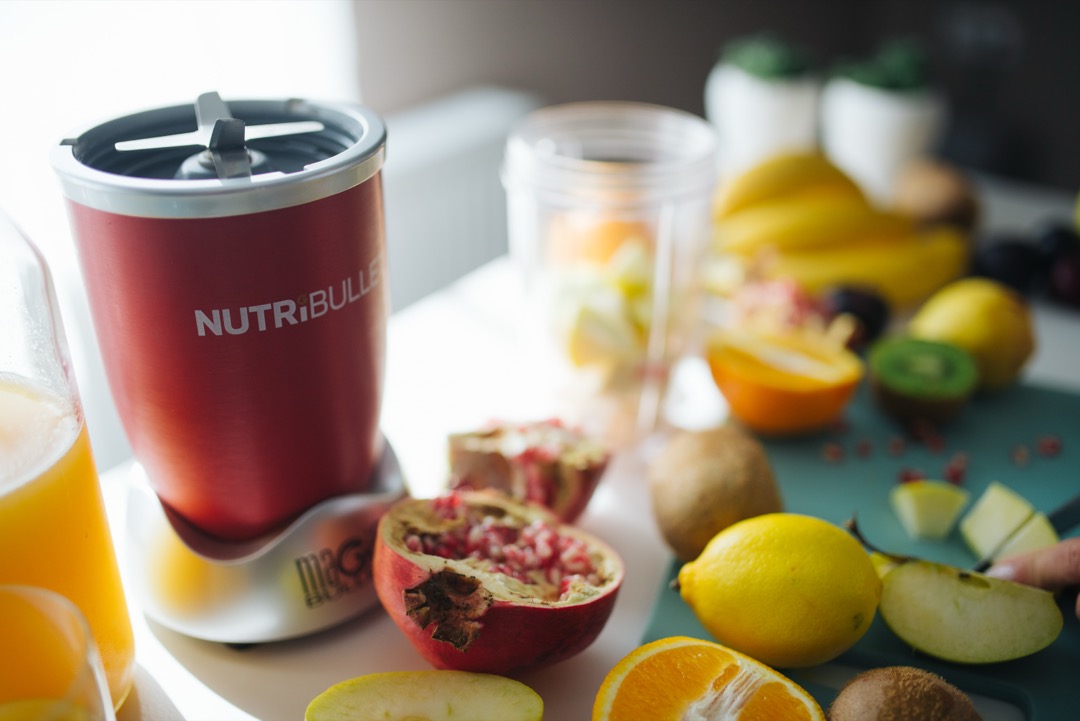
Best Quiet Blenders of 2026
The reason anyone searches for a quiet blender is almost always the same. Someone gets up at six, wants a smoothie, and does not want to wake a partner, a baby, a housemate, or the neighbour on the other side of a shared apartment wall. A blender is one of the loudest things most kitchens own, and unlike a vacuum or a hairdryer it gets used at the worst possible hour.
I am Nora Whitfield. I trained at the Culinary Institute of America and spent four years running a restaurant group’s test kitchen, where sound-enclosure blenders were standard equipment because a bar cannot have a machine drowning out the room every time someone orders a frozen drink. So I know what an enclosure actually buys you, and I know what it costs you in cabinet clearance and cleaning time, which is the part nobody writing about this category mentions.
Here is the honest frame this page starts from, and it is the thing most quiet blender roundups skip: there is no consumer noise standard for blenders, and the brands that market hardest on quietness publish the fewest numbers. Vitamix, Blendtec and Hamilton Beach all sell machines on being quiet without publishing a verifiable decibel specification anywhere. Where numbers do exist, they come from independent publications that do not disclose their microphone distance, meter weighting, or test load, so their figures cannot be compared with each other. I have not measured any of these blenders myself, and I am not going to invent a protocol to look authoritative. What follows is every published measurement I could attribute, labelled with its source, plus what owners consistently report and what I know about running enclosed machines in a working kitchen. If you are also weighing jar material, our guide to blenders with glass jars covers that side of the decision in detail.
| Product | Price | Buy |
|---|---|---|
| Breville BBL920BSS Super Q Blender for KitchensBest Overall | $499.95 | View on Amazon |
| Hamilton Beach Quiet Blender for Smoothies With Wave Action System (58175J)Budget Pick | $52.45 | View on Amazon |
| Hamilton Beach Professional 32 oz. Quiet Shield Blender for Smoothies (58870)Runner-Up | $299.00 | View on Amazon |
| Vitamix Ascent X5 Professional-Grade BlenderPremium Pick | $749.95 | View on Amazon |
| WantJoin Professional Commercial Blender With Shield Quiet Sound EnclosureRunner-Up | $199.99 | View on Amazon |
| nutribullet Ultra Personal Blender, 1200WRunner-Up | $106.02 | View on Amazon |
| KitchenAid Variable Speed Corded Hand Blender (KHBV53)Runner-Up | $49.99 | View on Amazon |
| Black+Decker Quiet Blender with 6-Cup Cyclone Glass JarRunner-Up | $58.99 | View on Amazon |
| magic bullet Personal Blender, 250W (MBR-1101)Runner-Up | $37.81 | View on Amazon |
| Vitamix 36019 The Quiet One Blender, 48 ozRunner-Up | $1,158.05 | View on Amazon |
Find the Best Quiet Blender for Your Need
Jump to whichever situation matches yours.
- Best quiet blender overall
- Best quiet blender for smoothies
- Best quiet personal and single-serve blenders
- Best quiet blender for an apartment or shared kitchen
- Best quiet blender that is still powerful
- More use cases
How We Chose These Quiet Blenders
This is a review of published measurements, manufacturer claims and owner reports, combined with my own experience running enclosed blenders in a professional kitchen. It is not an in-house decibel test, and I want to be direct about why. A meaningful sound measurement requires a calibrated meter of a stated class, a fixed distance, a declared weighting curve, an anechoic or at least controlled room, and an identical test load in every jar. I have none of that, and a number produced without it would look like evidence while being noise. Several sites in this category publish exactly that kind of number.
So every decibel figure on this page is attributed inline to whoever produced it, and where no figure exists I have written that no figure exists rather than filling the gap. Four of the ten machines here have no published number at all, from the manufacturer or from any lab, and that absence is itself a finding: it tells you the quiet claim on those listings is an adjective.
The comparability problem is worse than it first looks. Homes and Gardens contradicts itself inside a single article, printing 64 dB in its body text and 68 dB in its own specification table for the same blender. It also defines a quiet blender as 60 to 80 dB, while RTINGS’ top quiet picks all sit at 87 to 90 dB, which means by the first publication’s definition the second publication’s winners are not quiet blenders at all. Both sources are reputable. They are simply not measuring the same thing. Rank machines within one source; never rank a number from one against a number from another.
After that, I sorted on mechanism rather than marketing: does the machine have a physical sound enclosure, is the quiet a byproduct of low power, how long does it have to run to finish the job, and does the noise claim come with anything you can check.
Best Quiet Blenders Overall
Ten machines, each reviewed once below, in the order I would recommend them.
Best Overall: Breville Super Q
The Super Q is the quiet blender I would send most people to. TechGearLab measured it at 82.4 dB on its standard smoothie setting. For an 1,800-watt machine that is a genuinely good number, it is meaningfully below where full-power blenders normally land, and it is the lowest independently measured reading on this page for any machine without a hood over the jar.
Read the rest of the data before you get excited, though. Tom’s Guide measured the same machine at 93.7 dB at maximum speed with ice. Both figures are almost certainly correct for their own test conditions, and together they tell you the real story: this is quiet at the settings you use most and loud when you push it hardest. Breville itself publishes no decibel specification at all behind its noise suppression marketing, which is why a vocal minority of owners feel misled. They bought an adjective and got a machine that is merely better than average.
It takes the top spot over the shielded Hamilton Beach below for a buying reason rather than a blending one. The enclosure machine is quieter on every published number, but its listing has repeatedly lost Amazon’s own offer, and when that happens the only new unit available comes from a third-party seller with weak feedback at a markup. A recommendation is only useful if you can buy it reliably, and the Super Q is sold and shipped by Amazon itself. It also suits more kitchens. An enclosure needs cabinet clearance to lift off, it needs cleaning around, and it is one more thing to put somewhere, so a meaningful number of people will not live with one no matter how well it works. The Super Q adds a 10-year limited warranty that is among the longest here, an auto-clean cycle that removes the worst chore, and a personal cup so it covers the single-serve job as well. What it cannot do is match a shielded machine on noise when you push it hardest.

Breville BBL920BSS Super Q Blender for Kitchens
by Breville
The quiet blender most people should buy: the lowest independently measured smoothie-setting figure of any machine here without a hood, sold and shipped by Amazon, as long as you read its numbers as 82 dB on a smoothie rather than quiet at full speed.
Pros
- TechGearLab measured 82.4 dB on its standard smoothie setting, which is a genuinely low figure for an 1,800-watt machine
- 1,800 watts keeps it in full high-performance territory, so the noise reduction is not paid for with capability
- It includes a personal blending cup and an auto-clean cycle, so single-serve work does not need a second appliance
- The 10-year limited warranty is among the longest here, and the listing sells and ships through Amazon itself
Cons
- Breville markets noise suppression technology without publishing a single decibel figure of its own
- Tom's Guide measured 93.7 dB at maximum speed with ice, so the low reading applies to ordinary settings and not to hard work
- A vocal minority of owners say it does not live up to the noise marketing, and at this price that complaint carries weight
Best Enclosure Blender: Hamilton Beach Professional Quiet Shield
On the numbers this is the quietest machine on the page, and it solves the problem with physics rather than with a slogan. The shield is a removable acoustic hood that sits over the jar and blocks the direct sound path. Quietest.org and KitchenGearPro both put the machine around 65 to 70 dB with it fitted, and both report the shield-off figure roughly 20 dB higher. Because decibels are logarithmic, a 20 dB gap is not a fifth quieter, it is heard as several times quieter. That is the largest single noise reduction attributable to any feature on this page.
It also does not achieve the quiet by being weak. This is a full 1,500-watt peak machine that crushes ice properly, which matters because the overwhelming majority of blenders sold as quiet are quiet for the simple reason that they cannot do much. Getting both in one appliance is rare, and outside the commercial units it is essentially this machine alone. The 32-ounce jar doubling as a serving pitcher is a small thing that turns out to matter at breakfast.
On noise alone this machine would top the page, because it is the only one here whose quiet comes from a mechanism rather than from a compromise. Every other approach on this page buys silence by removing capability: a smaller motor, a shorter run, a softer load. An enclosure removes nothing. It sits behind the Super Q for one reason, and it is not about the blender. Amazon’s own offer on this listing comes and goes, and when it lapses the only new unit is sold by a third-party seller with weak feedback, at a premium over the usual price. If Amazon is selling it when you look, it is the quietest thing you can put on a counter. If it is not, check the seller before you order.
One caveat about the numbers. Hamilton Beach publishes no decibel figure of its own, so the 65 to 70 dB range rests entirely on third-party testing rather than on anything the manufacturer will stand behind.
The other limitation is worth repeating. The shield is removable, which means it is forgettable, and the noise comes straight back the moment you run the machine without it. In a shared kitchen where more than one person uses the blender, that is a real failure mode rather than a theoretical one.
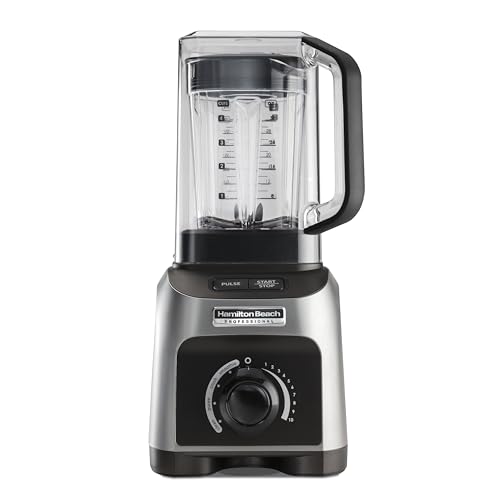
Hamilton Beach Professional 32 oz. Quiet Shield Blender for Smoothies (58870)
by Hamilton Beach
The quietest machine here on every published measurement and the only one that keeps full ice-crushing power behind an enclosure, held to second place only because its Amazon offer is unreliable.
Pros
- The removable shield is a genuine acoustic enclosure rather than a marketing word, and third-party measurements from Quietest.org and KitchenGearPro put the machine around 65 to 70 dB with it fitted
- Those same sources put the shield-off figure roughly 20 dB higher, and because decibels are logarithmic that gap is heard as several times louder, so the enclosure is doing real work
- It keeps full ice-crushing power behind the shield, which almost no other blender marketed on noise manages
- The 32-ounce jar doubles as a serving pitcher, so a finished batch goes to the table without decanting into anything else
Cons
- The shield lifts off and is easy to leave in a cupboard, and the noise returns in full the moment you run the machine without it
- Hamilton Beach publishes no decibel figure of its own, so the 65 to 70 dB range rests entirely on third-party testing
- The jar is BPA-free plastic rather than glass, which matters if avoiding plastic is part of why you are shopping
- Amazon's own offer on this listing lapses from time to time, and when it does the only new unit comes from a third-party seller with weak feedback at a markup, so check who is selling it before you order
Best Budget: Hamilton Beach Wave Action Quiet Blender
Hamilton Beach’s cheaper quiet machine takes a completely different approach to the same problem. Instead of a hood, the noise reduction is built into the geometry of the base itself, which damps motor vibration and airflow noise structurally. That is a genuine engineering mechanism rather than a small motor rebranded, and it is the reason this is the budget pick over machines that are quiet only because they are underpowered.
What you cannot do is verify it. Hamilton Beach publishes no decibel figure for this model, and I could find no independent lab that has measured it. So the position I can defend is narrow: the quiet here has a stated mechanism behind it, owner reports on noise are broadly positive, and there is no number. Anyone telling you it hits a specific figure is guessing.
The genuine glass jar is the pleasant surprise at this spend, because glass is normally the first thing cut from a cheap blender. Set your expectations on the motor accordingly. 800 watts is a peak figure, and a slower machine on frozen fruit means you spend longer listening to it, which partly undoes the point. Keep it to soft fruit, yoghurt and greens and it does the job without announcing itself to the whole flat.
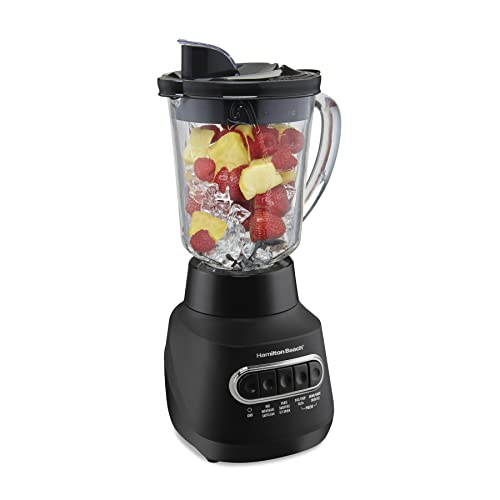
Hamilton Beach Quiet Blender for Smoothies With Wave Action System (58175J)
by Hamilton Beach
A structural approach to noise rather than a measured one, paired with a real glass jar, which makes it the sensible low-spend option as long as you accept that nobody has published a number for it.
Pros
- Its quiet comes from a patented base design that damps motor and airflow noise structurally, not from fitting a small motor and calling the result quiet
- It ships with a genuine 40-ounce glass jar, which machines at this spend almost always swap for plastic
- Hamilton Beach states the blades are tested against two tons of ice, an unusually specific durability claim for the price
- Jar, lid and blade assembly all go in the dishwasher, so every part that touches food comes apart properly
Cons
- Hamilton Beach publishes no decibel figure for it and no independent lab has measured it, so the quiet claim is entirely unverified
- There is no sound enclosure, so it cannot approach what a shielded machine does on the hardest loads
- 800 watts is a peak figure, and slower blending on frozen fruit means more seconds of noise, not fewer
Best Upgrade: Vitamix Ascent X5
Vitamix positions the Ascent X5 as its quietest full-power blender, and that claim is true in exactly the way it is worded and misleading in the way most people will read it. Quietest.org measures it at 87 to 89 dB. That is the lowest published figure for any full-power Vitamix, and it is not a quiet machine in absolute terms. It is quieter than other Vitamix machines, which is a relative claim about a famously loud line.
There is no enclosure here, and no enclosure means there is a floor on how quiet a 3-horsepower-class motor driving a blade through ice can be. What you are actually buying is the best-built machine on this page: SELF-DETECT containers that adjust the machine’s limits to whatever jar you fit, a 10-year warranty, and a parts pipeline that will still exist in a decade. Vitamix machines get repaired rather than replaced, and that is rare in small appliances.
The caveats are the review base and the silence from the manufacturer. Its review base is thin for a machine at this price, and Vitamix publishes no decibel figure of its own, so every number available for it comes from a third party. If quietness is the primary reason you are shopping, this is not the machine. If build quality is, and you want the least-loud way to own a Vitamix, it is the right one.

Vitamix Ascent X5 Professional-Grade Blender
by Vitamix
Vitamix's quietest full-power blender, which is a relative claim rather than a quiet machine, and worth buying for the build and the warranty more than for the noise.
Pros
- Quietest.org measures it at 87 to 89 dB, the lowest published figure for any full-power Vitamix
- SELF-DETECT containers set the machine's limits automatically, so a smaller container cannot be run at a speed that damages it
- The 10-year warranty and Vitamix's long parts availability make it the most repairable machine on this page
- It carries the highest rating of any full-size blender here and is sold by Amazon directly
Cons
- There is no sound enclosure, and 87 to 89 dB is quiet relative to other Vitamix machines rather than quiet in absolute terms
- 194 reviews is a thin record for a machine at this price
- Vitamix publishes no decibel figure of its own, so every number available for it comes from a third party
Best Large-Batch Enclosure: WantJoin Commercial Shield Blender
The WantJoin is the interesting outlier here: a genuine sound enclosure on a machine costing a small fraction of what the commercial shielded units do. It pairs that with 2,200 watts and an 80-ounce jar, which makes it the largest-batch machine on this page. That capacity matters more than it sounds for noise, because a household that blends once instead of three times has cut its noise events by two thirds regardless of what the meter says.
The problem is that the soundproof claim has nothing behind it. No independent lab has measured this machine, and the manufacturer publishes no figure, so the enclosure is visible but its effectiveness is unquantified. From experience with enclosed units, a hood that seals well and one that merely covers the jar behave very differently, and there is no data here to tell you which this is.
The recurring owner complaint is the one I would weigh hardest: pitcher bearing seals degrading over time, which leaks and, importantly, makes the machine louder as it ages. A quiet blender that gets noisier every year is a specific kind of disappointment. It is also sold by a third-party seller under Amazon fulfilment, and the listing splits Prime and non-Prime pricing in a way that catches people out. Buy it for the enclosure and the capacity, with clear eyes about the seals.
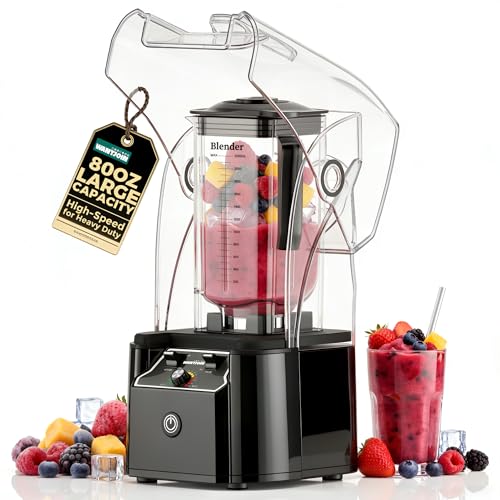
WantJoin Professional Commercial Blender With Shield Quiet Sound Enclosure
by WantJoin
The affordable route to a real sound enclosure with serious power behind it, held back by an unmeasured noise claim and a recurring bearing-seal complaint.
Pros
- It puts an actual sound enclosure on a machine costing a small fraction of what a commercial shielded blender does
- 2,200 watts behind an 80-ounce jar makes it the largest-batch machine here, and fewer runs means fewer noise events
- A self-cleaning cycle handles a jar that is awkward to reach into once the shield is closed over it
- The manufacturer states a 10-year warranty, which is unusual at this tier
Cons
- No independent lab has measured it, so the soundproof claim rests entirely on the manufacturer's own marketing
- Owners repeatedly report the pitcher bearing seals degrading over time, which leaks and makes the machine louder as it ages
- It is sold by a third-party seller with Amazon fulfilment, and the listing splits Prime and non-Prime pricing in a way that confuses buyers
Best Personal Blender: NutriBullet Ultra
NutriBullet’s approach to the Ultra is the most interesting thing about it, and it is the one place on this page where a brand has thought harder than the number. Rather than chasing a lower reading, it engineered the machine for a lower-frequency, less irritating sound signature. That is a real distinction. Two machines at an identical decibel level can be very different to stand next to, because high-frequency whine is what makes a sound grating while low-frequency rumble reads as tolerable.
The measurements, on the other hand, do not agree with each other. Techlicious reports 86 dB. Kitchenappliancehq measured up to 90 dB. That is a wide enough spread on a single machine to demonstrate the comparability problem in miniature, and I would not lean on either figure. What is not in dispute is the power: 1,200 watts is the most in NutriBullet’s personal line, and a faster blend is a shorter blend.
The brand caveat is worth stating plainly. NutriBullet carries a long-running pattern of seal and leak complaints across its range, and the review base on this model is a decent but not enormous sample to judge that from yet. If your reason for wanting a personal blender is protein shakes specifically, our guide to blenders for protein shakes works through that category on its own terms.

nutribullet Ultra Personal Blender, 1200W
by NutriBullet
The best personal blender here for anyone who cares about the character of the sound rather than the raw number, with the honest caveat that independent measurements of it do not agree.
Pros
- NutriBullet engineered it for a lower-frequency, less irritating sound signature rather than purely for a lower reading, which is the part of blender noise people actually complain about
- 1,200 watts makes it the most powerful machine in NutriBullet's personal line, so a single-serve blend is over faster
- The titanium-coated blade holds an edge better than the stamped blades used across cheap personal blenders
- 2,178 reviews is a substantial record for a personal blender this recent
Cons
- Independent figures disagree sharply, with Techlicious reporting 86 dB and kitchenappliancehq measuring up to 90 dB
- NutriBullet as a brand carries a long-running pattern of seal and leak complaints
- It is single-serve, so feeding a family means several separate noisy runs rather than one
Best Hand Blender: KitchenAid Variable Speed Hand Blender
This is the pick that breaks the frame, and it is the one I use most often. One independent measurement puts the KHBV53 at 86 dB, which on paper is no quieter than a mid-range countertop machine. In a kitchen it is dramatically quieter, and the reason is worth understanding because it applies to every blender you will ever own.
Noise from a blender is not just the motor. A large part of it is the jar acting as a resonating chamber, ringing at whatever frequency its walls and its empty air space favour. A hand blender goes into the pot, into a jug, into whatever the food is already in, with the food packed around the blade. There is no empty jar to ring. On top of that, the run lasts a few seconds rather than a minute, so the total noise exposure is a small fraction of a countertop blend even at a similar peak reading. The variable-speed trigger also lets you start genuinely slowly, which avoids cavitation, the air-through-the-blade sound that produces the ugliest spikes.
Its limits are hard ones. 180 watts will not handle ice or a thick frozen drink, and it is not a smoothie machine. The included jar holds three cups, so batch size is capped whenever you use a vessel rather than a pot, and the one-year warranty is the shortest on this page. What it does have is the highest rating here at 4.7 stars, across the second-deepest review record on this page behind only the Magic Bullet. For soups, sauces and anything already in a pan, nothing else here comes close on noise.

KitchenAid Variable Speed Corded Hand Blender (KHBV53)
by KitchenAid
The quietest way to get a soup blended, because it never fills a resonant jar in the first place, provided you never ask it to crush ice.
Pros
- It blends directly in the pot, so there is no empty jar to resonate, and that is the real reason it reads as quiet in a kitchen
- One independent measurement puts it at 86 dB, but the run lasts seconds rather than a minute, so total noise exposure is a fraction of any countertop machine
- 18,233 reviews at 4.7 stars is the highest rating on this page and the second-deepest review record here
- Variable speed on the trigger gives a genuinely slow start, which is where most avoidable blender noise spikes happen
Cons
- 180 watts will not handle ice or thick frozen drinks, and pretending otherwise would mislead you
- The included jar holds three cups, so batch size is limited whenever you do use a vessel
- The one-year warranty is the shortest on this page
Best Glass Jar: Black+Decker Quiet Blender
Black+Decker markets this on quiet technology and publishes no number to go with it, which by now is a familiar pattern. What makes it worth a place here is the jar: a genuine glass main jar on a machine sold on noise, which is close to unique. Glass rings brighter than copolyester rather than quieter, so this is not a noise advantage, but it is a durability and staining advantage that plenty of people are shopping for at the same time.
The six-tip serrated blade gives it more cutting edges than the standard four-point stack at this end of the market, and the machine is noticeably better behaved at its lower speeds, which is conveniently also where it is quietest. The included personal cup is plastic and the listing says so, which is more honesty than several rivals manage about mixed-material sets.
I have to report the reviews as they are, and they are genuinely split. Some owners describe it as pleasantly quiet; one prominent review calls it the loudest blender on the market. With no measured figure anywhere, there is no way to adjudicate that, and a split like this usually means the machine sits in the ordinary range and expectations were set by the marketing. The warranty is another gap: described only as limited, with no duration stated in the listing at all.

Black+Decker Quiet Blender with 6-Cup Cyclone Glass Jar
by Black+Decker
The only quiet-marketed blender here with a real glass main jar, recommended with the caveat that its own owners cannot agree on whether it is quiet at all.
Pros
- The main jar is genuine glass rather than plastic, which is rare on any machine sold on its noise performance
- A six-tip serrated blade gives it more cutting edges than the standard four-point stack at this price
- It adds a personal cup on the same base, and the listing is honest that the cup is plastic while the main jar is glass
- It performs noticeably better at its lower speeds, which happens to be where it is quietest as well
Cons
- Black+Decker publishes no decibel figure at all behind its quiet technology claim
- Owner reviews on noise are genuinely split, including one prominent review calling it the loudest blender on the market
- The warranty is described only as limited, with no duration stated anywhere in the listing
Cheapest Option: Magic Bullet Personal Blender
The Magic Bullet is not marketed as a quiet blender and has no decibel figure attached to it. It is on this page because it is quiet, for the least glamorous reason available: 250 watts cannot make much noise. That is the whole mechanism, and it is more reliable than most of the marketing on this page.
The evidence base is what makes it worth taking seriously. 121,058 reviews is by far the deepest record here, and across a sample that size there is no pattern of noise complaints, which is a stronger signal than any single lab measurement on a machine with a few hundred reviews. The cups thread onto the blade and go straight into the dishwasher, and the whole thing lives in a cupboard rather than occupying counter space, which suits a small shared kitchen where the full-size machine is already the problem.
The cost of that quiet is exactly what you would expect. It struggles with ice and solid frozen fruit, and the 22-ounce cup means one serving at a time. There is also a small piece of listing sloppiness worth flagging: the page states both a five-year and a one-year warranty in different places, so confirm which applies before you count on either. Buy it as a quiet second machine for soft blends, not as a replacement for a real blender.

magic bullet Personal Blender, 250W (MBR-1101)
by Magic Bullet
Quiet by physics rather than by design, carrying the largest review record on this page and the obvious limitation that 250 watts cannot make a frozen smoothie.
Pros
- 250 watts simply cannot generate much noise, which is the most reliable form of quiet on this page even though nobody markets it that way
- 121,058 reviews is by far the deepest record here, and no pattern of noise complaints appears anywhere in it
- The cups thread straight onto the blade and go in the dishwasher, so the whole job is over in seconds
- It stores in a cupboard rather than living on the counter, which suits a kitchen where a full-size machine is already the noise problem
Cons
- It struggles with ice and solid frozen fruit, which is the direct cost of the low wattage that makes it quiet
- The 22-ounce cup limits it to one serving at a time
- The listing states both a five-year and a one-year warranty in different places, which is worth clarifying before you rely on either
Best Commercial Sound Enclosure: Vitamix The Quiet One
This is the machine I used behind a bar, and it is the reference point for what an enclosure can actually do. The twist-lock hood is built for commercial service, meaning it survives being opened and closed dozens of times a shift, and the magnetic quick-clean back cover exists because the real problem with any enclosed blender is getting at the jar to clean around it. That detail is the difference between a shield you use and a shield you take off after a fortnight.
Behind the hood there is 3 HP, which makes this the most powerful machine on the page. The enclosure costs it nothing in capability, and that combination is the entire argument for the commercial format. The seller is KaTom Restaurant Supply, an established foodservice distributor, so this is a legitimate professional channel rather than an anonymous marketplace listing.
The noise data, remarkably for a machine named The Quiet One, is the weakest here. Vitamix publishes no decibel figure. Its own manual claims 18 dB below its closest competitor without stating either number, which is a comparison with both endpoints missing. Third-party estimates cluster loosely between 59 and 69 dB, a ten-decibel spread that is an estimate rather than a measurement. Owner reviews split hard along the same line: some say you can hold a conversation next to it, and others who bought it on the name say it is as loud as what they replaced. My read, from having run one, is that it is genuinely much quieter than an unshielded commercial blender and that people expecting near-silence at this price are always going to be disappointed.

Vitamix 36019 The Quiet One Blender, 48 oz
by Vitamix
The commercial answer to blender noise and the machine to buy if a shield has to survive daily service, bought on its build rather than on a decibel figure nobody will publish.
Pros
- It has a genuine twist-lock sound enclosure built for commercial bar service, which is the same principle as the Hamilton Beach pick executed at professional scale
- 3 HP behind the shield makes it the most powerful machine here, so the enclosure costs it nothing in capability
- A magnetic quick-clean back cover makes the enclosure openable, which is the practical failure point of every shielded machine
- It is sold by KaTom Restaurant Supply, an established foodservice distributor rather than an anonymous marketplace seller
Cons
- Vitamix publishes no decibel figure, and its own manual claims 18 dB below its closest competitor without stating either number
- Third-party estimates cluster loosely between 59 and 69 dB, which is a range wide enough to be an estimate rather than a measurement
- Owner reviews split hard, with some saying you can hold a conversation beside it and others saying it is as loud as what they replaced
Best Quiet Blender for Smoothies
Smoothies are the hardest test of a quiet blender, because frozen fruit and ice are exactly what makes a machine scream. The two things that matter are whether it can take a frozen load down to smooth quickly, since a slow machine simply means a longer noise, and whether the noise reduction survives being pushed. This is where the enclosure machines separate from the rest: a hood keeps working at full speed, while a damped base or a low-power motor does not have anything left to give.
| Product | Price | Buy |
|---|---|---|
| Hamilton Beach Professional 32 oz. Quiet Shield Blender for Smoothies (58870)Best for smoothies overall The shield keeps working at full speed, and third-party sources put it at 65 to 70 dB fitted on a frozen load | $299.00 | View on Amazon |
| Breville BBL920BSS Super Q Blender for KitchensBest smoothie machine without a hood TechGearLab measured 82.4 dB on the smoothie setting, though Tom's Guide read 93.7 dB at max with ice | $499.95 | View on Amazon |
| Hamilton Beach Quiet Blender for Smoothies With Wave Action System (58175J)Best low-spend option A damped base and a glass jar for soft fruit blends, with no published dB figure behind the claim | $52.45 | View on Amazon |
Best Quiet Personal and Single-Serve Blenders
Single-serve is where the quiet-because-it-is-weak tradeoff is most acute, and where it usually does not matter. A personal blender runs for twenty seconds on soft fruit and protein powder, and the total noise you make is a function of run time as much as peak volume. The one thing to check is what you actually blend: if it involves solid ice, wattage is not optional and the quiet claim on most personal blenders collapses. If it does not, the lowest-power machine here is genuinely the quietest thing you can buy.
| Product | Price | Buy |
|---|---|---|
| nutribullet Ultra Personal Blender, 1200WBest single-serve overall Tuned for a lower-frequency sound rather than a lower reading, though Techlicious and kitchenappliancehq disagree on the number | $106.02 | View on Amazon |
| magic bullet Personal Blender, 250W (MBR-1101)Best low-spend single-serve 250 watts cannot make much noise, and 121,058 reviews show no pattern of noise complaints | $37.81 | View on Amazon |
| KitchenAid Variable Speed Corded Hand Blender (KHBV53)Best pot-side alternative Blends in the pot with no jar to resonate, and the run is over in seconds | $49.99 | View on Amazon |
Best Quiet Blender for an Apartment or Shared Kitchen
Apartment noise is a structural problem as much as an acoustic one. Sound travels through the countertop into the cabinets and then into the wall, so a machine that measures well on a bench can still carry into the next room. Two things help more than the specification does: a hood that blocks the direct path, and short run times so the noise is over before anyone properly wakes up. A folded towel under the base costs nothing and cuts the vibration transmitted into the counter, which in a shared wall situation is often the part your neighbour actually hears.
| Product | Price | Buy |
|---|---|---|
| KitchenAid Variable Speed Corded Hand Blender (KHBV53)Best for shared walls Seconds of run time inside a pot instead of a minute inside a hollow jar, which is what carries through a wall | $49.99 | View on Amazon |
| Hamilton Beach Professional 32 oz. Quiet Shield Blender for Smoothies (58870)Best if you need a real blender A hood over the jar blocks the direct sound path, which is the only mechanism here that cuts noise without cutting power | $299.00 | View on Amazon |
| Hamilton Beach Quiet Blender for Smoothies With Wave Action System (58175J)Best low-spend apartment option Damped base and a small footprint, best kept to soft fruit so the blend stays short | $52.45 | View on Amazon |
Best Quiet Blender That Is Still Powerful
This is the combination almost nobody sells honestly. There are exactly two ways to make blending quieter: reduce the power, or enclose the sound. Everything marketed as a quiet personal blender takes the first route, which is fine until you put ice in it. If you need genuine power and genuine quiet in the same machine, you are choosing between an enclosure and the least-loud high-performance motor available, and the field is very small.
| Product | Price | Buy |
|---|---|---|
| Hamilton Beach Professional 32 oz. Quiet Shield Blender for Smoothies (58870)Best quiet and powerful overall 1,500 watts peak behind a shield measured at 65 to 70 dB by Quietest.org and KitchenGearPro, with no loss of ice-crushing power | $299.00 | View on Amazon |
| WantJoin Professional Commercial Blender With Shield Quiet Sound EnclosureBest large-batch enclosure 2,200 watts and an 80-ounce jar under a hood, though no lab has verified the noise claim | $199.99 | View on Amazon |
| Breville BBL920BSS Super Q Blender for KitchensBest unshielded high-power option 1,800 watts with the lowest independently measured smoothie-setting figure of any machine here without a hood | $499.95 | View on Amazon |
Best Quiet Blenders by Use Case
The narrower requests, each matched to the machine on this page that actually fits it.
| Product | Price | Buy |
|---|---|---|
| Vitamix 36019 The Quiet One Blender, 48 ozBest quiet commercial blender A twist-lock commercial enclosure built to survive daily service, with no published figure from Vitamix | $1,158.05 | View on Amazon |
| Vitamix Ascent X5 Professional-Grade BlenderBest quiet Vitamix The lowest third-party reading of any full-power Vitamix, which is still 87 to 89 dB | $749.95 | View on Amazon |
| WantJoin Professional Commercial Blender With Shield Quiet Sound EnclosureBest quiet blender for large batches An 80-ounce jar under a hood, so one run replaces three | $199.99 | View on Amazon |
| Black+Decker Quiet Blender with 6-Cup Cyclone Glass JarBest quiet blender with a glass jar A genuine glass main jar on a machine sold on quietness, with owner opinion genuinely split | $58.99 | View on Amazon |
| KitchenAid Variable Speed Corded Hand Blender (KHBV53)Best quiet hand blender No jar to resonate and a run measured in seconds rather than minutes | $49.99 | View on Amazon |
| magic bullet Personal Blender, 250W (MBR-1101)Best quiet blender at the lowest spend Quiet because 250 watts cannot be loud, backed by the deepest review record here | $37.81 | View on Amazon |
How to Choose a Quiet Blender
Start by deciding whether ice is involved. If it is, your options are an enclosure or a high-performance machine with a low independently measured reading, and everything else on the market is going to disappoint you regardless of what its listing says. If ice is not involved, a low-power machine is genuinely the quietest thing you can buy and you can spend the difference elsewhere.
Then check whether the quiet claim has anything behind it. A published decibel figure from the manufacturer, or an independent measurement from a named publication, is worth something. Quiet technology with no number attached is worth nothing, and four of the ten machines on this page have exactly that. And when you do have two numbers, only compare them if they came from the same source, because nobody in this category discloses their test conditions.
Buyer's Guide
Buying a quiet blender is mostly an exercise in reading claims carefully, because there is no consumer noise standard for this category and almost nobody publishes a number you can check. These are the six things I would weigh, in the order they actually matter.
A sound enclosure is the only way to get quiet and power together
There are exactly two mechanisms for a quieter blend. One is less power, which is why most quiet personal blenders are quiet. The other is a physical hood over the jar that blocks the sound path, which is what the Hamilton Beach Professional, the WantJoin and the Vitamix Quiet One all use. Third-party sources put the Hamilton Beach around 65 to 70 dB with its shield fitted and roughly 20 dB higher without it, which is the clearest illustration available that the shield rather than the motor is doing the work. If you need to blend frozen fruit before six in the morning, an enclosure is the only honest answer.
How to read a decibel number, and why they are not comparable
Decibels are logarithmic, so the differences are not what they look like. Roughly every 10 dB is perceived as a doubling or halving of loudness: a machine at 78 dB sounds about half as loud as one at 88 dB, and a 5 dB gap is a clearly audible difference rather than a rounding error. Beyond that, none of these figures are comparable across sources. No publication discloses its microphone distance, meter class, A or C weighting, or test load, so an 89 dB from one lab and an 84.8 dB average from another are not measuring the same thing. Homes and Gardens contradicts itself inside a single article, printing 64 dB in its body text and 68 dB in its own spec table for the same blender. Use a number to rank machines within one source, never across two.
The power tradeoff most quiet blenders are hiding
The overwhelming majority of blenders marketed as quiet are quiet because they are underpowered. The Magic Bullet on this page is the clean example: 250 watts cannot make much noise, and it also cannot crush ice. That is a fair trade if you blend bananas and protein powder, and a bad one if you make frozen drinks. Before you buy on noise, decide what the hardest thing you blend actually is. If it involves ice, you need either an enclosure or a genuinely powerful machine with a low measured reading, and the field narrows very fast.
Footprint and cabinet clearance on enclosure models
A hood adds height, and standard American upper cabinets sit about eighteen inches above the counter. Every shielded machine I have used in a kitchen needed to be pulled forward to clear the cabinet before the lid or the hood could come off, which turns a quick blend into a two-step operation. Measure the gap over the spot where the machine will actually live, then add the height of the hood in its open position rather than its closed one. Commercial enclosure units like the Vitamix Quiet One are built for an open bar counter with nothing above them, and it shows.
Jar material and what it does to the sound
Glass and copolyester ring at different frequencies, which is why two machines at the same measured level can feel very different to stand beside. Glass produces a brighter, harder sound; Tritan and copolyester are duller and lower. Neither is quieter in any measurable sense, so do not choose a jar material for noise reasons. What does change the noise measurably is how full the jar is. A nearly empty jar resonates like a bell, and adding liquid until the blade is properly submerged both lowers the pitch and reduces cavitation, which is where the ugly noise spikes come from.
What you can do without buying anything
Before you replace a machine, try the free version. Put a folded dish towel or a silicone trivet under the base so vibration is not transmitted straight into a hard countertop, which behaves like a soundboard. Move the blender off the back corner of the counter and away from a hollow cabinet wall, since both reflect sound back at you. Start on the lowest speed, let a vortex form, then step up, because the loudest moment of most blends is cavitation at startup rather than the blend itself. And do the noisy work in one batch at a sensible hour rather than three small runs. Between those four habits I have quietened kitchens without spending anything.
Final Verdict
The Breville Super Q is the quiet blender I would send most people to. TechGearLab’s 82.4 dB on the smoothie setting is the lowest independently measured figure here for a machine without a hood over the jar, it is sold and shipped by Amazon, and the 10-year warranty and auto-clean cycle make it easy to live with. Read its two published numbers together, though: quiet at the settings you use most, loud when you push it hardest.
If you want the quietest machine on this page and do not mind a hood, the Hamilton Beach Professional Quiet Shield is the one. Quietest.org and KitchenGearPro both put it around 65 to 70 dB with the shield fitted, and the enclosure is the only mechanism here that lowers noise without lowering power. Buy it when Amazon itself is the seller, and remember the shield only works when it is on the machine.
If you are spending as little as possible on a full-size countertop machine, the Hamilton Beach Wave Action model damps noise through its base design rather than by being underpowered, and it comes with a real glass jar, on the honest understanding that no published figure exists for it. And if what you mostly blend is soup, buy the KitchenAid hand blender instead of any countertop machine on this list: it never fills a resonant jar, it runs for seconds, and it will not wake anyone. For the rest of the small-appliance decisions that sit alongside this one, our food processor versus blender comparison and our best food processors guide are the logical next reads.
Frequently Asked Questions
Which blender makes the least noise?
How do I make my blender quieter?
Is there a truly silent blender, or a blender with a silencer?
What decibel level counts as a quiet blender?
Are blenders marketed as quiet actually quieter?
Related Articles
About the Reviewer

Nora Whitfield, CIA Culinary Arts, ServSafe Certified
A.O.S. Culinary Arts, The Culinary Institute of America
Nora Whitfield trained at the Culinary Institute of America and spent twelve years in professional kitchens, the last four running the test kitchen for a regional restaurant group where her job was to decide which equipment could survive a dinner service and which could not. She has seasoned more carbon-steel woks than she can count, boiled water in every kettle worth owning, and broken enough cheap gear to know exactly where manufacturers cut corners. She reviews kitchen equipment the way she specified it professionally: cook on it, clean it, and see what it looks like after a month.