The 9 Best Gluten-Free Bread Machines of 2026, Tested by a Chef
CIA-trained chef Nora Whitfield ranks the 9 best gluten-free bread machines of 2026 on cycle structure, pan shape, paddle handling, and cross-contact risk.
Updated
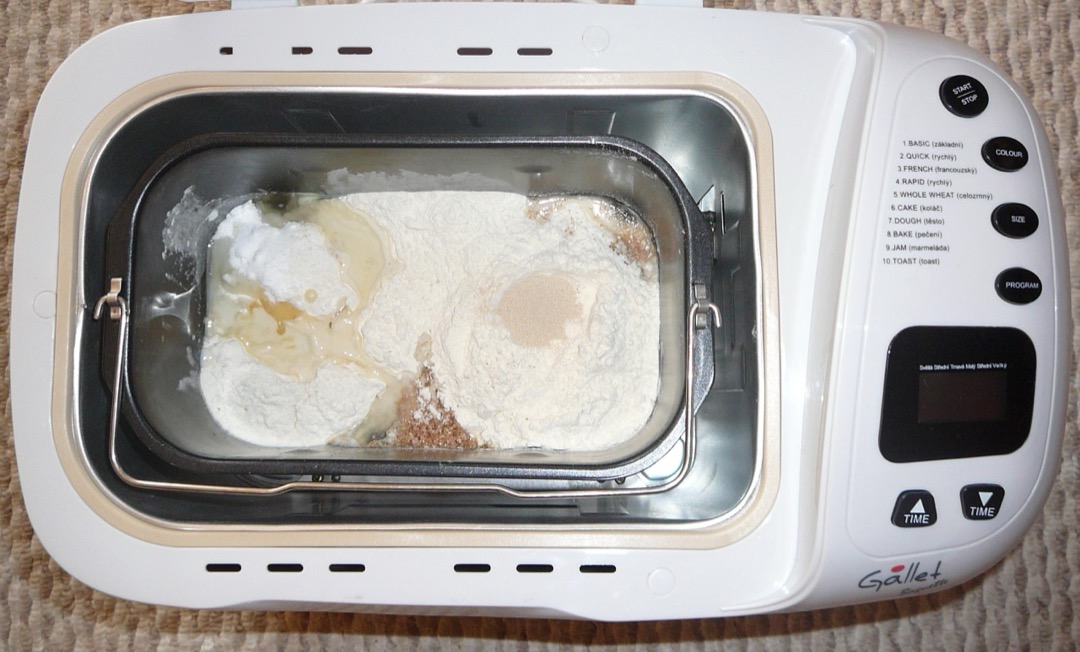
I spent four years running a restaurant group’s test kitchen, and the part of that job that transfers most directly to this page is the habit of not believing a control panel. A button labelled with a function is a claim, not a specification, and gluten-free is the label where the gap between the two is widest in the whole small-appliance category. Nearly every bread machine sold today has a gluten-free setting on it. Only some of them run a program that is genuinely different from the wheat cycle sitting next to it, and the difference between those two groups is the difference between bread and a dense wet slab you throw away.
The reason comes down to physics rather than recipe. Gluten-free batter is not dough. It has no elastic protein network, so there is nothing to develop through kneading and, far more importantly, nothing that can rebuild after being knocked down. A conventional wheat cycle deliberately punches the dough down between the first and second rise, because wheat gluten recovers and comes back stronger for it. Run that same sequence on a gluten-free batter and you have destroyed the only lift the loaf was ever going to get. What comes out is gummy in the middle, sunken on top, and blamed on the flour.
So the useful question for this 2026 guide was never which machines have a gluten-free button, because they all do. It was which machines do something meaningful around that button: a single-knead single-rise cycle, a pan shape that suits a batter rather than a dough, heat from above as well as below, a way to get the paddle out before the bake, and a coating you can actually clean. I looked at nine machines against those criteria, from an entry-level unit to a Japanese flagship with a heater in its lid, and every price, rating, and review count here was confirmed against a live, buyable listing before I wrote a word about it.
One thing to say up front, because it will save some readers a scroll. The Cuisinart CBK-110 is the best-selling all-round bread machine in the category and a great many people reading this already own one. It has no gluten-free program at all, which is why it does not appear below despite topping our general roundup of the best bread machines. If that is the machine on your counter, skip to the section on regular machines in the FAQs rather than shopping from this list first.
Find the Best Gluten-Free Bread Machine for Your Need
Two ways into this guide, depending on whether you want the ranking or the specific comparison:
Why Most Gluten-Free Settings Do Not Work
Here is the thesis of this entire page, and it is the one point every serious source in this category agrees on: a gluten-free button is not proof that the cycle behind it is right. Manufacturers add the label because shoppers filter on it. Adding a genuinely different program means re-engineering the stage timings in the firmware, and plenty of machines take the cheaper route of renaming a shortened wheat cycle.
What a correct gluten-free cycle does is simple enough to describe in one sentence. It mixes the batter once, lets it rise once, and bakes it, with no second knead and no punch-down anywhere in the sequence. That is the whole specification. A wheat cycle, by contrast, runs a knead, a first rise, a degassing punch-down, a second rise, and then the bake, and every one of those middle stages is actively harmful to a batter that cannot rebuild structure once the gas is driven out of it. There is no gluten to strengthen through the second knead. There is only air to lose.
My editorial position on this is unambiguous, and it is the reason this page is organised the way it is. Do not trust the button. Either verify what your machine actually does, or buy a machine that lets you override the preset with your own stage timings. Those are the only two safe positions, and the second one is why programmable machines punch above their price in this category specifically.
Verifying it is easy and costs you one loaf. Load a batch of gluten-free batter, start the gluten-free program, and watch through the window. Note the moment the paddle stops turning and the batter begins to rise. Then keep watching. If the paddle turns again at any point after that rise has visibly started, before the machine goes into its bake phase, you have a relabelled wheat cycle and the machine has just knocked the air out of your loaf. Most manuals will also tell you if you read the stage-timing table rather than the marketing page, though a good many manuals simply do not publish one.
If your machine fails that test, you are not stuck. Use a basic cycle instead, stop the machine manually once the first rise has finished, and restart it on a bake-only program. It is more attention than a preset asks for, but it produces a far better loaf than a badly implemented gluten-free button ever will.
How We Chose These Machines
Every machine here was assessed against the same five criteria, the way we would have evaluated a piece of equipment before a restaurant group bought a dozen of them, and every listing was confirmed as an active, in-stock, new-condition offer before it earned a place.
First, gluten-free cycle structure: whether the program is single-knead and single-rise, and whether the machine gives you any way to override it if it is not. Second, pan shape and heat distribution, which together decide whether a batter with no structure bakes through the middle or sets on the outside and stays wet in the centre. Third, paddle behaviour and removability, because in gluten-free baking the paddle is not a cosmetic annoyance, it is the thing that tears a fragile crumb apart on the way out. Fourth, pan coating and how it handles cleanup with a sticky batter, which is a durability question and, in a shared kitchen, a safety question. Fifth, the durability record in the ownership data, read for when machines fail rather than for the star average, because in this category the useful signal is the timeline of the one and two star reviews.
I want to be direct about the limits of my authority here. My expertise is kitchen equipment: how machines are built, what they do to food, and where they break. It is not celiac medicine. Where this guide covers cross-contact and shared-appliance safety further down, the guidance is sourced from the Gluten Intolerance Group and linked rather than asserted from my own judgement, and anyone managing celiac disease in the household should treat their own care team as the authority over anything written here. Where an independent lab has actually baked with one of these machines, I have said what they found and named them. Where no lab has tested a machine, I have said that too, because an untested machine is not the same thing as a bad one and readers deserve to know which they are looking at.
Best Gluten-Free Bread Machine Overall
These are the nine machines I would put in a kitchen that bakes gluten-free bread this year, each reviewed once below with its real limitations named rather than buried. The order runs from the machine that bakes the best gluten-free loaf down through the ones that solve a narrower problem well.
Best Overall: Zojirushi Virtuoso Plus BB-PDC20BA
This is the only machine on this page whose gluten-free loaf has been independently baked, tasted, and rated by a third party. TechGearLab ran controlled comparative bakes across much of this category and found the Virtuoso Plus produced the best gluten-free loaf of everything they tested. In a category where every other manufacturer’s gluten-free claim rests on its own marketing copy, that single data point does more work than any spec sheet, and it is the reason this machine leads the guide despite being the least sensible purchase on it for most households.
The hardware explains the result. There is a heater in the lid as well as the base, which matters far more for gluten-free than it does for wheat. A wet batter rises less and holds more moisture, so it finishes with a pale, soft, faintly damp crown unless something browns it from above. Almost every machine in this category heats from the base only. This one does not, and the top crust is visibly, immediately different for it. The pan is genuinely horizontal with two kneading blades, which gives a slack batter a shallow bed with more surface against the heating element rather than a tall column it has to hold up on its own, and two blades move batter across that width evenly where one would push it to one end.
There is a quieter feature worth naming for anyone sharing a kitchen. Zojirushi sells a genuine replacement kneading paddle separately, which makes keeping a dedicated gluten-free-only paddle a realistic proposition rather than a theory. That does not solve the whole cross-contact problem, and I go into why in the section on shared machines below, but it removes one of the harder parts of it cheaply.
The honest counterweight is the outlay, which is several times what most machines here cost and buys build quality and consistency rather than any feature you can point at. The paddles also stick in the finished loaf often enough that owners treat prying them out as routine, and a gluten-free crumb tears more easily than a wheat one does when you go in after them. This is the best gluten-free machine here. It is not the machine most people should buy.

Zojirushi Bb PDC20BA Virtuoso Plus 2 Lb Breadmaker, Black
by Zojirushi
The best gluten-free bread machine here, and the only one whose gluten-free loaf has been independently tested and rated best in class, with the lid heater and horizontal pan that a wet batter actually needs.
Pros
- Independent testing at TechGearLab produced the best gluten-free loaf of everything they baked, which is the only third-party validation of a finished gluten-free loaf anywhere in this category
- A heater in the lid as well as the base, which matters more for gluten-free than for wheat, because a wet batter needs heat from above to set a top crust instead of leaving a pale, damp dome
- A true horizontal pan with two kneading blades, so a slack gluten-free batter gets worked evenly across the pan rather than piled at one end by a single paddle
- Zojirushi sells a genuine replacement kneading paddle separately, which is what makes keeping a dedicated gluten-free-only paddle practical in a household that also bakes with wheat
Cons
- It costs several times what most machines on this page do, and the gap buys build quality and baking consistency rather than any feature you can point at on a spec sheet
- The kneading paddles stick in the finished loaf often enough that owners treat prying them out as part of the routine, which does more damage to a gluten-free crumb than to a wheat one
- The dedicated gluten-free paddle that makes a shared machine workable is a separate purchase rather than something in the box, and the machine itself is heavy enough that it stays wherever you first put it
Best Budget: Elite Gourmet EBM8103B Programmable Bread Maker
What makes the Elite Gourmet the budget pick is not simply where it sits on price, it is how little disappears to get there. In this category the gluten-free cycle is normally the first thing cut when a manufacturer is building down to a number, because it is firmware work that most buyers never verify. This machine keeps it, and keeps three loaf sizes and nineteen presets alongside it, which is a wider everyday range than several machines above it in this guide.
The three loaf sizes matter more here than they would on a wheat-only machine, and this is the point most gluten-free buyers miss. Gluten-free bread goes stale fast. The starches that give it structure retrograde more quickly than wheat starch does, and there is no gluten network holding moisture in the crumb, so a loaf that takes four days to eat is dry and crumbling by the second. Being able to bake at one pound rather than two, more often, produces genuinely better bread rather than being a compromise. A fifteen-hour delay timer and an hour of keep warm make that routine practical on a weekday.
The caveats are real and I would rather name them than have you discover them. There is a visible cluster of failures inside the first two months in the review record, which is the risk you accept at this level and the reason to buy where returns are straightforward. Loaves also frequently sit lower in the pan than the size setting implies, and that gap is more obvious with gluten-free batter than with dough, because there is less lift to start with. The bundled recipes need adjusting before they perform, usually toward slightly less liquid, and the manual gives you no steer on which way to go.

Elite Gourmet 2 Lb Programmable Bread Maker, 3 Sizes, 19 Presets, Black (EBM8103B)
by Elite Gourmet
The budget pick, and the machine that gives up the least to get there: a real gluten-free cycle, three loaf sizes, and nineteen presets at the entry tier of the category.
Pros
- A genuine dedicated gluten-free cycle survives at the entry tier of this category, which is unusual, because gluten-free is normally the first program cut to reach a low price
- Nineteen presets covering white, whole wheat, rye, French, sweet, pizza dough, cake, and jam, so the machine is not a single-purpose gluten-free appliance if the household bakes both ways
- Three loaf sizes, which matters more in gluten-free baking than in wheat baking because gluten-free bread stales quickly and a smaller loaf baked more often is simply better bread
- A 15-hour delay timer plus 60 minutes of keep warm, long enough to load the pan after dinner and still be asleep when the cycle finishes
Cons
- A visible cluster of failures inside the first two months in the review record, which is the risk at this level and the reason to buy where returns are straightforward
- Loaves frequently sit lower in the pan than the size setting implies, and that gap is more noticeable with gluten-free batter, which has less lift to begin with
- The bundled recipes need adjusting before they perform reliably, and the manual offers no guidance on which direction to adjust
Best Mid-Priced Machine: KBS Blue 2.2 lb Smart Bread Machine
The KBS Blue is the machine I would point most people toward when the flagship is out of reach but the entry tier feels too thin. Its most relevant feature for this page is the ceramic pan. Gluten-free batter is wet and sticky in a way dough is not, with far more of it in direct contact with the pan wall, and ceramic releases that batter more cleanly than a nonstick coating does once the nonstick has any age on it. It is also the coating gluten-free bakers ask about most often, for reasons that have as much to do with the chemistry of the surface as with how it performs.
The automatic nut dispenser is the other feature worth having rather than merely reading about. Almost every machine that advertises mix-in handling just sounds a beeper and expects you to be in the room with a bowl, which is useless on a delay-timer bake. This one has actual dispensing hardware in the lid that releases seeds or nuts at the right point in the cycle. For gluten-free baking that timing matters more than it does with wheat, because folding seeds in at the start means the paddle pulverises them into the batter rather than distributing them whole. Seventeen programs, sourdough and yogurt cycles, a fifteen-hour timer, and a touchscreen on a stainless body round out a machine that feels a tier above where it sits.
Two things to weigh against that. Ceramic coating flaking is a repeated complaint in the review record, and a flaked or scratched pan is more than a cosmetic problem in a gluten-free kitchen because damaged coating traps residue a wipe-down does not reach. The manual is also genuinely hard to follow, which with seventeen programs and a touchscreen to learn is a real cost in the first few weeks. And like most of this page, its gluten-free cycle carries no independent test data, so what happens between the knead and the bake is documented only by the manufacturer.

KBS Blue Bread Maker, 2.2LB Smart Bread Machine with Healthy Ceramic Pan, Touchscreen, Auto Nut Dispenser, 17 Automatic Programs
by KBS
The strongest mid-priced machine here, with a ceramic pan, a real automatic mix-in dispenser, and the widest everyday program range short of the flagship.
Pros
- A ceramic-coated pan rather than PTFE nonstick, which is the coating most gluten-free bakers ask for specifically because a sticky batter comes away from ceramic more cleanly than it does from worn nonstick
- An automatic fruit and nut dispenser that releases mix-ins at the right point in the cycle, which is the only version of that feature that works on an unattended overnight bake
- Seventeen programs including sourdough and yogurt alongside the gluten-free cycle, plus a 15-hour timer, in a stainless body with a touchscreen rather than a membrane keypad
- A 2.2 lb ceiling, which is slightly more headroom than the standard 2 lb machines here and useful if you bake for a household rather than for one person
Cons
- Ceramic coating flaking is a repeated complaint in the review record, and a flaked or scratched pan is a real problem in a gluten-free household because porous damage traps residue
- The manual is hard to follow, and with seventeen programs plus a touchscreen to learn, that is a genuine cost in the first few weeks
- The gluten-free cycle here has no independent test data behind it, so what it does between the knead and the bake is documented only by the manufacturer
Best for Stacked Diets: KITCHENARM 29-in-1 SMART Bread Machine
The KITCHENARM has the most genuinely useful feature on this entire page and it is one line in the manual: a built-in remove-paddle alarm. The single most effective technique in gluten-free bread machine baking is to pull the paddle out at the end of the knead, before the rise, so the loaf bakes with a smooth base and nothing to dig out of a fragile crumb afterwards. Everyone who writes about this category recommends it. Almost nobody does it, because it requires remembering to be in the kitchen at a specific unmarked moment forty minutes into a cycle. This machine tells you when. That is automation of the one thing the cycle itself cannot do for you, and no other machine here offers it.
The second reason it earns a place is menu breadth of a specific kind. Alongside Gluten-Free it carries Keto, Salt-Free, and Sugar-Free programs, which makes it the obvious answer for a household stacking more than one restriction on the same appliance. That is a more common situation than the product listings acknowledge: a gluten-free diet arrived at through celiac disease often sits next to a low-sodium requirement or a diabetes management plan in the same kitchen. Twenty-one bread menus in total, custom saved programs so a recipe needing a longer rest can run on your own timings, a fifteen-hour delay, and a fifteen-minute power-interruption recovery that saves a loaf through a brief outage.
What it lacks is external verification. No independent lab has tested this machine, so everything known about how its gluten-free cycle bakes comes from owners rather than controlled comparison, and that is a genuine gap next to the Zojirushi. The pan is a generic coated unit rather than a designed-for-the-machine part, so sourcing a replacement is harder than with an established brand. And the program list is long enough that the first two weeks involve real study, which is the opposite of what someone buying for one restricted diet usually wants.
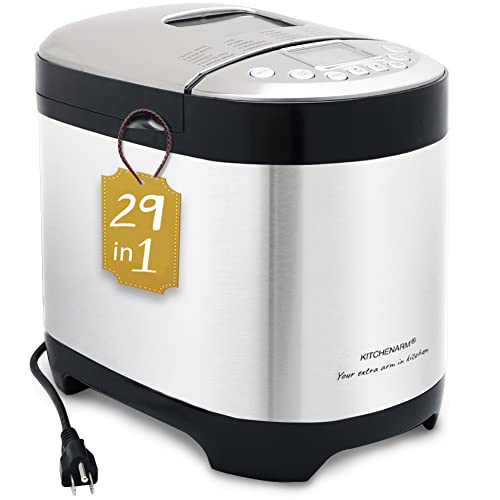
KITCHENARM 29-in-1 SMART Bread Machine with Gluten Free Setting
by KITCHENARM
The machine for a household running several restricted diets at once, and the only one here that will actively remind you to pull the paddle before the final rise.
Pros
- A built-in remove-paddle alarm, which is the standout feature on this page, because it automates the single most useful gluten-free technique there is and no other machine here prompts you to do it
- Keto, Salt-Free, and Sugar-Free menus sitting alongside Gluten-Free, which makes it the obvious machine for a household stacking more than one dietary restriction on the same appliance
- Twenty-one bread menus in total plus custom saved programs, so a gluten-free recipe that needs a longer rest than the preset allows can be run on your own timings
- A 15-hour delay timer and a 15-minute power-interruption recovery, so a brief outage partway through a cycle does not cost you the loaf
Cons
- No independent lab has tested this machine, so everything known about how its gluten-free cycle actually bakes comes from owners rather than from controlled comparison
- The pan is a generic coated unit rather than a designed-for-the-machine part, and replacements are harder to source than they are for the established brands
- The program list is long enough that the first two weeks involve real study, which is the opposite of what most people want from a machine bought for one restricted diet
Best PFAS-Free Pan: Hamilton Beach Programmable Bread Maker
This is the machine for the reader whose first question about a bread machine is not about programs at all, it is what the pan is coated with. That question comes up constantly in gluten-free baking communities and is almost never answered on a product listing, because most manufacturers simply write “nonstick” and leave it there. Hamilton Beach makes an explicit PFAS-free claim on this pan, and it is the only machine on this page that does.
Beyond the coating, what you are buying is mainstream-brand ordinariness, and I mean that as a compliment. Coated pans wear out. In a gluten-free household they wear out sooner, because a sticky batter gets scraped at more often and a scratched pan is a cleaning problem rather than a cosmetic one. When that day comes you want the manufacturer to still exist and the part to still be stocked, which is a materially different proposition from a brand that appeared on the marketplace two years ago. Three loaf sizes, a simple digital panel you stop needing the manual for after the first loaf, and an audible mix-in prompt that is worth using with gluten-free batter, since seeds added at the start get pulverised by the paddle rather than distributed.
Be clear on the limitations. Several reports of failure around the 22-month mark appear in the review record, which lands just outside most warranty windows and is exactly the kind of timeline pattern worth reading the one-star reviews for. The listing also contradicts itself on program count, with the title saying twelve settings and the bullets listing fourteen, so confirm the menu on the unit that actually arrives rather than trusting either number. And at 1,378 ratings the ownership record here is shallow next to most of this page, so the long-term failure pattern is less well mapped than the numbers suggest.
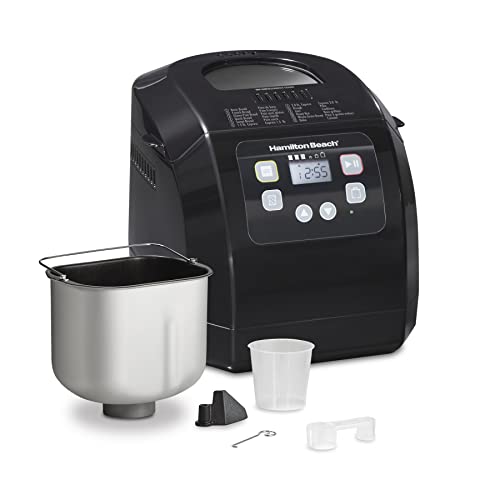
Hamilton Beach Automatic Bread Maker Machine, Digital, Programmable, Gluten Free, PFAS-Free Nonstick Pan
by Hamilton Beach
The answer for anyone whose first question about a bread machine is what the pan is coated with, from a mainstream brand that still stocks replacement parts.
Pros
- The only machine on this page with an explicit PFAS-free claim on the pan coating, which is the single most common question people ask about bread machine pans and is almost never answered on the listing
- A dedicated gluten-free program in a mainstream, widely serviced brand, which matters when a coated pan eventually needs replacing and you want the part to still exist
- An audible prompt for mix-ins, useful with gluten-free batter because seeds and nuts folded in too early get pulverised by the paddle rather than distributed
- Three loaf sizes and a simple digital panel, so the machine can be operated without the manual after the first loaf
Cons
- Several reports of failure around the 22-month mark in the review record, which lands just outside most warranty windows
- The listing contradicts itself on program count: the title says 12 settings while the bullets list 14, so confirm the menu on the unit that arrives rather than trusting either number
- At 1,378 ratings the ownership record here is shallow compared with most of this page, so the long-term failure pattern is less well mapped
Best Large Horizontal Loaf: West Bend Hi-Rise Bread Maker
The West Bend does two things nothing else here does at once: it bakes the largest loaf on this page, up to three pounds, and it does it in a genuinely traditional horizontal pan. Pan orientation matters more for gluten-free than for wheat, and the reason is structural rather than aesthetic. A vertical pan asks a batter with no gluten network to hold its own weight up a tall narrow column while it rises and bakes, which is precisely the geometry that leaves the middle underdone while the outside sets. A horizontal pan gives the same volume of batter a shallow, wide bed with more of it close to the heating element. Two kneading blades rather than one is not a luxury in that pan, it is a requirement, because a single paddle cannot move slack batter across that width evenly.
The detail that earns it a place in the Zone 2 comparison below is that it ships with a knead-blade removal tool in the box. No other machine here includes one. Given how central pulling the paddle is to a decent gluten-free loaf, and how much more damage a stuck blade does to a fragile crumb than to a wheat one, having the right implement supplied rather than improvised with a fork is worth more than the price difference between this and several machines above it.
The reliability record is the weak point and I will not dress it up. At 4.2 stars this is the lowest-rated machine in the roundup, some units failed inside four months, and the pattern points at the drive under repeated large, stiff loads. Dough sticking to the pan is a second recurring complaint, and it bites harder with gluten-free batter than with dough for the simple reason that a wet batter has far more contact with the surface. There is also an honest argument against the capacity itself: gluten-free bread stales fast enough that a three-pound loaf is the wrong buy unless you are genuinely feeding a large household every day.

West Bend Hi-Rise Bread Maker Machine, Gluten Free, 3-Lb, Horizontal Bread Pan with Dual Knead Blades
by West Bend
The largest gluten-free loaf on this page in a real horizontal pan, and the only machine here that hands you a blade-removal tool rather than leaving you to improvise one.
Pros
- It ships with a knead-blade removal tool in the box, which is a direct, practical answer to the paddle-hole problem and something no other machine here includes
- Up to a 3 lb loaf, the largest capacity on this page, and the only machine here that will feed a large household a gluten-free loaf from a single bake
- A genuine traditional horizontal pan at a mainstream level, so the loaf slices into rectangles rather than the tall narrow tower a vertical pan produces
- Two kneading blades rather than one, which is what a wide pan needs to move slack gluten-free batter evenly instead of pushing it to one end
Cons
- Dough sticking to the pan is a recurring complaint, and it bites harder with gluten-free batter than with dough because a wet batter has far more contact with the pan surface
- 4.2 stars is the lowest rating in this roundup, and some units failed inside four months, which points at the drive under repeated large, stiff loads
- A 3 lb capacity means a physically large machine, and gluten-free bread stales fast enough that the biggest loaf here is the wrong buy for most single-diet households
Best Dual Heater Outside the Flagship: Neretva 20-in-1 Bread Maker
A heater in the lid is the single piece of hardware that most visibly improves a gluten-free loaf, and only two machines in this guide have one. The other is the flagship. If you have read the section above on why gluten-free bread finishes with a pale, soft, faintly damp crown, this machine is the affordable route out of that problem, and that is essentially the whole case for it. Its 360-degree system heats from the top and the bottom, which browns the crust rather than leaving the batter to steam itself under a lid.
The ceramic pan is the second piece, and it pairs sensibly with the first. Sticky gluten-free batter releases from ceramic more cleanly than from a standard nonstick coating that has been through a couple of hundred cycles, which matters both for the loaf and for how thoroughly you can get the pan clean afterwards. Twenty programs cover conventional baking for the rest of the household, so this does not have to be a single-diet appliance, and the 1.65 pound setting alongside the two pound one is the more useful of the two given how quickly gluten-free bread goes stale.
The reservations are about the brand rather than the design. Durability reports are mixed, and there is no independent lab data to weigh against the owner record, so you are reading reviews without a controlled comparison to anchor them. Ceramic-coating wear is the category-wide caveat and applies here as it does to every ceramic pan in this guide. And there is no established service network behind it, which means a failed pan or paddle is a harder part to replace than it would be from a mainstream manufacturer. Buy this for the lid heater, knowing that is what you are buying.

Neretva Bread Maker 20-in-1 2LB Bread Machine with Dual Heater, Nonstick Ceramic Pan
by Neretva
The affordable route to a lid heater, which is the one piece of hardware that reliably improves the top crust of a gluten-free loaf, paired with a ceramic pan.
Pros
- One of only two machines on this page with a genuine dual heater, and the only one outside the flagship, which is the feature that browns the top of a gluten-free loaf instead of leaving it pale
- A ceramic-coated pan, which releases sticky gluten-free batter more cleanly than standard nonstick does once the coating has some age on it
- Twenty programs including the gluten-free cycle, so the machine covers conventional baking for the rest of the household without a second appliance
- A 1.65 lb setting as well as 2 lb, which suits gluten-free baking better than a single large size because the bread is best eaten within a couple of days
Cons
- Durability reports are mixed, and there is no independent lab data on this machine to weigh against the owner record
- Ceramic-coating wear is the category-wide caveat and it applies here, which matters in a gluten-free household because a damaged coating is harder to clean thoroughly
- The brand has no established service network, so a failed pan or paddle is a harder part to replace than it would be from a mainstream manufacturer
Best Compact Horizontal Loaf: Briskind 2 lb Ceramic Pan Bread Maker
The Briskind occupies a gap the rest of this page leaves open. Horizontal pans are rare, and the other horizontal machines here sit at the extremes: the flagship at one end and the three-pound West Bend at the other. This one puts a horizontal pan in a machine sized for a normal household loaf, topping out at two pounds with three sizes below it, which for a single gluten-free eater or a couple is the more sensible shape of the two. It also puts a ceramic coating on that horizontal pan, so the wide surface a wet batter clings to is the surface it clings to least. Owners consistently describe it as quiet and its instructions as clear, neither of which is a given in a category where manuals are a standing complaint, and the custom menu means a recipe that wants a longer rest is not blocked by the preset.
Now the thing that has to be said plainly, because it is the single most important fact about this machine. It has 254 ratings. That is by a wide margin the shallowest ownership record on this page, and it is not a small caveat dressed up as one. In a category where the useful information lives in the timeline of the one and two star reviews, 254 ratings is not enough of a record to see a failure pattern in. Everything I have written above about its build is drawn from a small number of owner reports and nothing else. There is no independent testing of it either, so both the gluten-free cycle and the durability rest on that same thin base.
Ceramic flaking is reported here as it is across the coated-pan machines in this guide, and with a record this shallow there is genuinely no way to judge how common it is. If you want the horizontal pan in a compact machine and you are buying somewhere returns are straightforward, this is a reasonable bet. It is a bet, and I would rather call it one.

Briskind 2 lb Bread Maker Machine with Ceramic Pan, 19-in-1, Horizontal Breadmaker
by Briskind
A horizontal pan and a ceramic coating in a normal-sized machine, which is the right shape for gluten-free bread, bought against an ownership record too thin to lean on.
Pros
- A horizontal pan in a machine sized for a normal household loaf rather than a 3 lb one, which is a combination nothing else on this page offers
- A ceramic coating on a horizontal pan, so the wide surface that a gluten-free batter clings to is the surface it clings to least
- Owners consistently describe it as quiet, and the instructions as clear, which is not the usual report in a category where manuals are a common complaint
- A flexible custom menu alongside the nineteen presets, so a gluten-free recipe that wants a longer rest can be run on your own timings
Cons
- Only 254 ratings, which is by a wide margin the shallowest ownership record on this page and means its failure pattern is essentially unmapped
- Ceramic flaking is reported here as it is across the coated-pan machines, and with so few reviews there is no way to judge how common it is
- No independent testing exists, so both the gluten-free cycle and the build quality rest entirely on a small number of owner reports
Best Low-Commitment Starter: Amazon Basics Programmable Bread Maker
There is a real question underneath a first gluten-free bread machine purchase, and it is not which machine is best. It is whether you will actually bake bread. Gluten-free baking has a steeper learning curve than wheat baking, the first two or three loaves are usually disappointing, and plenty of people buy a machine, produce something gummy twice, and put it in a cupboard. This is the cheapest honest way to find that out about yourself, and that is genuinely the argument for it.
The feature that makes it work in that role is the ExpressBake cycle, which finishes a loaf in under 90 minutes. That is the difference between deciding to bake gluten-free bread on a Tuesday and actually baking it, and it compresses the feedback loop while you are still learning what your flour blend wants. Fourteen settings including a gluten-free cycle is more programmed range than a deliberately stripped-back machine usually carries, and a full two-pound capacity with a programmable timer means nothing structural is missing.
What is missing is build quality. The housing is brittle, cracked cases appear in the review record, and there is no premium construction here to absorb the abuse. The manual is thin, which is a bigger problem in gluten-free baking than in wheat baking because the recipe adjustments are less intuitive and you have less to work from. It is also outclassed on features by the budget pick sitting immediately next to it in this guide, which is why it is the fallback rather than the first choice. If the Elite Gourmet is available, buy that. If it is not, or if you want the fastest possible answer to whether this is a hobby you will keep, this will bake you bread.

Amazon Basics Programmable Bread Maker, 2 Pound Non-Stick Automatic Bread Machine
by Amazon Basics
The cheapest way to find out whether you will genuinely bake gluten-free bread at home, with a sub-90-minute ExpressBake cycle and no pretence of being anything more.
Pros
- An ExpressBake cycle that finishes a loaf in under 90 minutes, which is the difference between deciding to bake gluten-free bread on a weeknight and actually doing it
- Fourteen settings including a gluten-free cycle, which is more programmed range than a deliberately stripped-back machine at this tier usually carries
- A low-commitment way to find out whether a bread machine earns its counter space before spending on a serious one, which is a real question in gluten-free baking where the learning curve is steeper
- A full 2 lb capacity and a programmable timer, so nothing structural is missing despite how basic the machine is
Cons
- The housing is brittle and cracked cases appear in the review record, with no premium build here to absorb the abuse
- The manual is thin, which is a bigger problem in gluten-free baking than in wheat baking because the recipe adjustments are less intuitive
- It is outclassed on features by the budget pick sitting next to it in this guide, so it is a fallback rather than a first choice
Bread Machines With a Dedicated Gluten-Free Setting
All nine machines in this guide have a dedicated gluten-free setting, which is exactly why searching on that feature does not narrow anything down. The button is table stakes now. What actually separates these machines is not whether the setting exists but what the machine does around it: whether anyone outside the manufacturer has verified the finished loaf, whether the machine helps you perform the technique the cycle cannot perform for itself, and whether the pan and the heat suit a batter rather than a dough.
Three machines here do meaningfully more than press a labelled button, and they do it in three different ways. One has been independently tested. One automates the paddle removal that improves every gluten-free loaf regardless of cycle quality. One hands you the tool for that job and bakes the biggest loaf on the page while doing it.
| Product | Price | Buy |
|---|---|---|
| Zojirushi Bb PDC20BA Virtuoso Plus 2 Lb Breadmaker, BlackBest-tested gluten-free cycle The only gluten-free cycle here whose finished loaf has been independently baked and rated best in class by TechGearLab, rather than described by its manufacturer | $454.00 | View on Amazon |
| KITCHENARM 29-in-1 SMART Bread Machine with Gluten Free SettingBest gluten-free cycle assist A built-in remove-paddle alarm prompts you at the end of the knead, automating the one gluten-free technique no cycle can perform on its own | $106.99 | View on Amazon |
| West Bend Hi-Rise Bread Maker Machine, Gluten Free, 3-Lb, Horizontal Bread Pan with Dual Knead BladesBest gluten-free cycle for a big loaf Ships with a knead-blade removal tool and bakes up to 3 lb in a horizontal pan, the largest gluten-free loaf on this page | $109.99 | View on Amazon |
Buyer's Guide
Every machine in this guide has a gluten-free button, which is exactly why the button is the wrong thing to shop on. Six specifications actually determine whether the loaf that comes out is bread or a brick, and most of them are buried in the manual rather than printed on the box.
Whether the Gluten-Free Cycle Is Single-Knead and Single-Rise
This is the whole ballgame and it is almost never in the specifications. Gluten-free batter has no gluten network, which means there is nothing to develop through repeated kneading and nothing that can rebuild after being degassed. A correct gluten-free program mixes once, rises once, and bakes. A badly implemented one is a shortened wheat cycle that punches the batter down between rises, which destroys the only lift the loaf was ever going to get and produces the dense, gummy result people blame on their recipe. You can only find this out by watching a full cycle or reading the stage timings in the manual, so the safer purchase is a machine with a custom program you can override if the preset turns out to be wrong.
Pan Orientation and What It Does to a Wet Batter
Most bread machines use a vertical pan, deeper than it is wide, which bakes a tall narrow tower. That shape is awkward with wheat bread and worse with gluten-free, because a batter with no structural strength has to hold its own weight through a tall column while it rises and bakes, and the middle stays underdone while the outside sets. A horizontal pan is wider than it is tall, so the batter sits in a shallower bed with more surface exposed to the heating element, which is exactly what a loaf that struggles to bake through needs. Horizontal machines are rarer and generally use two kneading blades, because one paddle cannot move batter across a wide pan evenly.
Heat Distribution and Whether There Is a Lid Heater
Nearly every bread machine heats from the base only, and the top of a gluten-free loaf pays for it. Wheat dough browns on top through its own sugars and the steam trapped in the chamber, but gluten-free batter is wetter, rises less, and finishes with a pale, soft, faintly damp crown that never develops a crust. A heater in the lid solves it directly by browning from above, and it is the single piece of hardware that most visibly improves a gluten-free loaf. Only two machines in this guide have one. Convection is the partial substitute, moving hot air around the chamber rather than radiating heat downward, which helps with evenness but does less for the crust.
Paddle Count and Removability
Every bread machine leaves a hole in the base of the loaf where the paddle sat, and on a two-blade machine you get two. It is cosmetic in wheat bread. In gluten-free bread it is worse, because the crumb is more fragile and digging a stuck paddle out of a cooled loaf tears it apart. Two things make this manageable. A machine that alerts you at the end of the knead so you can lift the batter, pull the paddle, and put it back is doing the work for you. A machine that ships with a blade-removal tool at least gives you the right implement. For a shared household, check whether a replacement paddle can be bought separately, because a dedicated gluten-free paddle is far cheaper than a dedicated machine.
Pan Coating: Ceramic, Standard Nonstick, or PFAS-Free
Treat this as a tradeoff rather than a ladder, because none of the three is simply better. Standard PTFE nonstick releases well when new and is the cheapest to replace, but it wears and scratches, and a scratched pan is a genuine problem in gluten-free baking because damaged coating traps residue that a wipe-down does not reach. Ceramic releases sticky batter well and does not use PTFE, but flaking is the most consistent complaint across every ceramic machine here. PFAS-free nonstick answers the chemistry question directly and is the newest of the three, which also means the least long-term wear data. What matters more than which you choose is that you can buy a replacement pan when the coating goes, and that you never let a metal utensil near it.
Loaf Size Matched to the Household
Size down rather than up, and size down harder than you would for wheat bread. Gluten-free bread stales noticeably faster than wheat bread, because the starches it relies on for structure retrograde more quickly and there is no gluten network holding moisture in the crumb. A large loaf that takes four days to finish will be dry and crumbling by day two, so a smaller loaf baked more often is not a compromise, it is better bread. The other half of the argument is mechanical: a pan built for a large loaf running a small batch spreads the batter thin, which browns at the edges before the centre sets. Buy for the loaf you will actually eat inside two days.
Choosing a Gluten-Free Flour Blend for Your Machine
The machine is one half of the result and the flour is the other, and in gluten-free baking the flour half is larger. A useful working frame for a bread blend is roughly 60 to 70 percent starches, meaning things like tapioca, potato, and cornstarch, against 30 to 40 percent whole-grain gluten-free flours such as brown rice, sorghum, millet, or buckwheat. The starches give you lightness and a tender crumb. The whole-grain flours give you flavour, colour, and enough substance that the loaf tastes like bread rather than like a sponge. Tip that ratio too far toward starch and you get something pale and cotton-like. Too far toward whole grain and it bakes heavy and dense.
There is one specific, checkable thing worth knowing before you buy a bag, and it catches an enormous number of people. Bob’s Red Mill 1-to-1 Baking Flour and King Arthur Measure for Measure both state on the package that they are not recommended for yeast baking. They are cup-for-cup substitutes formulated for cakes, cookies, muffins, and quick breads, and they are the two bags most likely to be on the shelf in front of you. Reach for either one, put it in a bread machine with yeast, and you will get a poor loaf that has nothing to do with your machine or your technique. Buy a blend that says bread flour or bread mix on the front, or build your own to the starch-to-whole-grain ratio above.
The other non-negotiable is a binder, because you have to replace what gluten was doing. Gluten is what traps the carbon dioxide the yeast produces and gives bread the elasticity to hold a rise, and without a substitute the batter simply cannot contain the gas. Xanthan gum is the common answer at roughly a teaspoon per cup of flour for a bread recipe. Psyllium husk is the alternative a lot of experienced gluten-free bakers prefer, because it holds water as well as structure and produces a crumb that is less rubbery and more genuinely bread-like. Check your blend before adding either, though, since many commercial blends already include a binder and doubling up produces a gluey loaf.
Two smaller points that pay off. Weigh your flour rather than scooping it, because gluten-free blends vary enormously in density and a cup of one is not a cup of another. And use oil rather than butter as your fat, both because oil disperses more evenly through a batter and because delay-start baking rules out dairy entirely. Any neutral oil works; our oil smoke point chart covers which stay stable and flavourless at baking temperatures. If you plan to blend your own flours regularly, a food processor mixes a large batch of dry blend far more evenly than a whisk does, and an evenly mixed blend is one fewer variable when a loaf goes wrong.
Is It Safe to Share a Bread Machine Between Gluten and Gluten-Free Baking?
This is the most important question on this page and it is the one where I am least qualified to give you an answer, so I am going to give you a source instead of an opinion.
The Gluten Intolerance Group, a celiac advocacy organisation, publishes appliance cross-contact guidance, and on bread machines specifically it is direct. Their guidance is to use a dedicated gluten-free bread machine, not to bake both gluten-free and gluten-containing breads in the same machine, and that having two separate bread machines is the safest approach. That is their position stated plainly, not my paraphrase of it, and it is the position I would follow in a professional kitchen serving a celiac guest.
The mechanism is worth understanding, because it explains why a thorough clean is not the same as a solved problem. Flour is a dust, and it goes airborne every time a pan is loaded and every time a dry cycle begins, settling in the lid, in the vents, and along the seams of the baking chamber. The pan itself is the second route: nonstick and ceramic coatings scratch, and a scratched or flaked coating is porous in a way a smooth one is not, holding residue that no amount of wiping reaches. The third is the paddle and the shaft seal it sits on, which is a moving joint with a gap in it that dough and batter work into and where a brush cannot follow. And the fourth is simply crumbs in the baking chamber itself, below and around the pan, which a wipe-down of the pan does not touch at all.
Celiac disease is an autoimmune condition, not an intolerance, and trace exposure causes real intestinal damage in people who have it, including when there are no symptoms to warn them. That is why the guidance from a celiac organisation is as firm as it is, and why I am not going to soften it into something more convenient. Anyone managing celiac disease in the household should follow their own care team’s advice over anything on this page.
There is a practical middle path and it is worth naming honestly for what it does and does not cover. In a household that is avoiding gluten by preference or for non-celiac sensitivity rather than managing diagnosed celiac disease, a shared machine with a second dedicated pan and paddle, kept separately and used only for gluten-free baking, removes the two contact routes that carry the most residue. It is considerably cheaper than a second machine, which is why the flagship’s separately available replacement paddle is a genuinely useful detail. What it does not address is the baking chamber itself, the lid, or the airborne flour dust, and if diagnosed celiac disease is in the picture, that remaining exposure is precisely the part the guidance above is telling you not to accept.
How to Choose a Gluten-Free Bread Machine
Verify the Cycle Before You Trust It
Buy on the assumption that the gluten-free button might be a relabelled wheat cycle, then test it on your first loaf. Start the program, watch the paddle, and note whether it turns again after the batter has begun to rise. One knead and one rise is correct. A second knead means the machine is degassing a batter that cannot recover, and you should switch to running a basic cycle manually, stopping it after the first rise, and restarting on bake-only. A machine with custom programmable stages sidesteps the whole question, which is why programmability is worth more in this category than in general bread baking.
Pull the Paddle Before the Final Rise
This is the highest-value minute you will spend on a gluten-free loaf and it works on every machine here. When the knead finishes and before the rise gets going, open the lid, lift the batter out with a wet spatula, pull the paddle off the drive shaft, drop the batter back in, and close the lid. The machine carries on exactly as programmed. The loaf bakes with a smooth base and there is nothing to dig out of it afterwards, which matters far more with a fragile gluten-free crumb than with wheat bread. Set a phone alarm for the end of the knead, or buy the machine in this guide that sets one for you.
Match the Pan to a Batter, Not a Dough
Horizontal beats vertical for gluten-free, and it is worth paying for. A tall narrow pan asks a structureless batter to support itself through a column while it bakes, which is how you get a set exterior over a wet middle. A wide shallow pan puts more of the batter near the heating element and gives it less height to hold up. If you cannot get a horizontal pan within budget, bake smaller loaves in the vertical one rather than larger ones, since a smaller batch in the same pan gives you a shallower bed and the same benefit.
Read Reviews for the Failure Timeline, Not the Star Average
Star averages across this page run from 4.2 to 4.6, which is a range too narrow to make a decision on. The information you want is in the one and two star reviews and specifically in when they say the machine died. Two months, four months, and twenty-two months are three completely different problems: the first is a defect you can return, the second is a drive failing under load, the third lands outside most warranties. Across the machines here that pattern is consistent, with drive failures under stiff loads, coating wear on the pan, and housings giving way on lighter builds. Sort by lowest rating and read the dates. Then run a new machine hard in its first month rather than saving it, so a defect surfaces while you can still act on it.
Buy Smaller Than You Think, and Buy Where Returns Are Easy
Gluten-free bread stales faster than wheat bread does, so a loaf you cannot finish in two days is a loaf that gets thrown away. Size to what you will actually eat, not what the household could theoretically consume, and bake more often. And given the failure timelines above, the return policy is a genuine specification in this category rather than an afterthought, which is why I would rather have an easily returned budget machine than a hard-to-return mid-range one. That same logic applies to most of the equipment around it, from rice cookers to prep tools.
Final Verdict
The Zojirushi Virtuoso Plus is the best gluten-free bread machine on this page and most people reading this should not buy it. Both of those things are true and I would rather say them together than pretend otherwise. It is the only machine here whose gluten-free loaf has been independently baked and rated best in class, it has a lid heater and a real horizontal pan, and its separately available replacement paddle solves part of the shared-kitchen problem. It also costs several times what the rest of this page does, and what that money buys is consistency rather than any feature you could point at on a box.
For most gluten-free households the sensible buy is the Elite Gourmet EBM8103B, which keeps a genuine gluten-free cycle, three loaf sizes, and nineteen presets at the entry tier, and gives up early-life reliability to get there. If you want a machine that feels like a real appliance rather than a trial run, step up to the KBS Blue for the ceramic pan and the working mix-in dispenser, and accept that its gluten-free cycle has no independent testing behind it and that ceramic flaking is a documented complaint. Those are the honest tradeoffs, and there is no option here that avoids all of them.
Whichever way you go, do the two things that improve every loaf regardless of what you spend. Verify what your gluten-free cycle actually does on the first bake, and pull the paddle before the final rise. If you are also baking with wheat in the same kitchen, read the cross-contact section above and take the Gluten Intolerance Group’s guidance seriously rather than mine. And if you want the version of this guide that covers conventional baking as well, including the machines here that have no gluten-free program at all, our roundup of the best bread machines is the wider view, with the best colanders and strainers covering the prep gear that turns up alongside it.
Frequently Asked Questions
Can you make gluten-free bread in a regular bread machine?
What setting should I use on a bread machine for gluten-free bread?
Why is my gluten-free bread gummy or sunken in the middle?
Do I need xanthan gum for gluten-free bread machine bread?
Can you make gluten-free pizza dough in a bread machine?
Related Articles
About the Reviewer

Nora Whitfield, CIA Culinary Arts, ServSafe Certified
A.O.S. Culinary Arts, The Culinary Institute of America
Nora Whitfield trained at the Culinary Institute of America and spent twelve years in professional kitchens, the last four running the test kitchen for a regional restaurant group where her job was to decide which equipment could survive a dinner service and which could not. She has seasoned more carbon-steel woks than she can count, boiled water in every kettle worth owning, and broken enough cheap gear to know exactly where manufacturers cut corners. She reviews kitchen equipment the way she specified it professionally: cook on it, clean it, and see what it looks like after a month.