12 Best Whistling Tea Kettles of 2026, Tested by a CIA-Trained Chef
The best whistling tea kettle keeps whistling only if you descale it. Chef Nora Whitfield reviews 12 stainless, enamel, glass and solid copper kettles for 2026.
Updated
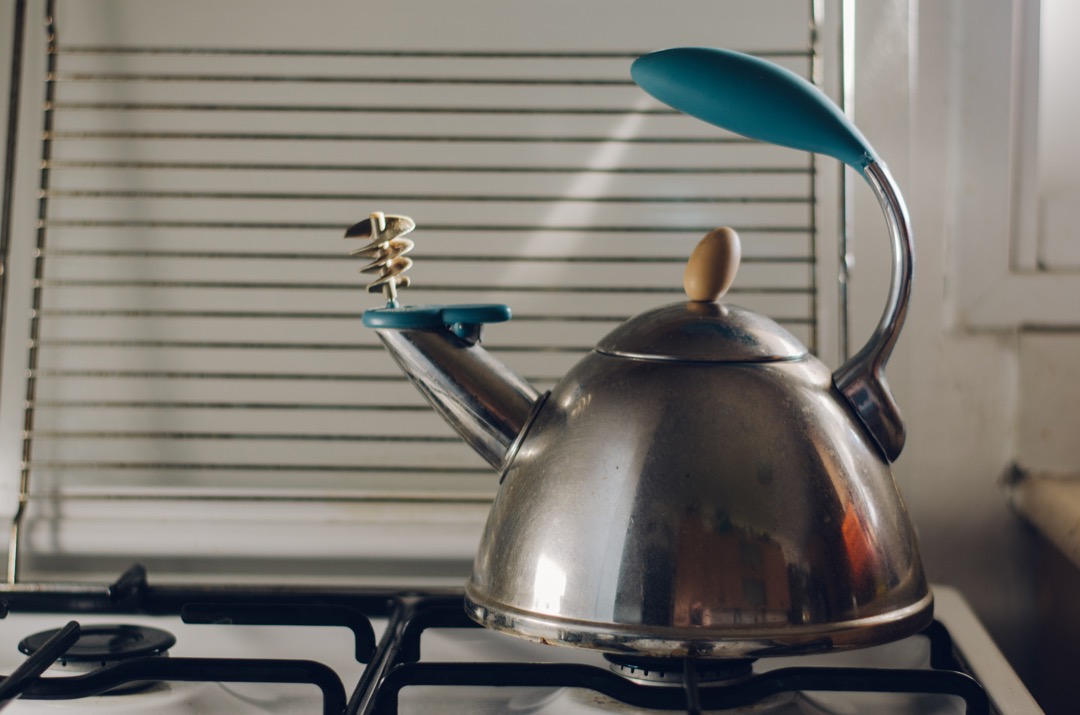
Almost every complaint I read about whistling kettles is the same complaint: it stopped whistling. People treat that as the kettle dying, and they buy another one. It is almost never the kettle. The whistle is a maintainable part, and it is the only part of a kettle that has a service interval.
Here is the mechanism, once, plainly. A whistle is a constriction. Steam has to be pressurised behind a narrow gap and forced through it fast enough to set up a tone, which is why a kettle only whistles at a genuine boil and stays silent at a simmer. In most kettles that gap sits between two small plates in a disc under the spout cap, or under the flip-up cap itself. Scale from your water is deposited exactly there, because it is the last hot surface the steam touches on its way out. As scale builds under the disc, the disc stops seating flat. Steam then leaks around it instead of being forced through it. There is no longer enough pressure differential to make a note, so the tone thins, drops, and goes. Nothing is broken. A fifty-fifty white vinegar soak, a wipe of the seat, and a firm reseat of the disc brings it back, and I have brought back kettles that their owners had already replaced.
I spent four years running a restaurant-group test kitchen, where a kettle either works every service or gets thrown out, and that experience is why this guide leads with the part everyone else treats as a fixed feature. The best whistling tea kettle for you is the one whose whistle you can hear, whose spout you can open one-handed, and whose disc you can actually get at to clean. Everything else, capacity, material, brand, is downstream of that. If you cook on gas specifically, the base geometry argument in our tea kettle for a gas stove guide is the companion piece to this one, because a flame that wraps up the sides of a kettle is a separate problem from a whistle that has gone quiet.
I assessed twelve whistling kettles for 2026 across stainless steel, enamel on steel, borosilicate glass and solid copper, checking every listing live, verifying induction compatibility one SKU at a time, and saying so out loud wherever a review record is too thin to lean on.
Find the Best Whistling Tea Kettle for Your Need
Different kitchens want different kettles. Jump to yours:
- Best whistling tea kettles overall
- Best stainless steel whistling tea kettles
- Best enamel and retro-style whistling tea kettles
- Best glass whistling tea kettles
- Best copper whistling tea kettles
- Best electric whistling tea kettles
- Best small whistling tea kettles
- More whistling kettles by whistle type
How We Chose These Kettles
Start with what we do not do. We do not run an acoustics lab, so we do not publish decibel figures for whistles, and we deliberately do not repeat the decibel numbers a competing affiliate site publishes for this category. Those numbers appear with no stated microphone, no stated distance, and no stated method, and the same article’s paired boil-time table is internally inconsistent with itself. A number with no method behind it is not data, it is decoration, and reprinting someone else’s decoration as though we had measured it would be worse than saying nothing. What I can tell you is how loud a whistle is by consistent owner report across a real review record, and I have done that for every kettle here.
Boil times get the same treatment. A boil time is only comparable within one method and one volume: same starting water temperature, same fill level, same burner, same cooktop. Blending other people’s boil times into a ranking produces a table that looks authoritative and means nothing, because a 1.25 quart kettle on a small ring and a 3.2 quart kettle on a power burner are not in the same experiment. Where volume genuinely affects how fast a whistle arrives, I say so in the review rather than dressing it up as a measurement.
Induction compatibility was verified per SKU, never assumed per brand or per material. That distinction matters more in this category than anywhere else in the kitchen, because enamel goes both ways, copper occasionally goes the right way, and a premium brand name is no guarantee at all. Several kettles here are not induction-safe, including the Teabloom glass kettle and, surprisingly for its price, the SMEG.
Finally, every ASIN on this page was checked as a live, in-stock, new-condition listing with a real buy box before it was written about. Where a review pool is thin, the review says so in plain words rather than letting a star rating imply a confidence the evidence does not support. Two kettles here qualify: the Teabloom at 81 reviews and the SMEG at 182. Both are worth considering. Neither has enough of a record to tell you how it behaves in year three.
Best Whistling Tea Kettles Overall
These are the twelve kettles I would put on a hob in 2026, each reviewed once below with what it genuinely does well and where it gives something up. The overall pick leads because it solves the everyday problems, one-handed pouring and a stated induction rating, at a price nearly everyone can justify. The use-case sections further down regroup the same kettles by material, by size, and by the sound of the whistle itself.
Best Overall: Farberware 2.3-Quart Stainless Whistling Tea Kettle
The Farberware wins on the two things you touch every single day. The spout cap locks open, which means you tip the kettle with one hand and pour, instead of the two-handed manoeuvre most kettles force on you where a towel holds the cap back while your other hand controls a full pot of boiling water over a cup. It sounds like a small detail on a spec list. It is the difference between a kettle you use happily for a decade and one that quietly annoys you every morning.
The second is that it states induction compatibility outright. At this price that is genuinely uncommon, and it means the kettle survives a move, a kitchen renovation, or a switch of hob without becoming a decoration. The body is polished stainless in the classic egg shape, and the lid fits tightly enough that steam stays in the body and drives the whistle rather than escaping around the rim. Farberware has been making kitchen equipment for a hundred and twenty years, which is not proof of quality on its own, but it does mean there is a company to complain to and a name buyers recognise in a category otherwise dominated by listings from brands that appeared last year.
Two honest limitations. A 4.2 rating across a few hundred reviews is solid rather than exceptional, and it is a much thinner record than the Primula’s, so the confidence here comes from brand history rather than from volume of evidence. And the egg shape means the flat footprint at the bottom is smaller than the wide-base kettles in this guide, so match it to a modest burner ring rather than the largest one you own. One practical warning that has nothing to do with the kettle itself: a Used - Like New Amazon Resale offer sits directly beneath the new buy box on this listing, and it is very easy to click by accident. Check what you are adding to the basket.
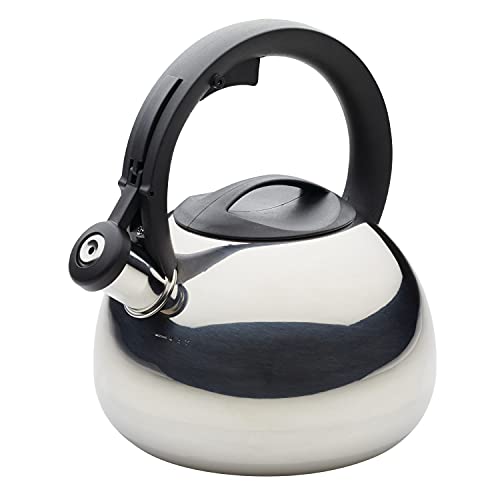
Farberware Stainless Steel Tea Kettle, Whistling Teapot, 2.3-Quart, Silver
by Farberware
The whistling kettle I would put in front of most kitchens first: a recognisable brand, a spout cap that locks open for one-handed pouring, and a stated induction rating at a price where that is rare.
Pros
- A 120-year heritage brand that buyers recognise on sight, which matters in a category where most listings come from names nobody has heard of
- The spout cap locks open, so you pour one-handed instead of holding the cap back with a towel while you tip
- A tight-fitting lid keeps steam in the body rather than venting it around the rim, which is what speeds the boil
- Explicitly rated for induction, which most kettles at this price never claim at all
Cons
- A 4.2 rating is solid rather than exceptional for this category, and the review record is modest at a few hundred owners
- The egg-shaped body gives a smaller flat footprint than the wide-base kettles here, so it wants a matched burner ring
- A Used - Like New Amazon Resale offer sits directly under the new buy box and is easy to click by mistake
Budget Pick: Primula Stewart 1.5-Quart Whistling Tea Kettle
The Primula is my value pick because of the evidence behind it rather than the ticket price. More than twenty-two thousand people have reviewed this kettle. That is the deepest owner record in this entire guide by an enormous margin, and it changes the nature of what you are buying: with a record that size you are not guessing about how it behaves after two years, whether the whistle keeps working, or whether the folding handle stays tight. Everything that can go wrong with it has already gone wrong for someone and been written down.
The design decisions are sensible ones. The handle folds flat, so the kettle goes in a cupboard rather than living permanently on a burner collecting cooking grease. The mouth is wide, which matters far more than it sounds, because a wide mouth is the difference between descaling being a two-minute job with a cloth and a hand, and being an awkward business with a bottle brush. Given that descaling is the maintenance this whole guide is built around, buy a kettle you can get into. At 1.5 quarts it also comes to a full head of steam quickly, so the whistle arrives sooner than it does on a large-capacity kettle.
Where the money was saved is thickness. The gauge is thin, which shows up as dents rather than failures, and there is no capsulated base, so heat arrives as a concentrated ring rather than a spread field. The one hard exclusion: induction compatibility is never claimed anywhere in this listing, and I treat unclaimed as unrated. If you cook on induction, buy the Circulon or the Farberware instead and do not gamble on this one.
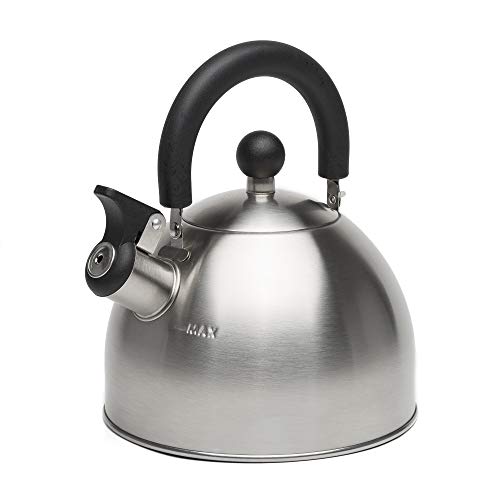
Primula Stewart Whistling Tea Kettle for Stovetop, 1.5-Quart
by Primula
The best-value whistling kettle here on evidence alone: nearly twenty-three thousand owners describing how it behaves, a folding handle, and a mouth wide enough to descale properly.
Pros
- 22,700 owner reviews, the deepest record of any kettle in this guide by a very wide margin
- The handle folds down flat, so the kettle stores in a cupboard instead of permanently occupying a burner
- A wide mouth that you can get a hand and a cloth into, which is what makes descaling quick rather than a chore
- At 1.5 quarts it reaches a full head of steam fast, so the whistle arrives sooner than on a large-capacity kettle
Cons
- Induction compatibility is never claimed anywhere in the listing, so induction owners should skip it rather than gamble
- The steel gauge is thin, which is the expected trade at this price and shows up as dents rather than failures
- There is no capsulated base, so heat arrives as a concentrated ring rather than a spread field
Upgrade Pick: Viking 3-Ply Stainless Steel 2.6 Quart Tea Kettle
The Viking is the only kettle in this guide with a genuinely different construction, and it is worth understanding what that means. Almost every other stainless kettle at any price is a single sheet of steel with a heat-spreading disc bonded or capsulated into the bottom. This one is 3-ply through the entire body: an aluminium core sandwiched between stainless layers all the way up the walls, not just underneath. The practical result is that heat moves around the vessel rather than concentrating where the burner touches, which is why fully clad cookware resists warping and hot-spotting in a way disc-bottomed cookware does not.
The details around that are thought through as well. The lid is tempered glass, so you watch the water come up rather than inferring it from the sound, which is genuinely useful if you pull water off before a full rolling boil for green tea. The handle is cast stainless with a heat break built into the casting, which is the correct engineering answer to an all-metal handle: metal cannot melt, scorch, or peel, but it does conduct, so you interrupt the conduction path deliberately instead of pretending the problem away. It is also sold and shipped by Amazon, which removes the authenticity questions attached to the reseller-fronted premium listings elsewhere on this page.
The costs are honest. This is a real step up in price and what you buy is construction and longevity rather than a faster boil, because water boils at the same temperature regardless of what surrounds it. The matte black finish shows every fingerprint. And it is heavy when full, which is the direct physical cost of three layers of metal. If you want one kettle for the next fifteen years and you would rather not think about it again, this is the one.

Viking 3-Ply Stainless Steel Tea Kettle, 2.6 Quart
by Viking
The buy-once stainless kettle: a full 3-ply body rather than a base disc, a glass lid, a handle with a designed heat break, and Amazon as the seller of record.
Pros
- True 3-ply construction through the entire body rather than a bonded disc on the bottom only, which is a genuinely different build from everything else here
- A tempered glass lid lets you watch the water instead of guessing at the boil from the sound
- The cast stainless handle has a heat break designed into it, so the metal grip does not conduct straight from the body to your hand
- Sold and shipped by Amazon, which removes the third-party authenticity questions attached to several premium listings in this category
Cons
- A real step up in price over a competent stainless kettle, and the gain is construction rather than a faster boil
- The matte black finish shows fingerprints immediately and stays visible until you wipe it
- It is heavy to lift when full, which is the direct cost of the three-layer body
Runner-Up: LUXGRACE 2.8 Quart Stainless Whistling Tea Kettle
The LUXGRACE is the large-batch, loud-whistle option, and it does both jobs at a price that undercuts everything else offering either. At 2.8 quarts, roughly thirteen cups, one boil fills a French press and a teapot together, which is the size that makes sense for a household where several people want hot water at the same time. The whistle is loud by consistent owner report, and loud is not a luxury on a kettle this size, because a big kettle takes longer to come up and gives you more time to wander off and forget about it.
Underneath, the metal capsulated base is the feature actually worth paying for. A burner ring lands on a sandwich of heat-spreading metal rather than a single thin sheet, which distributes the heat across the whole bottom instead of concentrating it in one circle. That is what keeps a base flat over years rather than developing the rocking wobble that a warped kettle gets. The construction is PFOA-free food-grade stainless and the listing states it plainly rather than gesturing at it with a non-toxic banner.
Now the quirk, and it is a real one that the listing itself discloses. The manufacturer’s own tip says to fill the kettle to 80 percent for the whistle to sound reliably. Read that as a design constraint rather than a suggestion: below that fill level there is not enough steam volume to drive the whistle properly, and you will get a weak note or none. If you routinely boil a mug’s worth of water, this is the wrong kettle and the Le Creuset Demi is the right one. Beyond that, it is a generic brand with no track record outside this listing, and induction is implied by the capsulated base without ever being stated, which is not the same as rated.

Stainless Steel Whistling Tea Kettle with Metal Capsulated Bottom, 2.8 Quart
by LUXGRACE
The high-volume, loud-whistle runner-up: about thirteen cups on a capsulated base, on the condition that you fill it to 80 percent so the whistle sounds.
Pros
- 2.8 quarts, roughly 13 cups, at a price most brands charge for half that volume
- A metal capsulated base spreads heat across the bottom instead of letting a burner ring concentrate on thin steel
- PFOA-free food-grade stainless construction, stated plainly in the listing rather than implied by a banner
- The whistle is loud by consistent owner report, which is the spec that decides whether a kettle actually calls you back to the kitchen
Cons
- The listing's own tip says to fill to 80 percent for the whistle to sound reliably, which is a real usability quirk you should know before you buy
- A generic brand with no wider reputation, so there is no track record outside this one listing
- Induction is implied by the capsulated base but never actually stated, and implied is not the same as rated
Teabloom Purity Glass Whistling Kettle
Glass whistling kettles are a much thinner category than you would expect from how they are marketed, and the Teabloom is the one I am comfortable naming. It is genuinely plastic-free: borosilicate glass, stainless, and silicone, with nothing else touching the water. That matters more here than in most categories, because a kettle holds water at boiling point repeatedly for years, which is the harshest thing a home cook does to a material.
Borosilicate rather than soda-lime is the specification that makes it usable at all. Borosilicate has low thermal expansion, so a temperature difference across the wall does not build enough stress to crack it, which is precisely what happens to ordinary glass when it meets a burner. The other thing this one gets right is base width. Most glass kettles are narrow-bottomed, which puts a small area of glass over the heat and slows everything down; the Teabloom’s base is 5.9 inches, which is wide enough to heat at a reasonable rate.
The practical argument for glass is one nobody makes: you can see the scale. On a stainless kettle, scale builds invisibly under the whistle disc until the tone dies and you are left guessing. On this one you watch the white film accumulate on the inside wall and descale before it ever reaches the whistle, which turns the maintenance from reactive into scheduled. Two honest caveats. It has 81 reviews, which is a thin record at this price and I am flagging it rather than burying it in a footnote. And it is explicitly not induction-compatible, so induction owners should stop reading here.

Teabloom Purity Glass Whistling Kettle, 56 oz
by Teabloom
The one genuinely plastic-free glass whistling kettle worth naming, with a wide base that heats properly, held back by a review record still in double digits.
Pros
- Genuinely plastic-free, built from borosilicate glass, stainless and silicone with nothing else in the water path
- A wide 5.9 inch base heats faster than the narrow-bottomed glass kettles that dominate this category
- Thermal-shock resistant borosilicate rather than ordinary soda-lime glass, which is the distinction that decides whether glass survives a burner
- You can watch scale building on the inside wall and descale before it ever reaches the whistle
Cons
- Only 81 reviews, which is a thin record at this price, and I would rather flag that than bury it
- Explicitly not induction-compatible, so it is out entirely if you cook on an induction hob
- Glass carries chip and drop risk that stainless simply does not have
Circulon 2-Quart Enamel on Steel Whistling Tea Kettle
The Circulon is the enamel kettle I recommend to induction owners, and that sentence is doing more work than it looks. Enamel on steel is a category where compatibility is genuinely unpredictable, because the steel underneath varies and manufacturers frequently do not test or state it. Circulon does, and it is induction-ready. Combine that with a real cookware brand and a published quality guarantee and you have a colourful kettle you can actually complain to someone about, which is not true of most of the enamel listings on Amazon.
The flip-up spout is the best-executed one in this guide. The cap seats over the spout opening rather than beside it, which is why it is genuinely spill-free rather than nominally so, and it is also the easiest whistle in this guide to service, because lifting the cap exposes the whole seat for wiping. Smooth enamel is also better than bare stainless at hiding the heat tint and scorch marks a burner leaves behind, which is a cosmetic point but the specific cosmetic point that makes a kettle look tired after a year.
The limitation is the one that applies to every enamel vessel ever made: it chips. Drop it on a tiled floor and you will have a bare-steel divot, and no brand has solved this. Treat it the way you would treat any enamelled cookware, which is the same logic behind the care advice in our cast iron cleaning guide. Two quarts is also on the small side once you are serving three or four people at once, and there are very few colourways, so if turquoise is wrong for your kitchen your options run out quickly.

Circulon Tea Kettle Stovetop, Enamel on Steel Whistling, 2-Quart, Turquoise
by Circulon
The enamel kettle to buy if you cook on induction, with a brand guarantee behind it and a flip-up spout that genuinely does not spill.
Pros
- A real cookware brand with a published quality guarantee behind it, which is unusual among colourful enamel kettles
- The flip-up spout is genuinely spill-free in use rather than nominally so, because the cap seats over the opening instead of beside it
- Smooth enamel resists the scorch marks and heat tint that bare stainless collects over a burner
- Induction-ready, which most enamel and every glass kettle in this guide is not
Cons
- Enamel chips if you drop it on a hard floor, and that is the recurring failure across the entire enamel category
- Two quarts is small once a household is making tea for three or four people at once
- Very few colourways, so if turquoise is not your kitchen you have little to choose from
Jucoan 2.3 Quart Vintage Enamel Tea Kettle
The Jucoan exists for people who want the look of a vintage enamel kettle without the price of a heritage one, and on that specific brief it delivers. The floral porcelain glaze is a genuine style rather than a printed transfer approximating one, and at a budget price the alternative is plain brushed stainless. It is also induction-compatible, which puts it ahead of the far more expensive Teabloom and SMEG on a spec that a lot of buyers only discover matters after they have paid.
Practically it is sensible. The bottom is flat, which conducts quickly and sits stable on a grate rather than rocking, and the handle folds down so it stores in a cupboard rather than occupying a burner. At 2.3 quarts it is a proper household size, and the whistle is loud, which pairs well with a kettle you are likely to walk away from. If you want a kettle that looks like it came from a farmhouse kitchen and behaves like a modern one, this is the least compromised way to get there.
The number to pay attention to is 0.8mm. That is the steel thickness under the enamel, and it is thin. A thinner substrate flexes more, which means the enamel layer on top is under more stress, which means it will chip and dent sooner than a heavier-bodied kettle like the Chantal. That is the trade you are making, and it is a reasonable one at this price as long as you know you are making it. It is also a small brand with essentially no track record beyond this listing, and the floral pattern is emphatically not neutral.

Jucoan 2.3 Quart Vintage Enamel Tea Kettle
by Jucoan
Vintage enamel looks and an induction rating at a budget price, bought with the understanding that a 0.8mm body will chip before a heavy one does.
Pros
- Vintage floral enamel styling at a price where the rest of the category is plain brushed steel
- A flat bottom conducts heat quickly and sits stable on a grate rather than rocking on a curved base
- The handle folds down, so it stores in a cupboard rather than living on the hob
- Induction-compatible, which the pricier glass and most copper options in this guide are not
Cons
- 0.8mm is thin for enamel on steel, and it will chip or dent sooner than a heavier-bodied kettle
- The floral pattern is a strong look that will not suit every kitchen
- A small brand with little track record, so there is nothing to check beyond this listing
Hongfuda 3.2 QT Solid Copper Whistling Kettle
Copper is the most misrepresented material in this entire category, and this kettle is here because it is real. The listing states solid copper in its own bullets and prints the wall thickness, 1.8mm, which is the number that separates an honest copper listing from a copper-coloured one. Coated listings describe the colour and the aesthetic at length and never state a gauge, because there is no gauge of copper to state.
What you get for it is the best heat conduction of any material on this page by a wide margin. Copper moves heat several times faster than stainless, which means it comes up to a whistle sooner on the same burner setting and responds immediately when you change the heat. At 3.2 quarts it is also the joint-largest kettle here, so it is doing that for a lot of water at once. The handle is hand-woven hemp rope, which insulates well and, unlike a moulded plastic grip, has nothing in it that can soften or deform near a flame.
The genuinely unusual feature is that it is induction-compatible. Copper does not couple with an induction field on its own, and most solid copper cookware is simply out on induction; this one solves it with a stainless encapsulated base bonded to the copper body. That is a real piece of engineering rather than a marketing claim. The costs are a premium price for a single-purpose vessel, the fact that copper tarnishes and wants an occasional polish if you care about the shine, and the sheer cupboard space a 3.2 quart kettle occupies.

3.2 QT Solid Copper Whistling Kettle
by Hongfuda
Real solid copper with a published wall thickness and an induction-capable base, which is the combination the copper-toned lookalikes cannot offer.
Pros
- Genuinely solid copper rather than a copper-coloured coating over steel, stated in the listing's own bullets
- 1.8mm is a meaningful wall thickness for copper, and the listing prints the number, which the lookalike listings never do
- A hand-woven hemp rope handle stays cool without relying on a plastic that can soften
- Induction-compatible despite the copper body, thanks to a stainless encapsulated base, which is genuinely unusual
Cons
- A premium price for a vessel that does exactly one job
- Copper tarnishes and needs occasional polishing if you want it to stay bright
- 3.2 quarts takes real cupboard space, and it is a large object to store
Chantal Anniversary 2 Quart Enamel-on-Steel Whistling Teakettle
Chantal is one of the few genuine heritage names in enamel kettles, and the Anniversary model is built the way that reputation was earned. The body is one piece and seamless, which means there is no joint anywhere that can eventually weep, split, or collect scale in a place you cannot reach. The interior is boiler enamel, which is non-reactive, so nothing metallic ever gets into the water regardless of how long it sits. The bottom is wide and flat, so heat arrives across the base rather than in a ring.
The whistle is the reason to buy it and also the reason not to. It is a harmonica-style two-plate whistle producing a soft, musical note rather than a shriek, and if a piercing whistle makes you flinch three times a day then this is genuinely the kettle for you. I would put it in a quiet kitchen without hesitation. In a kitchen with a range hood running on full power, it will lose. That is not a defect, it is a design choice, and the honest framing is that loud and gentle are preferences rather than a quality ranking. Decide which one describes your kitchen before you read another review.
Two disclosures. It is sold through a third-party reseller rather than by Chantal or Amazon directly, which is worth knowing at this price even though the listing itself checks out as a live, new-condition buy box. And induction is not confirmed anywhere in the listing, so treat it as unrated for induction rather than assuming that enamel on steel implies it. It does not, as the Teabloom and SMEG both demonstrate in the other direction.

Chantal Anniversary Enamel-on-Steel Whistling Teakettle, 2 quart, Chili Red
by Chantal
The kettle for anyone who finds a shrieking whistle unpleasant: a soft harmonica note from a seamless heritage enamel body, on the condition that your kitchen is quiet enough to hear it.
Pros
- One of the genuine heritage names in enamel kettles, with a design lineage rather than a marketing story
- A one-piece seamless body, so there is no seam anywhere that can eventually weep or split
- A non-reactive boiler-enamel interior, which means nothing metallic gets into the water
- A wide flat bottom that heats evenly and sits flat on a grate or a smooth top
Cons
- The whistle is deliberately gentle and will lose to a range hood running on full power
- Sold through a third-party reseller rather than by Chantal or Amazon directly
- Induction is not confirmed anywhere in the listing, so treat it as unrated for induction
SMEG 2.3 Liter 50s Retro Style Stovetop Whistling Kettle
There is no point pretending this is a performance purchase. People buy the SMEG kettle because of how it looks, they search for it by brand name, and no other kettle in this guide is a substitute for it. On that basis it succeeds completely: the 50s silhouette is the real thing rather than a generic retro shape, and the polished chrome detailing is properly finished rather than a printed approximation. A 4.5 rating is also strong for a design-led object, where styling usually costs something in function, and the silicone-sleeved handle is comfortable through a full boil rather than merely decorative.
The whistle is loud, which suits the kettle. It is a 2.3 litre body, roughly 2.4 quarts, so it takes a while to come up, and a loud note is the right pairing for a kettle that gives you time to leave the room. If you want the retro kitchen and you want to hear the kettle from the next room, this and the Jucoan are the two here that do both.
Two things you should know before spending this much. It is sold by a third-party reseller rather than by SMEG or Amazon, which is not disqualifying but is worth weighing at a premium price. And it is not induction-compatible. That is a real gap on a design-led premium kettle in 2026, and it is exactly the kind of specification a strong brand name tempts you to assume is handled. It is not. If you cook on induction and want the retro look, the Jucoan is your answer instead, at a fraction of the cost.

SMEG Stovetop Whistling Kettle, 50s Retro Style, 2.3 Liter
by SMEG
The retro design pick, bought for the silhouette and the chrome, with two disclosures attached: a third-party seller and no induction support.
Pros
- The 50s retro silhouette people search for by brand name, which no other kettle in this guide can substitute for
- Polished chrome detailing that is genuinely well finished rather than a printed approximation of it
- A 4.5 rating is strong for a design-led product, where styling usually comes at the cost of function
- The silicone sleeve on the handle keeps the grip comfortable through a full boil
Cons
- Sold by a third-party reseller rather than by SMEG or Amazon, which is worth knowing at this price
- Not induction-compatible, which is a real gap on a premium kettle in 2026
- The most expensive kettle in this guide, and the styling is a large part of what that buys
Alessi 9093 Design Kettle with Bird-Shaped Whistle
The Alessi 9093 is the bird-whistle kettle, and it is the only one in this guide with a serious evidence base behind it. Michael Graves designed it in 1985, it sits in MoMA’s permanent collection, and it has 2,268 Amazon reviews, which is a remarkable depth of record for a design object at this price. Most bird-whistle kettles you will find are unbranded homages with a handful of reviews. This is the original with an actual owner history you can read.
The whistle is genuinely different, and that is the entire product. Air passes through a shaped resin bird mounted on the spout and produces a two-tone call rather than a single flat note, which is a much more pleasant sound to hear repeatedly than a shriek and a much more distinctive one than a hum. It is also, usefully, induction-compatible, which the SMEG is not. If you want a design-led kettle and you cook on induction, the choice between the two premium design pieces here is already made for you.
Two honest points. It is sold by a third-party reseller rather than by Alessi or Amazon. And the resin bird is a wear part. I know this not because reviewers complain about it but because Alessi sells replacement birds separately, which is a company telling you plainly that the part wears out. Factor a replacement into the ownership cost. Beyond that, this is a premium price for roughly two quarts of capacity, and you should be clear with yourself that you are buying a designed object with a lovely sound rather than a better boil.

Alessi 9093 Design Kettle with Handle and Bird-Shaped Whistle
by Alessi
The bird-whistle kettle with an actual evidence base: a MoMA-collected Graves design, induction-capable, sold by a reseller and carrying a bird that Alessi expects you to replace.
Pros
- A Michael Graves design held in MoMA's permanent collection, and the only true bird whistle here with a serious review record behind it
- 2,268 reviews is a remarkable depth of evidence for a design object at this price point
- Induction-compatible, unlike the SMEG, which is the other design-led kettle in this guide
- The two-tone bird call is genuinely a different sound from a flat shriek, and that is the entire reason people buy it
Cons
- Sold by a third-party reseller rather than by Alessi or Amazon
- The resin bird is a wear part, and Alessi sells replacements separately, which tells you plainly that it does wear
- A premium price for a two-quart kettle, and you are paying for the design rather than the boil
Le Creuset Enamel On Steel 1.25 qt Demi Tea Kettle
The Demi is genuinely small, and that is the point of it. At 1.25 quarts it is a one-or-two-cup kettle rather than a scaled-down family kettle, which means it comes up to a whistle fast and does not sit half-empty on the hob wasting energy heating water nobody is going to drink. If you live alone, or you and one other person drink tea at different times, this is the right shape of object and most of this guide is oversized for you.
It also has the cleanest sourcing on this page. It is sold directly by Amazon, which means none of the third-party reseller questions attached to the SMEG, the Alessi and the Chantal apply here. For a brand as counterfeited as Le Creuset that is worth real money on its own. The porcelain enamel is non-porous, so it resists stains and scratches and wipes clean rather than needing scouring, and the stainless knob and handle are simple, replaceable-feeling hardware rather than a moulded plastic assembly.
The costs are exactly what you would expect. It is expensive for the amount of water it holds, and a large part of what you are paying for is the name and the colour. The carbon steel body is also lighter in the hand than heavy-gauge stainless, so it feels less substantial than its price suggests. And induction is not confirmed in the listing, so do not infer it from the enamel construction. As a gift, though, it is the obvious pick here, and it pairs naturally with the sort of considered small-kitchen equipment we cover in our rice cooker guide.

Le Creuset Enamel On Steel Demi Tea Kettle, 1.25 qt., Sea Salt
by Le Creuset
The small-kitchen and gift pick: a genuinely one-to-two-cup kettle in Le Creuset enamel, sold by Amazon directly, at a price that is about the name as much as the hardware.
Pros
- Sold directly by Amazon, so none of the third-party authenticity questions that follow the SMEG and Alessi listings apply here
- Genuinely small at 1.25 quarts, which is one or two cups rather than a family boil
- Non-porous porcelain enamel resists stains and scratches, and wipes clean instead of needing scouring
- The brand cachet makes it the obvious gift kettle in this guide
Cons
- A high price per ounce of capacity even measured against the other premium kettles here
- The carbon steel body is lighter in the hand than heavy-gauge stainless rivals
- Induction is not confirmed in the listing, so do not assume it from the enamel construction
Best Stainless Steel Whistling Tea Kettles
Stainless is the default for a reason: it is inert with water, it takes flame contact on the sides without complaint, and there is no coating on it that can chip or peel. What separates a good stainless kettle from a bad one is gauge and base construction, and only one of those is ever printed on a listing.
Base construction is the more important half and it comes in three grades on this page. A full 3-ply body, which is the Viking, runs an aluminium core through the walls as well as the bottom, so heat moves around the whole vessel. A capsulated disc, which is the LUXGRACE, sandwiches a heat-spreading layer into the bottom only, which is a genuine improvement over bare steel at a fraction of the cost of full cladding. A single sheet of steel, which is what the Farberware and most budget kettles use, delivers the burner ring straight to one circle of thin metal. That concentration is what warps bases, creates the rocking wobble on a smooth hob, and produces most of the heat tint you see after a year.
Gauge is thickness and nobody publishes it, so weight in the hand is your only proxy. On heat tint, which is the blue and purple discolouration a burner leaves on polished stainless: it lifts with plain white vinegar or an acidic stainless cleaner on a cooled kettle. Scouring will not remove it and only adds scratches on top of it.
| Product | Price | Buy |
|---|---|---|
| Viking 3-Ply Stainless Steel Tea Kettle, 2.6 QuartBest stainless steel whistling tea kettle A full 3-ply body rather than a base disc, a glass lid, and a cast handle with a designed heat break, sold by Amazon | $159.99 | View on Amazon |
| Farberware Stainless Steel Tea Kettle, Whistling Teapot, 2.3-Quart, SilverBest everyday stainless option A single-sheet body with a locking spout cap for one-handed pouring, and a stated induction rating | $29.99 | View on Amazon |
| Stainless Steel Whistling Tea Kettle with Metal Capsulated Bottom, 2.8 QuartBest stainless option for large batches A capsulated base under about thirteen cups, with a loud whistle, provided you fill it to 80 percent | $29.99 | View on Amazon |
Best Enamel and Retro-Style Whistling Tea Kettles
Enamel is where the design-led kettles live, and it is also where the buying decision gets genuinely tricky, because the two things people assume about enamel are both wrong. The first assumption is that enamel implies induction compatibility. It does not, and this section is the clearest demonstration on the page: the Circulon and the Jucoan are both explicitly induction-ready, while the SMEG at several times the price is not, and the Chantal never states it either way. Verify per SKU. A brand name will not do it for you and neither will the material.
The second assumption is that a premium enamel kettle will not chip. Every enamel vessel chips, at every price, and it is the defining failure of the category. What differs is how soon, and the number that governs it is the thickness of the steel underneath. The Jucoan’s substrate is 0.8mm, which is thin, so the glaze on top is under more stress and will chip and dent sooner. The Chantal’s seamless one-piece body is the other end of that spectrum. Neither is wrong, they are just different lifespans at different prices, and you should choose knowing which one you bought.
On sound, this section spans the full range. The SMEG and the Jucoan are both loud. The Chantal is deliberately gentle. If you have a range hood you run while you cook, the gentle one will lose to it.
| Product | Price | Buy |
|---|---|---|
| SMEG Stovetop Whistling Kettle, 50s Retro Style, 2.3 LiterBest retro-style whistling kettle The 50s silhouette people search for by name, with a loud whistle, but not induction-compatible and sold by a reseller | $179.95 | View on Amazon |
| Circulon Tea Kettle Stovetop, Enamel on Steel Whistling, 2-Quart, TurquoiseBest enamel kettle for induction A real cookware brand with a guarantee, a genuinely spill-free flip-up spout, and a stated induction rating | $41.99 | View on Amazon |
| Jucoan 2.3 Quart Vintage Enamel Tea KettleBest budget enamel kettle Vintage floral glaze and induction compatibility at a budget price, on a thin 0.8mm steel body that will chip sooner | $24.69 | View on Amazon |
| Chantal Anniversary Enamel-on-Steel Whistling Teakettle, 2 quart, Chili RedBest enamel kettle for a gentle whistle A seamless one-piece heritage body with a soft harmonica note, unrated for induction and sold by a reseller | $68.00 | View on Amazon |
Best Glass Whistling Tea Kettles
This is a one-product section and I would rather explain why than pad it. Borosilicate whistling kettles are a genuinely thin category on Amazon. Most glass kettles sold for a hob have no whistle at all, because a glass spout is a difficult place to mount a steam constriction, and most of the ones that do claim a whistle are electric kettles with a beep. The closest rival I found to the Teabloom is a rebadge of a glass kettle already covered in our gas stove kettle guide, so listing it again here would be padding rather than choice.
The specification that matters is borosilicate rather than soda-lime. Borosilicate has low thermal expansion, which means a temperature difference across the wall does not build enough internal stress to crack it. Soda-lime glass, which is what ordinary drinking glasses and cheap teapots are made of, does not have that property and will eventually fail over direct heat. If a glass kettle listing does not say borosilicate, assume it is not.
Glass is also out on induction entirely, and there is no workaround. An induction hob heats by inducing a current in a ferrous base, and glass is not ferrous, so there is nothing to induce. Any glass kettle that appears to work on induction is doing it through a separate steel interface disc, not through the glass. The compensating advantage is real though: on glass you can watch scale accumulating on the inside wall and descale on a schedule, instead of discovering the problem when the whistle dies.
| Product | Price | Buy |
|---|---|---|
| Teabloom Purity Glass Whistling Kettle, 56 ozBest glass whistling tea kettle Genuinely plastic-free borosilicate with a wide 5.9 inch base that heats properly, on a review record still in double digits and explicitly not for induction | $39.95 | View on Amazon |
Best Copper Whistling Tea Kettles
Before anything else, the warning. The best-selling copper whistling kettles on Amazon are not copper. They are stainless steel with a copper-coloured finish, and they are frequently listed with copper in the title, copper in the bullets, and a photograph that is indistinguishable from the real thing. This is the single most misleading corner of the kettle category and it catches a lot of people.
The tell is price. Copper is an expensive metal and a solid copper kettle costs roughly three times what a copper-toned steel one does, so if a copper-look kettle is priced alongside ordinary stainless, it is ordinary stainless with a coating on it. The second tell is a published wall thickness. Honest solid-copper listings state a gauge in millimetres, because that thickness is the thing they are charging you for; the Hongfuda prints 1.8mm. Coated listings talk at length about the warm tone and the vintage aesthetic and never once state how thick anything is. The third tell, once it arrives, is a magnet on the side wall. Solid copper is not magnetic. Test the side, not the bottom, because a genuine copper kettle with an induction-capable base will hold a magnet on the base by design.
What real copper buys you is conduction. It moves heat several times faster than stainless, so it reaches a whistle sooner on the same setting and responds immediately when you turn the heat down. It also tarnishes, which is normal and reversible with a polish, and which a coated lookalike will never do, because there is no copper there to oxidise.
| Product | Price | Buy |
|---|---|---|
| 3.2 QT Solid Copper Whistling KettleBest copper whistling tea kettle Genuinely solid copper with a published 1.8mm wall thickness, a hemp rope handle, and a stainless encapsulated base that makes it induction-capable | $99.99 | View on Amazon |
Best Electric Whistling Tea Kettles
There is no product table in this section, because there is no product. There is no true whistling electric kettle sold on Amazon, and I want to say that plainly rather than recommend something adjacent and let you discover it at home.
Every electric kettle marketed as whistling uses an electronic beep, a chime, or an indicator light. None of them use a steam whistle. I ran eight searches across the major electric kettle brands looking for a genuine one, and the single listing whose title claimed a whistle had one review and template-spam bullets that had been recycled verbatim across unrelated products. That is not a product, it is a title written to catch this exact search.
The physics explains why, and it is not a gap in the market waiting to be filled. A steam whistle needs steam under pressure, forced through a narrow constriction fast enough to set up a tone. A stovetop kettle produces that because the lid and the spout cap hold the steam in until it has nowhere to go but through the whistle gap. An electric kettle does the opposite: it vents freely through an open spout, and its thermostat cuts power the instant the water reaches boil. There is never enough pressure behind the spout to drive a reed, and the appliance switches itself off at precisely the moment a whistle would begin. Building a real whistle into an electric kettle would mean sealing it and letting pressure build, which is a pressure vessel, not a kettle.
So the honest choice is a straightforward one. If you want speed and automatic shut-off, buy an electric kettle and accept a beep, and be aware that a beep in a noisy kitchen is quieter than most people expect. If you want the sound, keep a stovetop kettle for it. If you keep a stovetop kettle specifically because you want to be called back from another room, buy loud: the LUXGRACE, the Jucoan and the SMEG are the three loudest whistles in this guide by consistent owner report, and any of them will reach you through a closed door in a way an appliance chime will not.
Best Small Whistling Tea Kettles
Small kettles suit one or two drinkers and they suit them better than a scaled-down family kettle does. Less water means the kettle reaches a whistle faster, which is the difference between putting the kettle on and standing there, and putting the kettle on and doing something else. It also means you stop heating water you are not going to drink, which is the invisible waste in every oversized kettle. If you make one or two cups at a time, buy for that and not for the dinner party you have twice a year.
The one pairing to avoid is a small base on a wide burner. That is the worst combination in this entire guide, because on gas the flame has nowhere to go but up the sides, where it reaches the handle root and the spout, and on an electric coil or a radiant hob it means most of the element is heating air. Match the kettle to the smallest ring you have. If your hob only has large burners, buy a wider kettle instead.
Between these two, the difference is what you are optimising for. The Le Creuset Demi at 1.25 quarts is the genuinely small one, and it is sold directly by Amazon with the clean sourcing that brings. The Primula at 1.5 quarts is barely bigger and comes with twenty-two thousand seven hundred reviews behind it, which is the single deepest evidence base on this page.
| Product | Price | Buy |
|---|---|---|
| Le Creuset Enamel On Steel Demi Tea Kettle, 1.25 qt., Sea SaltBest small whistling tea kettle A genuinely one-to-two-cup 1.25 quart kettle in Le Creuset enamel, sold by Amazon directly, with induction unstated | $73.55 | View on Amazon |
| Primula Stewart Whistling Tea Kettle for Stovetop, 1.5-QuartBest small kettle on evidence 1.5 quarts with a folding handle, a wide mouth that makes descaling easy, and the deepest review record in this guide | $17.99 | View on Amazon |
More Whistling Kettles by Whistle Type
The whistle is the one part of a kettle you will hear several times a day for a decade, so it is worth choosing deliberately rather than accepting whatever came with the shape you liked. These three sit at the extremes of what is available: a shaped two-tone bird call, a soft harmonica note, and an unambiguous loud one.
| Product | Price | Buy |
|---|---|---|
| Alessi 9093 Design Kettle with Handle and Bird-Shaped WhistleBest bird-shaped whistle A MoMA-collected Graves design with a genuine two-tone bird call and 2,268 reviews, though the resin bird is a wear part Alessi sells separately | $139.99 | View on Amazon |
| Chantal Anniversary Enamel-on-Steel Whistling Teakettle, 2 quart, Chili RedQuietest and gentlest whistle A soft harmonica-style note from a seamless heritage enamel body, which will lose to a range hood on full power | $68.00 | View on Amazon |
| Stainless Steel Whistling Tea Kettle with Metal Capsulated Bottom, 2.8 QuartLoudest whistle A loud automatic whistle on about thirteen cups of capacity, provided you fill it to 80 percent as the maker instructs | $29.99 | View on Amazon |
Buyer's Guide
A whistling kettle is a simple object with one moving idea in it, and almost every disappointment traces back to one of these six things. Work down them in order before you spend anything.
Whistle Type and Volume
There are three mechanisms in common use. A fixed spout whistle has a two-plate disc built permanently into the spout and sounds whenever steam passes through it. A flip-up cap covers the spout and whistles only while closed, which is the easiest type to clean because the cap lifts clear of the seat. A bird whistle, of which the Alessi is the only serious example here, uses a shaped resin body to produce a two-tone call rather than a single note. Volume is a genuine preference rather than a quality ranking. Loud carries over a range hood and calls you back from another room, which is a safety feature if you leave the kitchen. Gentle is far more pleasant if you stand at the hob and hear it three times a day. Decide which of those two describes you before you read a single review.
The Whistle as a Maintainable Part
This is the point nobody makes and it is the most useful thing in this guide. A whistle needs steam forced through a narrow gap under pressure. Scale from your water builds under the whistle disc and around its seat, the disc stops sealing, steam leaks past rather than through, and the tone goes quiet. That is what has happened in almost every my kettle stopped whistling complaint you will read online. The fix is a fifty-fifty white vinegar and water soak for an hour, a brief boil, three rinses, and then lifting the disc or opening the cap to wipe the seat and press it firmly back into place. In a hard-water area do it every few months. Once you understand the whistle as a serviceable part, kettles stop failing at it.
Base Construction
Three constructions are on this page and they behave differently. A full 3-ply body, as on the Viking, has an aluminium core running through the walls as well as the bottom, which distributes heat most evenly and resists warping best. A capsulated or encapsulated disc, as on the LUXGRACE and the Hongfuda, sandwiches a heat-spreading layer into the bottom only, which is a real improvement over bare steel and costs far less than full cladding. A single sheet of steel, which is what most budget kettles are, concentrates the burner ring onto one circle of thin metal. That concentration is what warps a base, creates the rocking wobble on a flat cooktop, and drives most of the heat tint you see after a year. If you cook on a powerful burner, put your money into the base before anything else.
Induction Compatibility
Verify this per SKU, not per brand and not per material, because it varies within both. Glass is out entirely, so the Teabloom is not an induction kettle and says so. Copper is usually out, though the Hongfuda solves it with a stainless encapsulated base and is therefore in. Enamel goes both ways: the Circulon and the Jucoan are both explicitly induction-ready, while the Chantal and the Le Creuset Demi never claim it. Most surprising, the SMEG is a premium kettle in 2026 that is not induction-compatible, which is exactly the sort of thing a brand name tempts you to assume away. A capsulated base is a hint that a kettle might couple with an induction field, but it is not a rating, and I treat anything unstated as unrated rather than guessing.
Capacity Against Household Size
Match the volume to how you actually drink. Around 1.25 to 1.5 quarts, which is the Le Creuset Demi and the Primula, suits one or two people and reaches a whistle fastest because there is less water to bring up. Two to 2.3 quarts covers most households and is where the Farberware, the Circulon, the Jucoan, the Chantal and the Alessi all sit. Go to 2.8 or 3.2 quarts, the LUXGRACE and the Hongfuda, only if you genuinely fill a French press and a teapot from one boil, because a big kettle tempts you toward a big burner and takes longer to whistle. One rule applies at every size: never boil a kettle below its minimum fill line, because that is how bases warp and how a dry element of any kind gets ruined.
Handle and Spout Safety
Handles are where cheap kettles fail, and the failure point is the handle root where it meets the hot body. Thermoset plastics like phenolic and Bakelite hold their shape at temperature and are the safe default. Soft injection-moulded plastics soften and deform, and you can usually tell them apart by flex and by smell. Wrapped handles, like the Hongfuda's hemp rope and the SMEG's silicone sleeve, insulate well and have nothing that can melt. Bare stainless, as on the Viking, cannot be damaged at all but conducts heat, which is why the Viking builds an explicit heat break into the casting. On spouts, a cap that locks open, as the Farberware's does, means you pour one-handed instead of holding a hot cap back with a towel, and that is a real everyday safety gain rather than a feature-list entry.
How to Choose the Best Whistling Tea Kettle
The short version is three questions in order. First, how loud do you want the whistle, and be honest about your kitchen rather than aspirational. If you leave the room while the kettle is on, or you run an extractor fan, buy loud and treat it as a safety feature. If you stand at the hob, buy gentle and enjoy it. Second, do you cook on induction, and if so, check that specific listing rather than trusting the brand or the material. Glass is out. Copper is usually out unless it has a bonded stainless base. Enamel goes both ways within the same price bracket, and a well-known name is no guarantee at all.
Third, can you get at the whistle to clean it. This is the question nobody asks and the one that decides whether your kettle is still whistling in five years. A flip-up cap that lifts clear of the spout, like the Circulon’s, is the easiest to service. A fixed two-plate disc, like the Farberware’s, needs the disc lifted and the seat wiped, which takes thirty seconds once you have done it once. A kettle with a narrow mouth you cannot get a hand into makes the whole job harder than it needs to be, which is why the Primula’s wide mouth is more valuable than it appears on a spec sheet.
After that, size it to your household honestly rather than to your largest imaginable occasion, and never boil below the minimum fill line. The rest of the decision is material, finish, and how much you care about the object itself, which are real reasons to spend money and not ones I would argue anyone out of. A kettle sits on the hob every day, in view, next to the wok and everything else you actually use, and liking it is a legitimate criterion.
Final Verdict
The Farberware 2.3-quart is my best overall whistling tea kettle for 2026, because it gets the daily-use details right at a price nearly everyone can justify. The spout cap locks open, so you pour with one hand instead of wrestling a hot cap with a towel, and it states induction compatibility outright, which most kettles in its price bracket never do. Add a tight lid that keeps steam driving the whistle and a brand with a century of history behind it, and you have a kettle that solves the ordinary problems well. Its record is modest at a few hundred reviews and the egg-shaped body wants a matched burner ring rather than your largest one, and neither of those changes the recommendation.
If you want the deepest possible evidence base behind your money, the Primula Stewart is the best-value pick here, with twenty-two thousand seven hundred owners describing exactly how it behaves, a folding handle, and a mouth wide enough to descale properly, on the single condition that you are not cooking on induction. If you want to buy once and stop thinking about it, the Viking 3-ply is the upgrade, and it is the only kettle in this guide with cladding running through the walls rather than a disc in the bottom.
Whichever you choose, descale it. Every kettle here will eventually go quiet if scale is allowed to build under the whistle, and every one of them will start whistling again after an hour in vinegar and a wipe of the seat. That single habit does more for a kettle than any amount of money spent at purchase. If you cook on gas, read the base geometry argument in our gas stove kettle guide before you buy, because a flame wider than the base is a separate problem this page does not solve, and once the water is boiling, a rice cooker takes the other half of the stovetop workload off your hands.
Frequently Asked Questions
What actually makes a tea kettle whistle, and why does the whistle stop working?
Is there such a thing as a whistling electric kettle?
How do I tell a real copper kettle from a copper-coloured finish?
Which whistling kettles here work on an induction cooktop?
How do I descale a kettle and bring a dead whistle back?
Should I buy a loud whistle or a gentle one?
Related Articles
13 Best Tea Kettles for a Gas Stove of 2026, Tested by a CIA-Trained Chef
kettles-boiling
8 Best Woks of 2026, Tested by a CIA-Trained Chef
cookware
12 Best Travel Tea Kettles of 2026, Tested by a CIA-Trained Chef
kettles-boiling
14 Best Stainless Steel Tea Kettles of 2026, Tested by a CIA-Trained Chef
kettles-boiling
10 Best Glass Tea Kettles of 2026, Tested by a CIA-Trained Chef
kettles-boiling
About the Reviewer

Nora Whitfield, CIA Culinary Arts, ServSafe Certified
A.O.S. Culinary Arts, The Culinary Institute of America
Nora Whitfield trained at the Culinary Institute of America and spent twelve years in professional kitchens, the last four running the test kitchen for a regional restaurant group where her job was to decide which equipment could survive a dinner service and which could not. She has seasoned more carbon-steel woks than she can count, boiled water in every kettle worth owning, and broken enough cheap gear to know exactly where manufacturers cut corners. She reviews kitchen equipment the way she specified it professionally: cook on it, clean it, and see what it looks like after a month.